Fed Holds Interest Rates Steady at New Chair’s First Meeting
The move was widely expected. Will Kevin Warsh change things?
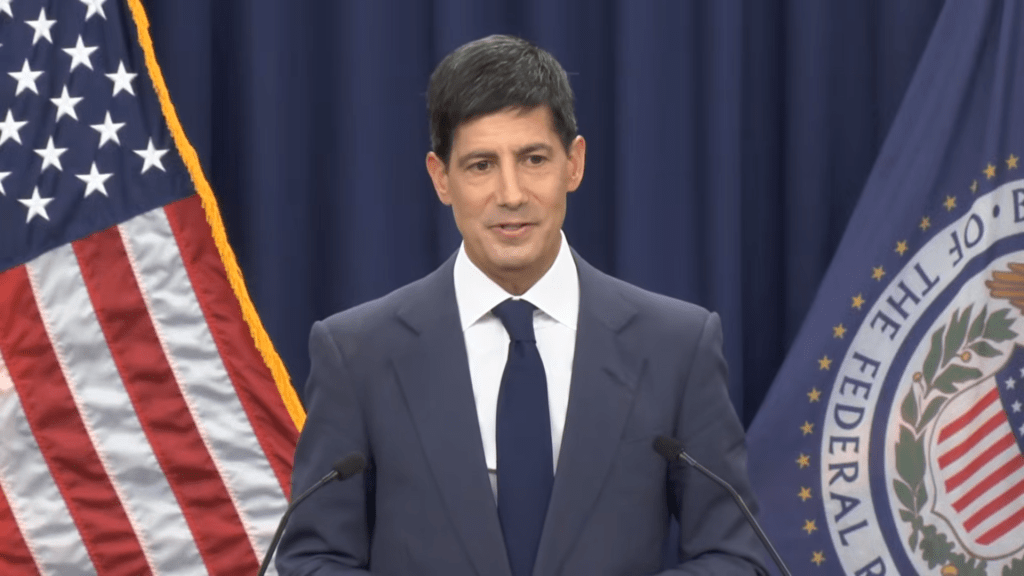
At Kevin Warsh’s first meeting as Federal Reserve Chair, the Federal Open Market Committee has once again decided to keep interest rates at 3.5 to 3.75 percent. It has now been over six months since interest rates have changed.
According to a statement from the FOMC, the board of governors unanimously voted in favor of the pause.
The FOMC statement was relatively short compared with previous ones released by the committee, and did not contain language as it did after the previous meeting—that suggested that the central bank might cut rates in the near future.
Indeed, in its quarterly projections, nine members of the committee said they expected at least one rate hike this year, with six members supporting two or more hikes. In March, no members expected any rate hikes in 2026, and indeed the committee still expected one cut.
During his first press conference as chairman, Warsh emphasized the central bank’s commitment to price stability and the establishment of five task forces to review key aspects of monetary policy. The task forces, which he said ought to deliver final recommendations by the end of this year, will include ones on Fed communications, the Fed’s balance sheet, data sources and methodology, productivity and jobs, and inflation.
The committee itself will not be providing forward guidance from now on, Warsh said, which represents a break from recent years. “I can’t give any forward guidance about what we’re going to do next,” the chairman said. “The good news is we’ll be meeting in six weeks.”
That will not keep other members of the committee from speaking out, however, as Cleveland Fed President Beth Hammack did in a speech earlier in June when she said: “For today, it’s reasonable to keep rates steady given the uncertainties around the economic outlook. But if recent trends continue, it may soon be appropriate to act.”
Also, for now, the central bank will continue to produce its quarterly projections – the so-called dot plot – though Warsh himself will not be offering input on those projections.
The chairman also said nothing about the well-known stance of President Donald Trump on interest rates, which he has said the Fed ought to lower. When asked about his conversations with the president, he declined to make a comment.
Economic snapshot
Inflation has reared its head again, as the committee also acknowledged in its statement, with the international energy shock caused by the war with Iran making itself felt as a driver of U.S. inflation. In May, the all-items consumer price index saw a 4.2 percent increase compared with a year earlier and up from 3.8 percent in April, according to the Bureau of Labor Statistics. For the month, prices were up 0.5 percent in May, after an increase of 0.6 percent in April.
The index for energy rose 3.9 percent in May, after rising 3.8 percent in April and 10.9 percent in March, and in May, energy prices accounted for over 60 percent of the overall increase. Gasoline and fuel oil both were up in price more than 40 percent compared with a year ago.
At the same, the U.S.-Iran agreement to reopen the Strait of Hormuz pushed the price of oil below $80 per barrel, the lowest price since the start of the war. Further downstream effects of the closure have yet to be accounted for, furthering the uncertainty around the Fed’s decision making.
Though never quite down to the Fed’s target of an overall annualized 2 percent, the rate of inflation was close to the goal as recently as both February and January, when it was 2.4 percent year-over-year.
Industry reactions
At the first FOMC meeting with Kevin Warsh as the new Fed chairman, an extra measure of attention is focused on him. Not moving interest rates this early in his tenure is important, argued Bonaventure CEO Dwight Dunton, whose company is a multifamily investment management firm with nearly 9,000 units.
“With a new chair just coming online, any move, up or down, risks being read as political,” Dunton told Multi-Housing News. “Holding steady lets Warsh reestablish the Fed’s independence, which matters more right now than any single rate decision.”
READ ALSO: How the New Fed Chair Could Affect Policy, Multifamily Investing
The European Central Bank recently raised rates by a quarter point from 2 percent to 2.25 percent, citing inflation concerns tied to energy, noted Josh Rubin, an agent at Douglas Elliman in New York City.
“We’re seeing similar reports, and while the Federal Reserve often moves in tandem with the ECB, and some may feel a quarter-point move is warranted, patience was the theme at the meeting,” Rubin said.
Though inflation is an important consideration, it might be transitory, Dunton points out. With a durable ceasefire deal announced and the price of oil coming down, the Fed can wait to confirm the direction the oil market is going. It’s possible that the central bank will go an extended period without hiking to offset inflation.
“Also, Warsh has signaled (that) he wants the Fed to communicate less, not narrate every decision,” Dunton said. “Expect a quieter posture, or at most, commentary about why there will be less commentary. The independence dynamic is the headline. A new chair holding steady to avoid any appearance of political influence is the story to watch.”
The impact on multifamily
Even though the Fed didn’t raise this time, future hikes are a distinct possibility, as is keeping rates at the current relatively elevated level.
“Inflation has been rising, oil supplies are depleted, and there’s continued uncertainty about the war in Iran and associated availability of oil,” said Anne Park, an agent in Douglas Elliman’s Houston region.
“These factors would traditionally have prompted a rise in interest rates,” Park said. “But these aren’t normal times: the president appears unconcerned by inflation, there is a new chair of the Federal Reserve and there is an upcoming midterm election of unusual importance. I predict that there won’t be a change in interest rates in the near future.”
For low- to middle-income buyers, who are currently facing mortgage interest rates over 6 percent, buying a home will remain challenging, Park said. That has a negative effect on inventory, and on market activity in general. Many people will continue to need to rent their residence, which will keep the price of renting high.
“With capital costs remaining elevated, multifamily starts will remain suppressed, a near-term challenge for development but supportive of fundamentals for existing assets,” Dunton said. “There will be muted new supply, cap rates will likely stay flat, possibly drifting modestly higher,” he added. “Expect the continued shift toward five-year over ten-year deals rather than ten-year terms.”