Why the Midwest Is Now the Most Affordable Region in the Nation
But the region is at risk of losing its lead, according to the Economic Innovation Group.
The most affordable housing in the United States is now concentrated in markets in the Midwest, according to a new report by the Economic Innovation Group, a Washington, DC-based think tank that focuses on economic policy. The title goes to a number of markets in Wisconsin, Iowa, Indiana, Ohio, and western Pennsylvania.
The risk of the Midwest losing affordability is real, however, now that people seem to be moving to the region again. In 2025, the Midwest recorded positive net domestic migration, EIG explains, citing Census Bureau data. In fact, the Midwest was the only U.S. region where all states gained population from July 2024 to July 2025, the bureau reports.
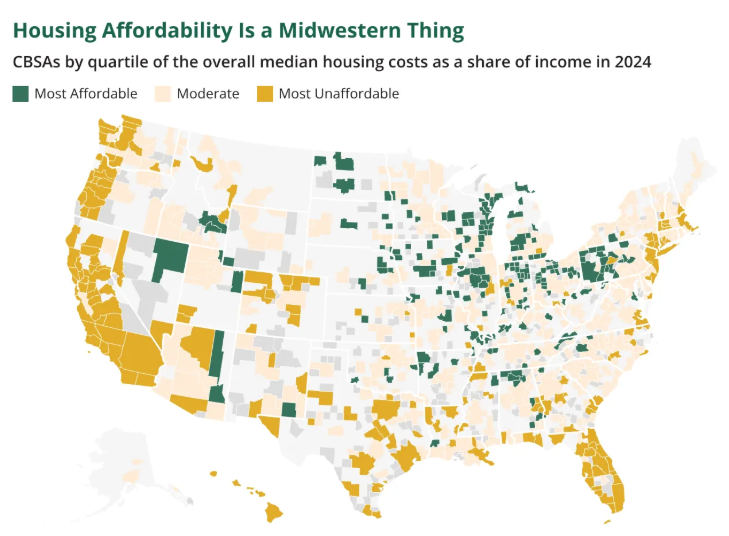
Affordability seems to be a factor in bringing people to the region, Jess Remington, one of the authors of the report, told Multi-Housing News.
“It’s possible that housing affordability will help to spark migration to the Midwest,” Remington told MHN. “Last year, for the first time in a decade, more Americans moved into the Midwest from other states than moved out. The shift is small so far, but it’s a sign that the demand that priced people out of other regions may now be heading to the heartland.”
Supply still trumps demand in some places
The Midwestern communities with the best housing affordability have strong local economies, the report also found. Indeed, all of the top-ten areas by housing affordability in 2024 ranked in the top half nationally for household income, and seven had a strong manufacturing base.
“These places are middle-class, with median household incomes around $75,000 and mean (incomes) well into the six figures,” EIG notes. “They have modest population growth, low unemployment and low poverty. Young adults with ordinary jobs are buying homes without breaking the bank. In many ways, these are communities where the American Dream is still alive.”
READ ALSO: Multifamily Has a Lot to Gain—And Lose—in the Midterms
One example cited by the organization is Le Mars, Iowa, in the northwestern part of the state, which is home to the Blue Bunny ice cream manufacturing plant, where thousands of residents work. In 2024, Le Mars was the most affordable housing market in the country, with residents spending an average of only 17 percent of their income on housing costs that year. Median household income was roughly $83,000.
Warsaw, Indiana, in the northern part of the state, is another example of a market that’s seeing the same dynamic, according to the report.
In some Midwestern places marked by high poverty rates, even sizable supply doesn’t mean housing affordability. But these markets are the exception, the report explains: low-income metropolitan and micropolitan areas account for only 3 percent of the national population. For everywhere else, affordability is linked to how well supply is meeting demand, which is the case in many Midwestern markets.
Clouds on the horizon
For now, these Midwestern markets are maintaining their housing affordability because their stock of habitable housing modestly exceeds demand. For affordability to continue, EIG says, they will need to keep adding supply as that very affordability draws newcomers.
If, however, Midwestern markets see more population growth without additional housing development, their affordability will evaporate. That has already happened in a few Midwestern markets, according to EIG.
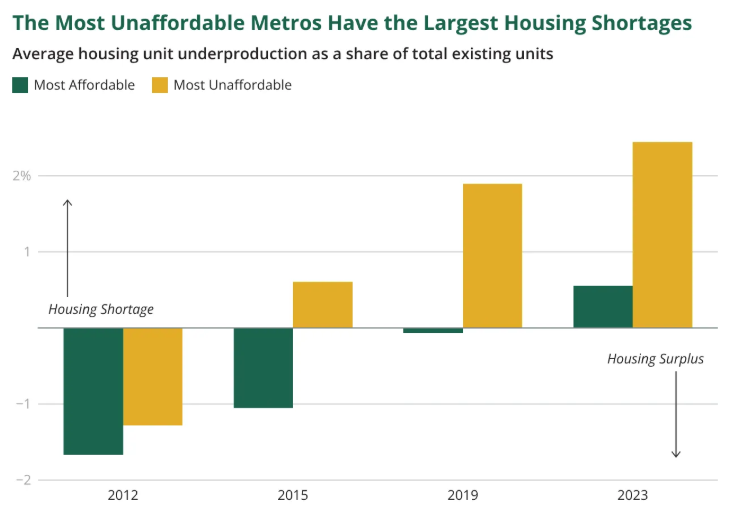
“Appleton, Wisconsin, ran a housing surplus in 2012 equal to about half a percent of its stock; by 2023 it had swung to a shortage of nearly 6 percent, the largest gap among affordable places,” the report explains. “Jefferson City, Missouri, still had a surplus as recently as 2019, but now runs a shortage close to 3 percent.”
In only a few years, household formation has exceeded housing development in those places, and it could happen in other parts of the Midwest.
A population influx drawn to affordable housing in economically strong places could, ironically, put pressure on affordability—a dynamic that has occurred in other parts of the country, including markets in the Mountain West, the report notes, particularly Colorado, which used to be characterized by affordability, but isn’t any more.
EIG stresses that it doesn’t have to be that way, and it might not be, considering that it is now widely recognized that the obstacle to housing development in most places is restrictive land-use rules that make building enough product overly burdensome or even illegal.
A wave of state-level zoning reforms and the passage of the federal 21st Century ROAD to Housing Act are steps forward, the report avers. In the Midwest, major citywide reforms in markets such as Minneapolis and Columbus, Ohio, might help. But unless more changes, even the current Midwestern advantage in affordability could be only temporary.