Multifamily Hits a Rocky Patch, Financing Remains Resilient
The executives discussed the new realities of multifamily finance during a Walker & Dunlop panel discussion.

Multifamily fundamentals are relatively weak these days, but demand for financing remains relatively resilient, according to Walker & Dunlop Investment Partners executives who participated in a virtual roundtable with members of the media on Wednesday.
Demand is especially strong for bridge financing, which is seen as a way to get through the current climate of stalled valuations and tepid rent growth.
“The market hasn’t stopped, it’s just a lot more disciplined in today’s environment,” WDIP Chief Investment Officer Marcus Duley said. “The focus right now is on cash flow basis, and not really underwriting value add or market growth.”
Then and now
The U.S. multifamily market is a study in contrast between then and now, according to Duley. “Then” being 2020 to 2022, when the market was driven by low interest rates and cheap capital. Cap rates were low and valuations were high, and the rent growth outlook in a lot of places was very strong. Now, multifamily investors have to deal with a higher interest-rate environment and the hangover from the cheap money days.
“We also saw a huge wave of construction starts that created the supply pipeline that we’re dealing with today,” Duley said. “That was a very frothy environment, where every deal seemed to work with the expectation of cheap capital and high market rent lasting forever, or at least over a five-year underwritten hold.”
READ ALSO: Institutional Capital Beating Bushes for Value-Add Deals
That environment has been turned on its head, Duley pointed out. Interest rates are higher, so debt is more expensive. Cap rates are higher, so in turn, values have fallen and reset relative to the same NOI. Rent growth is very muted, and in some markets it is negative on new leases.

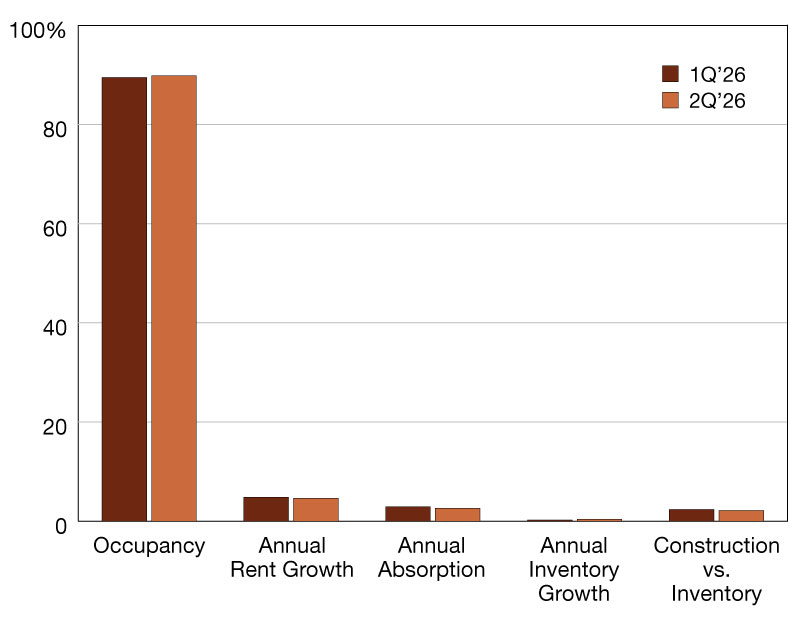
An in-house survey of 1.5 million institutional multifamily units shows negative new-move rent growth, at minus 1.4 percent, positive renewal growth at 2.7 percent and overall blended growth at 2.9 percent, Duley noted. Occupancy at 92.5 percent and turnover at 36 percent, the lowest quarterly reading on record.
At the same time, a wave of new supply—started during the days of cheap capital and anticipated rent growth—is still coming online. Operators are laser focused on retention now, in light of the new supply, Duley said. Starts are down considerably, but it will be some years before that changes the current dynamics of the multifamily market.
The oncoming supply is gradually being absorbed, but the recovery remains uneven as sluggish job growth weighs on household formation, and slower rates of immigration keep rent growth and occupancy normalization uneven across markets.
Funds’ return of capital anemic
One key aspect of the current finance climate is that the market is starved for return of capital, according to WDIP Managing Director of Portfolio Manger-Equity Brian Cornell. Value-add and opportunistic real estate funds from the 2019-2021 era have returned very little capital to investors to date, particularly for the larger sized vehicles.
That conclusion, Cornell said, is based on data from Preqin, namely the most recent summary of all reported real estate fund performance to date, covering over 200 funds with about $200 billion of invested capital.
“One of the most telling data points from this set of information is that fund investors are not getting their money back at a historic level,” Cornell explained. “So when you look at all funds in total, distributions on paid investment is how much of a fund’s investment has been received as distributions. The median DPI across 214 funds and $200 billion is only 15 percent for 2019 through 2021, which is really shocking.”
Managers with the discipline and capacity to realize returns and distribute capital in the current environment are well equipped to capture new commitments. On the whole, smaller funds (less than $250 million) have been better at returning capital, perhaps because they are a little more nimble, having smaller investment pools from which to make strategic decisions.
For many funds, however, the current climate means that fund managers are trying not to sell, Cornell said. At a time of depressed values, they are utilizing short-term refinancings and looking for any way to extend their investment life periods. Bridge lenders are benefiting from this dynamic as owners are choosing to refinance instead of sell.
Not the same animal as corporate finance
WDIP Senior Managing Director and Group Head of Debt Geoff Smith noted that there are significant differences between corporate credit—an industry that is seeing its tumult reported widely in business media—and credit secured by real estate.
“We obviously have a very complicated geopolitical situation right now, which is straining energy markets,” Smith said. “So there’s concern that the distress in the corporate credit market will come come fast and then come hard. That’s one of the biggest distinctions between the private corporate credit versus real estate credit.”
Real estate credit, by contrast, is secured by hard assets, Smith said. “In a negative or recessionary period of time, they don’t go anywhere,” he noted. “Property values can go up or down, depending on what’s happening in the capital markets and the financing markets. But overall, you’re not losing that anchor in your valuation.”
That security means relatively less volatility for real estate finance, which allows more back leverage on mortgage credit than on corporate credit, Smith said. That back leverage is also producing yields that are actually competitive from a risk-adjusted standpoint, outpacing the corporate credit environment.
Even as corporate private credit contends with liquidity questions in semi-liquid vehicles, greater sensitivity around marks and redemptions, and early signs of borrower stress, CRE-focused private credit is differentiated by ongoing refinancing pressure and transitional capital needs. That will continue supporting demand for bridge financing.
“In many instances, we’re seeing valuations that are at or just below the developers cost basis,” Duley said. “That’s really creating good demand for bridge financing, because developers simply need more time. That’s where in real estate private credit, multifamily is going to stand out.”