Institutional Capital Beating Bushes for Value-Add Deals
The strategy aligns with reset prices and firming fundamentals in select submarkets.

For institutional investors, multifamily development and value-add investment missteps were easy to avoid during the period of ultra-low interest rates and meteoric multifamily rent growth in the waning days of the pandemic. Amid the rate spikes in 2022, growing supply and slowing or even declining rent growth—particularly in the Sun Belt, they largely abandoned those strategies in favor of snapping up new projects struggling to stabilize on the cheap.
As of late, however, institutional investors have been broadening their risk spectrums to include value-add opportunities, driven by stronger returns and valuations and, until recently, interest rate stability, among other trends. Over the past several months, firms such as Ares and Mesirow have raised
$200 million and $1.2 billion, respectively, for value-add funds that are seeking multifamily assets, either exclusively or in a mix of targeted properties.
Similarly, early this year, real estate investment manager Heitman raised $2 billion for its latest value-add fund, exceeding its $1.75 billion target, and garnered an additional $620 million in co-investment capital commitments. Heitman’s fund is seeking returns of 12 to 14 percent from contrarian but growth-
oriented opportunities across several sectors, including multifamily, said Mike Carney, vice president of the firm’s investment research, who focuses on the apartment and medical office sectors.

Mixed signals
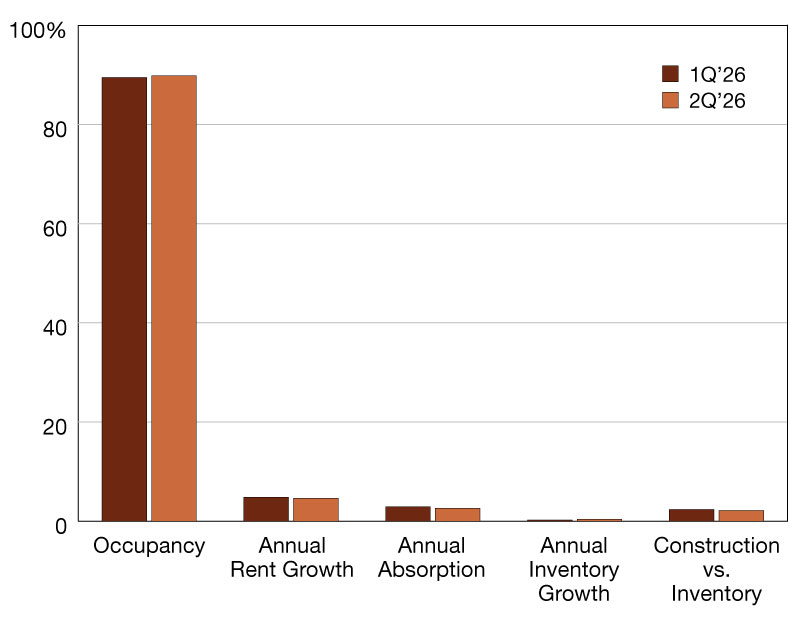
According to Cushman & Wakefield, multifamily developers delivered 400,000 units in 2025 in the U.S. This reflected a year-over-year decline of 26 percent, while rent growth remained relatively flat. Additionally, net absorption of 355,000 units in 2025 ranked as one of the strongest showings in the last 25 years, the brokerage reported, even with a seasonal slowdown in the final quarter.
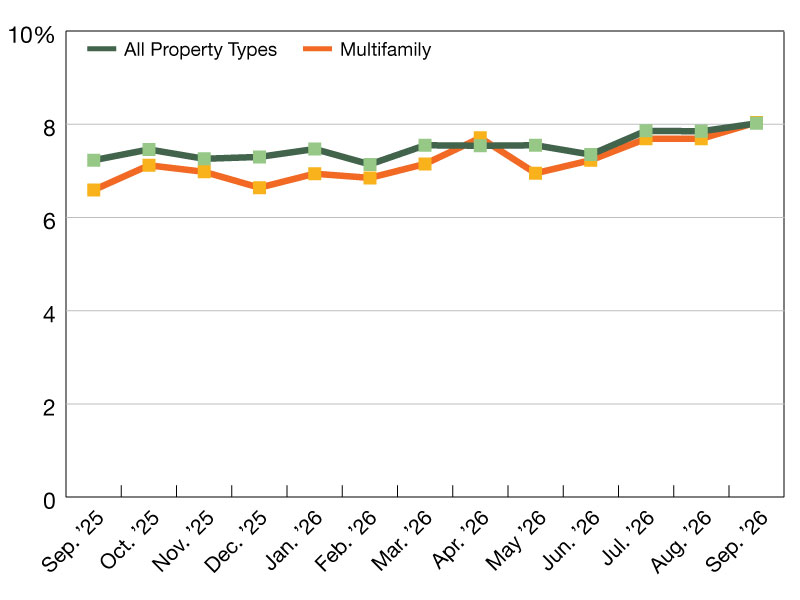
Heitman is being selective and is cognizant of changing economic conditions, Carney acknowledged. A recent rise in bond market volatility has increased interest rate uncertainty, and higher energy costs stemming from the Iran war are fueling expectations for higher inflation and reduced spending power. Meanwhile, tepid job growth and immigration policies could affect demand.
There are certainly some risks that shouldn’t be discounted. But we’re not sitting on our hands in a wait-and-see mode—we’re going to move with conviction.
—Mike Carney, Vice President, Investment Research Group, Heitman
Still, Carney sees reasons for optimism, such as the One Big Beautiful Bill Act’s positive impact on tax savings and business investment. “There are certainly some risks that shouldn’t be discounted,” he said. “But we’re not sitting on our hands in a wait-and-see mode—we’re going to move with conviction.”
During the past few years, Waterton has primarily pursued favorably priced contrarian deals in out-of-favor markets, said David Schwartz, co-founder & CEO of the firm. It has concentrated about 70 percent of that investment in gateway cities, including San Francisco, Los Angeles and Seattle, frequently implementing light improvements to units and common areas. Unlike markets in the Sun Belt, those metros experienced far less construction and were better positioned for rent growth as absorption rebounded, he said.

But with the Sun Belt out of favor, Waterton is beginning to explore that region’s submarkets for its encouraging supply and rent growth prospects. In December, Waterton purchased Country Club Lakes, a 555-unit garden style community in Jacksonville, Fla. The firm planned to continue previously started unit upgrades and to refresh the common areas.
“It’s not universal—there are still plenty of Sun Belt submarkets where you’ll have continued excess supply this year, next year and even into 2028,” reported Schwartz, whose firm attracted more than $1.7 billion from global institutional investors in 2024 for a multifamily value-add fund. “Those are harder to make sense of given our typical five-to-seven-year hold period.”
Digging deeper
Waterton’s willingness to seek deals in the Sun Belt also coincides with the return of capital and more competition for certain assets in gateway cities, he pointed out. Platte Canyon Capital, a multifamily investment firm focused on value-add and distressed opportunities, is also seeing more investors crowd into the arena of acquiring new but struggling properties, shared Brennen Degner, the firm’s co-founder & CEO.
Institutional investors are beginning to look at value-add opportunities as an alternative, he added. But even in that space, some investors that have been focusing purely on assets built within the last two decades are beginning to expand their thinking.
“There has been a material void in institutional capital availability for traditional value-add deals. It’s been nonexistent for 1960s or 70s product, and the box is very narrow for 1980s vintage,” he said. “But the pendulum seems to be swinging. Some groups that wouldn’t invest in properties that were built before 2000 are starting to at least ask questions and dig deeper into product that’s a little older.”
Filling a hole
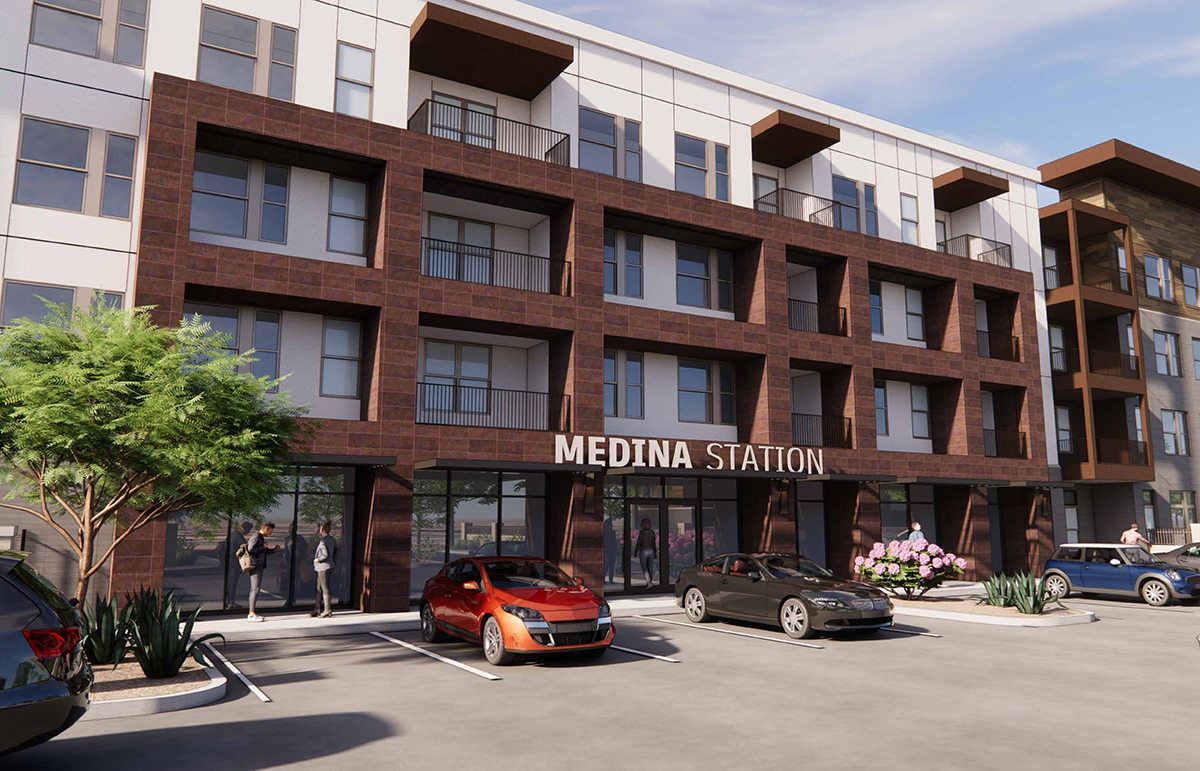
In a similar fashion, institutional investors have yet to plow capital back into the development arena, which is creating opportunities for firms such as Origin Investments, a multifamily fund and DST sponsor that invests alongside accredited investors. In March, a venture between Origin and NRP Group, a multifamily developer and manager, broke ground on a 353-unit apartment project in Phoenix’s Medina Station master-planned community. The deal represents the first investment by Origin’s Select Asset Fund, which plans to finance five short-duration Sun Belt and mountain region opportunities.
“We’ve been able to get access to tier one developer pipelines that were unavailable to us in 2021 and 2022 when the market was awash with institutional capital,” reported David Welk, Origin’s managing director of acquisitions. “But because of the dislocation in the market over the past three years, we’ve been able to have some meaningful and collaborative conversations with these developers.”
Some groups that wouldn’t invest in properties that were built before 2000 are starting to at least ask questions and dig deeper into product that’s a little older.
—Brennen Degner, Co-Founder & CEO, Platte Canyon Capital
Most investors aren’t zeroed in on a single investment strategy. Depending on a submarket’s fundamentals, compelling cases can be made for just about every approach, including delivering new multifamily units in a supply shortage, continuing to acquire struggling properties at a discount, and pursuing value-add deals, noted Dwight Dunton, founder & CEO of Bonaventure, an alternative asset management firm that derives about 10 percent of its equity from institutional investors.
What’s not compelling—or realistic—is buying assets with the assumption that market dynamics alone will fuel NOI growth absent efforts to optimize operations, including capital improvements, added Dunton. Trying to time market bottoms can be risky, too, he said.
“We’d rather see markets that are demonstrating rent growth traction than try to catch a falling knife.” “While the returns could be slightly lower versus nailing the absolute bottom, the flip side is that you avoid investing in an unstable market that continues to slide.”