How Self-Service Leasing Is Reshaping the Renter Journey From Search to Sign
Operators and technology providers examine how digital tools are changing the experience for prospective renters.
Technology and artificial intelligence have become increasingly embedded in real estate operations. Although multifamily remains a relationship-driven business, operators are adapting to renter needs and using technology to improve overall performance.
The 2026 Technology Adoption Report from Multifamily Insiders, which covers 118 companies with portfolios ranging from fewer than 1,000 units to more than 200,000 units, has provided some insightful data into the type of technology adoption operators are focusing on. Among foundational tools, resident screening registered a 96 percent adoption rate, while online payments, e-signatures, online leasing and property website all exceeded 87 percent.
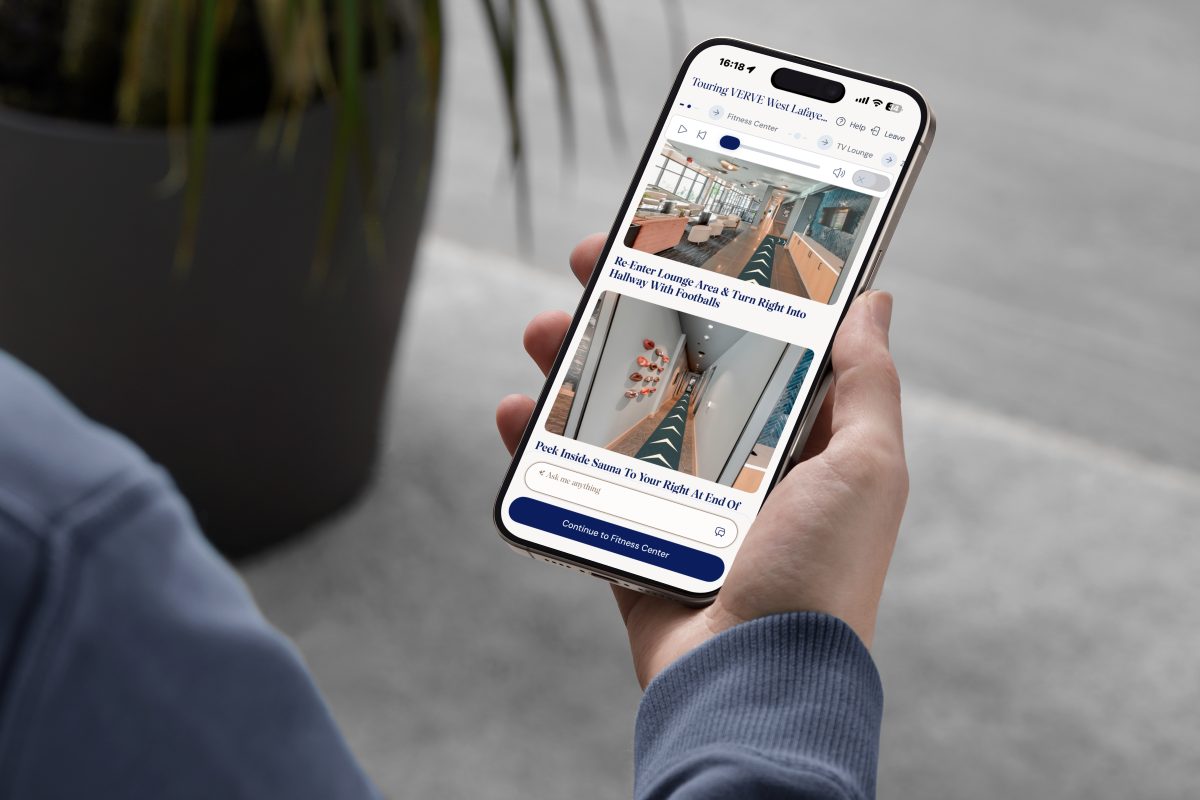
The findings also show that adoption varies considerably by technology and portfolio size. While operators with large portfolios might show 100 percent adoption of resident portals, financial management tools, leasing contact centers sit at 36 percent and self-guided tours at 57 percent. Some operators have moved beyond adoption and are focusing on maximizing utilization, while others are still introducing these tools across their portfolios.
Self-service technology represents a particularly relevant part of this shift. A broader leasing journey now can include property websites and virtual content, automated communication, tour scheduling, self-guided tours, applications, electronic lease signing and, eventually, renewals.
READ ALSO: Case Studies in Resident Self-Service
Self-service leasing is now considered a mainstream component of the leasing process and not just an emerging innovation, according to Lori Reeves, senior adviser with the Real Estate Technology and Transformation Center. Reeves sees this shift as a result of expectations for convenience and flexibility, efforts to extend availability beyond operating hours and advances in technology.
“I’d call it standard in the sense that almost every operator has some version of it now, but “standard” and “consistent” are two different words,” said Chelsea Kneeland, innovation insider at Multifamily Insiders. While the pandemic and changing prospect expectations might have accelerated the initial wave of adoption, she also noted that a centralization of leasing operations and leaner staffing models continue to drive demand.
Cardinal Group Cos. is among the operators that have embraced self-guided touring across its properties. The company completed 11,182 self-guided tours in the last 10 months and 56 percent of those started within 15 minutes of scheduling.
By removing traditional office-hour restrictions, these tours allow prospects to visit a community when it’s most convenient for them. Through Cardinal’s integration with EliseAI, automated follow-up can also deliver pricing, promotions and application links immediately after a tour.
“By aligning our tech stack, we’re meeting modern renters exactly where they are and delivering an experience that matches their digital-first expectations”, explained Courtney Travis, manager of customer experience at Cardinal.
Removing friction
Technology providers are also seeing results from integrating self-service tools into the broader leasing process. Cardinal selected Aigentless, an AI-driven proptech startup specializing in interactive self-guided tours and lead-to-lease automation, as its exclusive self-guided tour provider through a three-year national partnership.
According to Aigentless data, 75 percent of tours on its platform are booked the same day, while more than half are booked within 15 minutes of starting the tour.
“We see that prospects clearly want on-demand access”, noted Bella Campise, co-founder & CEO of Aigentless. Self-guided tours also extend availability beyond traditional operating hours, as around 60 percent of leases procured from Aigentless are completed outside office hours.
There are a few main models of integration that vary depending on operator strategy. Self-guided tours are used as a primary touring options, which for some operators, according to Campise, has now become a default, which allows leasing employees to spend more time on resident engagement, renewals, follow-up and prospects who need personal assistance. Campise emphasized that most of the tours end at the leasing office during office hours, giving staff an opportunity to answer questions and complete the interaction after the prospect has explored the property independently.
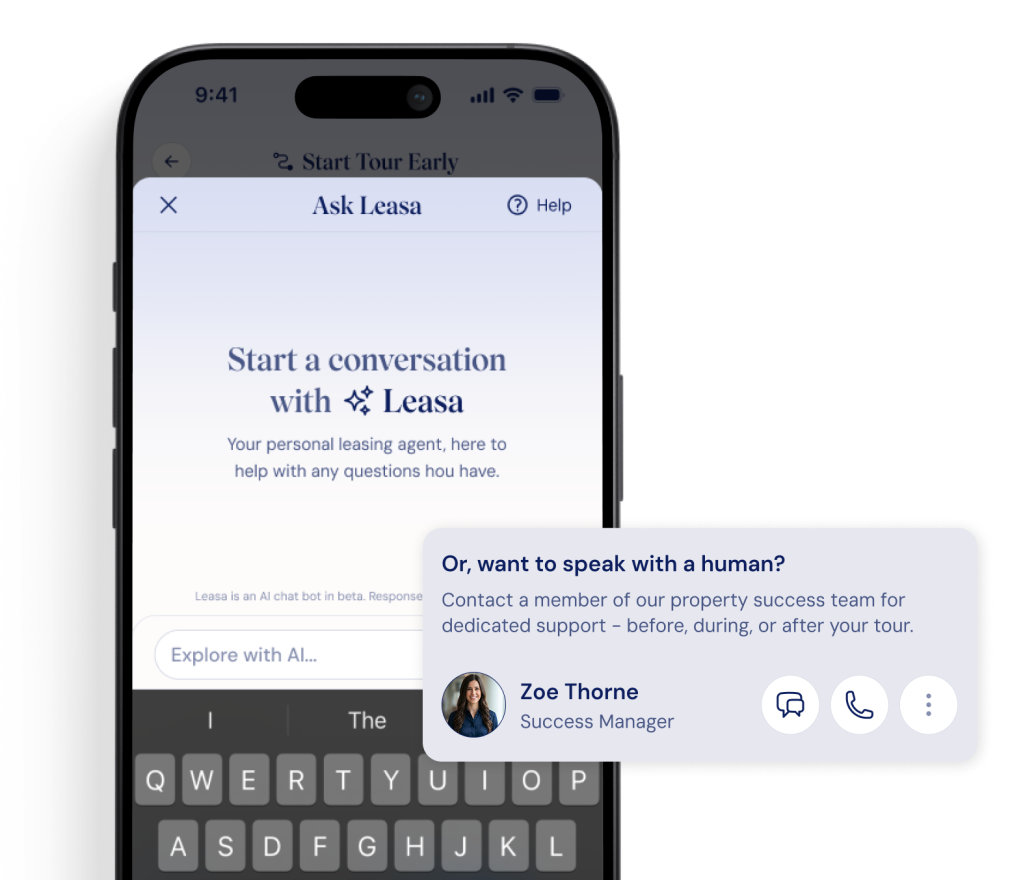
Prospects can tour properties with the help of real-time AI guidance, as Leasa narrates, answers questions, and connects to human support when needed. All images courtesy of Aigentless 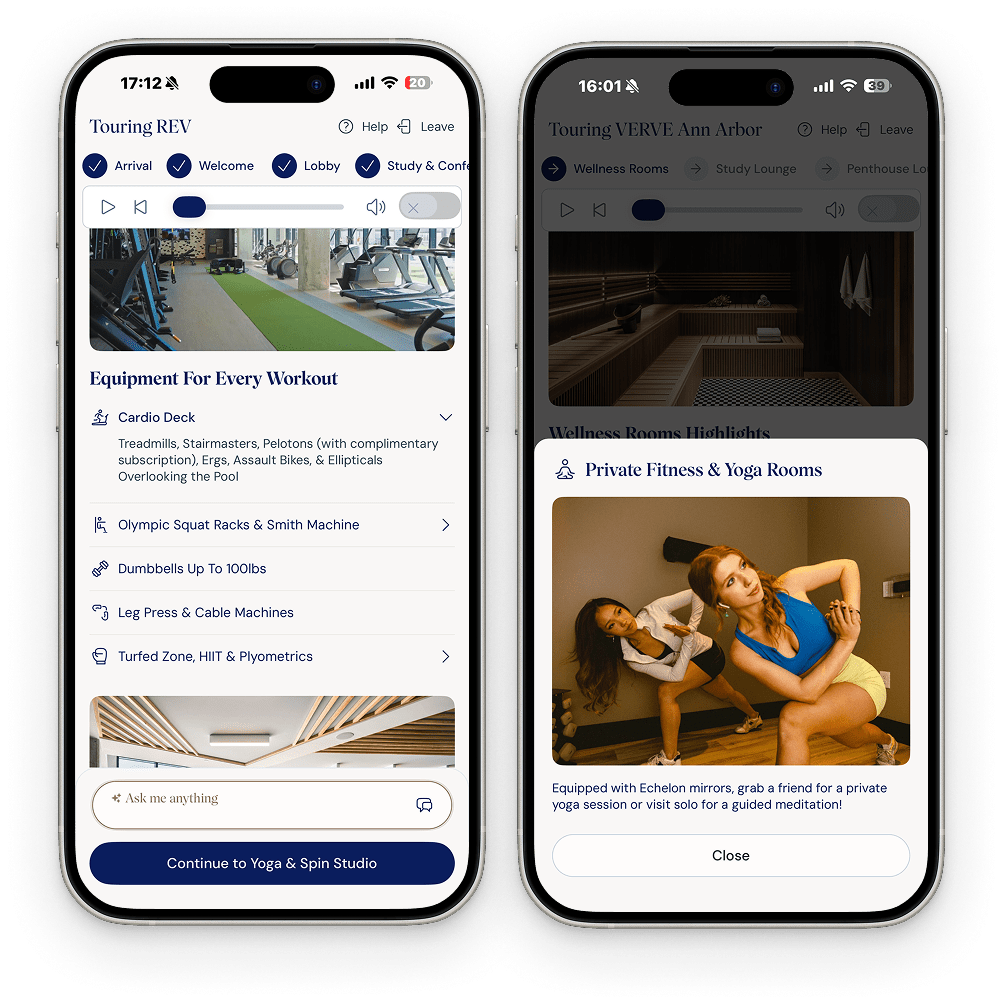
Prospects can look up the amenity packages available at the properties during the self-guided tours. 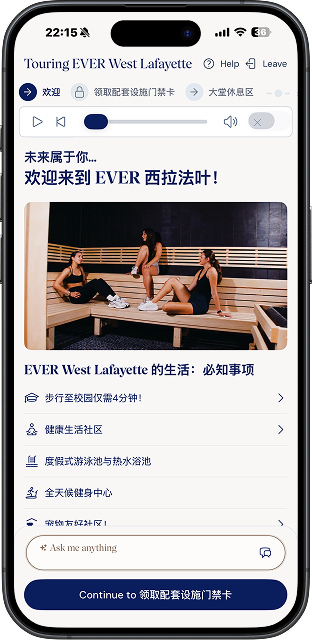
Aigentless provides the self-guided tours in multiple languages. 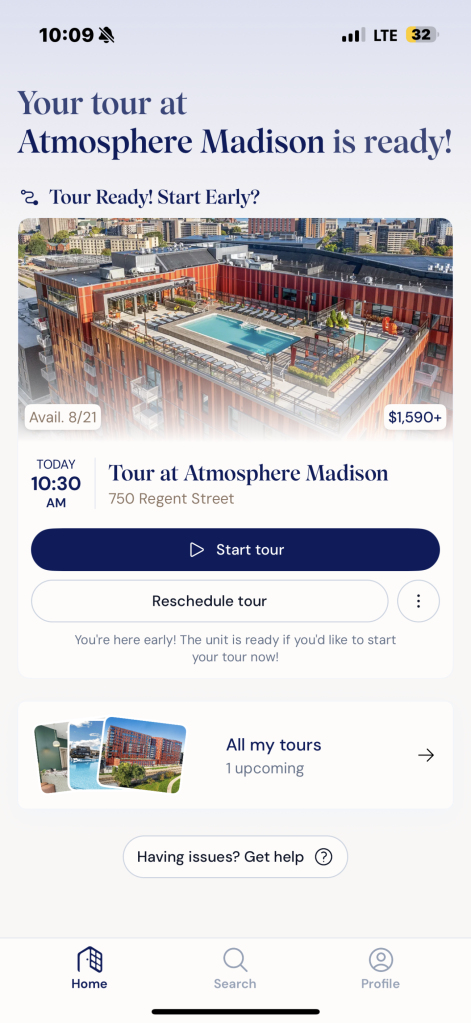
Atmosphere Madison (recently rebranded as The Axton), managed by Cardinal Group Cos., is a student housing community near the University of Wisconsin-Madison campus and can be visited as part of the self-guided tours. 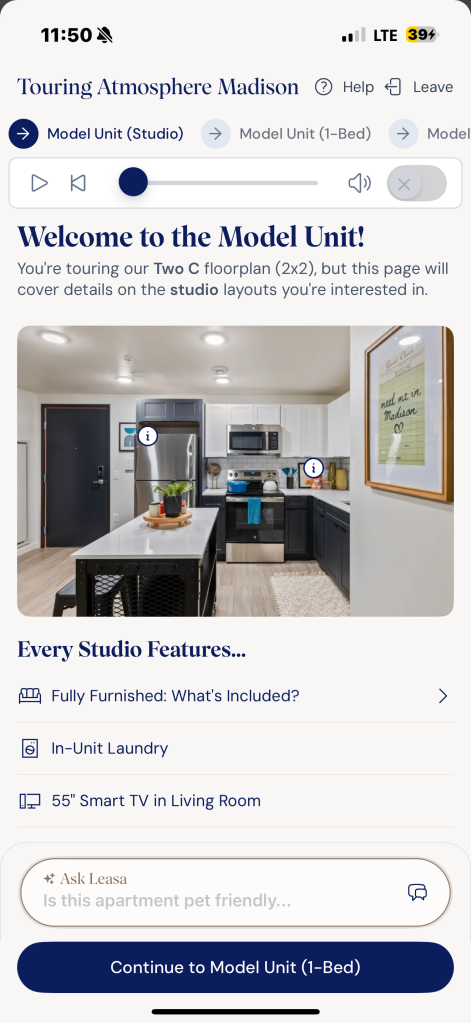
Prospects can tour units and use Leasa to ask further questions.
Self-guided tours can also be used to capture leasing data.
“Every Aigentless tour generates valuable data on prospect preferences, behavior and feedback that our partners are able to feed into top of funnel marketing and operational and investment decisions,” Campise said.
Aigentless reports an overall tour-to-application rate of more than 30 percent. However, Campise noted that access alone does not necessarily produce stronger conversion. Prospects also need useful property information, intuitive experience and access to assistance. A self-guided tour that provides only an entry code could still require prospects to contact the leasing office before they feel comfortable applying.
Cardinal has implemented Aigentless across more than 120 of its student, multifamily and BTR communities, allowing on-site teams to focus more on resident engagement and follow-ups, instead of conducting repetitive tours.
Without a doubt, self-service technology improves access and response speed. Conversion, however, depends more heavily on content, integration and follow-up.
“Speed matters in leasing, but speed without continuity is not enough”, said Chris Radliff, COO of 29th Street Living.
READ ALSO: Reconfiguring Property Management Operations With AI
No one-size-fits-all model
29th Street Living evaluates tools separately for each property. Radliff said the company considers factors such as physical layout, access control, neighborhood, staffing model, customer profile, leasing complexity, tour completion and prospect feedback, among others.
Self-service tools are more likely to become part of standard operations when they improve both the leasing performance and the prospect experience, Reeves noted. What determines whether this type of technology moves beyond the rollout phase is seamless integration, easy to use tech, identity verification and compliance controls.
Security also affects how operators implement self-service options. Village Green, a national apartment management and marketing company operating in more than 20 states, offers self-guided tours, chatbots, AI tools, digital applications and electronic lease signing. However, prospects must submit the appropriate documentation before participating in a self-guided tour or beginning the digital application, according to Ashley Sinclair, an executive vice president at the company. Village Green uses a third-party vendor to verify identities as part of its cybersecurity, fraud-prevention and risk-mitigation efforts.
A 2024 JLL guide mentioned that three-quarters of multifamily owners surveyed had experienced an increase in rental frauds, according to the National Multifamily Housing Council. Recommended safeguards include stronger screening technology, identity verification, secure digital systems, employee training and a closer oversight of technology providers.
“There isn’t a one-size-fits-all approach, as renting an apartment is still a big commitment for most renters, whether it’s their first apartment home or fifth, and we see that all ages and demographics have different needs and comfort levels with technology and AI,” Sinclair stated.
The need for a human handoff
Even as digital adoption increases, prospects continue to seek human assistance at key points in the leasing process. Village Green has found that many want to explore and gather information independently, but still turn to leasing professionals at key decision points. They may also need help discussing parking, storage or pets, or want real-time support while completing the application.
“Self-service where convenient, human engagement where valuable,” said Reeves.
Cardinal has incorporated this type of handoff into its self-guided-tour process. During business hours, tour routes deliberately end at the leasing office, allowing employees to welcome prospects, answer additional questions and reinforce community experience.
“We’re blending tech with physical hospitality touches along the path tour itself—incorporating handwritten welcome notes, local community treats, and branded promos they can take home, “Travis said. “Technology provides the access and convenience, but thoughtfulness is what turns a tour into a home.”

Self-service tools could extend beyond the initial tour and application. Radliff sees opportunities in qualification screening, document collection, lease execution, move-in scheduling, payments, service requests and certain renewal activities.
Looking ahead, Campise expects AI to make the self-service experience more personalized. Tour content could be tailored to each prospect’s interests, budget and must-haves, using preferences gathered before the visit to create a more individualized journey.
READ ALSO: Why AI Adoption Needs Accountability
She also sees a gap between some operators’ assumptions and prospects’ expectations. While potential renters don’t want the “hard sell” of a leasing agent and expect instant access, not all operators are comfortable adding self-guided touring options to the leasing process, as they believe human interaction is necessary at every stage.
“As best practices shift to fall in line with today’s digital-first consumer expectations, we expect adoption of self-service options to become a requirement, rather than a nice-to-have,” Campise said.
Self-service leasing is becoming standard across the renter journey, with tools being used for routine tasks, allowing leasing employees to remain available for more complex and final decisions, while also providing more control and on-demand access to prospects.
As AI in multifamily becomes more personalized, operators will need to preserve human support at moments where it adds the most value. For now, the industry seems to be moving toward a more connected leasing model, one in which technology and human services complement each other.