The Silver Tsunami Is Here. Can Senior Housing Close the Supply Gap?
Two Harbert Management Corp. executives weigh in on what's limiting development and what it will take to serve the next generation of residents.

For years, senior housing development has failed to keep pace with the aging U.S. population, widening the supply-demand gap even as sector fundamentals continued have strengthened.
Following a slowdown between 2020 and 2022, senior housing occupancy reached 89.9 percent in the second quarter of 2026, up 200 basis points year-over-year and marking 20 consecutive quarters of growth, according to recent NIC data. Yet construction remains near historic lows as the oldest Baby Boomers enter their 80s.
In a conversation with Multi-Housing News, Brian Landrum and Trent Johnson, co-heads & senior managing directors overseeing the senior housing division at Harbert Management Corp., discuss what’s holding back development, how they identify viable markets and what the next generation of senior housing will require. Through its subsidiary, Harbert South Bay, the firm has developed more than 11,000 senior housing units across luxury communities in 15 states.
READ ALSO: Top Multifamily Developers
Can the senior housing industry add enough supply to meet demand from the Silver Tsunami?
Landrum: No, and that supply-demand imbalance is the story right now. The oldest Baby Boomers turn 80 in 2026 and the Census Bureau projects the 80-and-older population—the age band that best proxies demand for our industry—to grow roughly 4.6 percent a year through 2030 with a single-year spike above 7 percent in 2027 alone. The industry needs 35,000 to 45,000 new units delivered every year through 2050 to keep pace with that demand.

Today, 80 percent of the largest metro areas in the U.S. have either zero or one new senior housing communities under construction. Meanwhile, the demographic wave is just getting started and the force of that tsunami is undeniable. Only 580 units broke ground nationally in the second quarter—the lowest quarterly total on record—which equates to 2,400 new unit starts on an annual run-rate. The most units ever delivered in any single calendar year—the strongest development cycle the sector has seen—was 34,000.
As another proxy, actual construction starts in 2025 were 12,000 units—we are starting less new units as each quarter passes. Our industry is underbuilding relative to what’s coming and that supports the value of the assets we already own.
What would you say is preventing more projects from moving forward today?
Landrum: Construction financing and immediate area submarket rents are the obstacles that decide whether development calculus for a project pencils out today. Post-pandemic underwriting has moved to lower loan-to-value ratios, more recourse and higher debt-service-coverage requirements. Construction lending has become scarcer as many lenders redirected attention toward managing existing loans to get paid back and the deals that do close carry the higher cost of capital left behind by the Fed’s 2022–2024 rate tightening cycle.
In many markets, the average all-in development cost per unit has increased by more than 25 percent in the past few years. Projects are also highly location-specific and zoning restrictions, land availability and site limitations can make development challenging.
Lastly, the human capital expertise required to execute on new projects today is in short supply. Similar to some industry capital providers, not all sector-specific development teams remained an ongoing concern post-pandemic. However, I do believe capital—human and financial—will re-emerge when there is an attractive development opportunity set on a go-forward basis.
To what extent does workforce availability influence your site selection, operating assumptions and decisions about where to develop?
Landrum: Heavily and earlier in the process than you might expect. Labor is our single largest operating expense line—roughly 40-50 percent of total costs, depending on acuity. A market can look strong on occupancy and rent growth and still be a pass if the local caregiver and nursing labor pool is not deep enough to staff it on a consistent and reliable basis, therefore avoiding costly outside contract labor.
We evaluate local labor market depth—wage rates, unemployment, competing employers, the nursing and certified nursing assistants pipeline—as an underwriting input on the same tier as demographics, competitive set and rent comparables. It helps shape our operating assumptions and the industry, as a whole, is still working through this.
How do you assess the depth of demand for high-end communities?
Landrum: We do not take Class A demand on faith. Demand-coverage analysis is the first underwriting screen on every deal, not an afterthought. We test it the way any real estate market gets tested but, in terms of senior housing, that is part of our ‘secret sauce.’ This leads us to a lot of quick noes. What gives us confidence in the high-end specifically is how it performed through the worst stretch the industry has seen.
Baby Boomers hold roughly 40 percent of all U.S. real estate wealth, an estimated $19 trillion, and for most seniors, roughly 70 percent of overall net worth sits in home equity—an asset a move to senior housing converts into cash to fund exactly this kind of community.
Additionally, 80 percent of seniors that own a home do not have a mortgage. Once you consider a house’s true carrying cost—insurance, real estate taxes, maintenance, HOA fees etc.—the ‘sticker shock’ of a high-end community’s monthly fee mostly disappears.
What distinguishes the strongest U.S. development markets from those where you’re proceeding more cautiously?

Johnson: The clearest signal is high occupancy paired with very little new supply sitting behind it. Fifteen of the top 30 metros have occupancy levels north of 90 percent.
Additionally, five of the top 30 metros have seen total senior housing inventory shrink over the past three years as older buildings close or convert faster than new ones open. Counterintuitively, that makes them more attractive for new products, not less.
Lastly, we are more cautious in markets still carrying the occupancy drag from the last supply cycle. That doesn’t mean we avoid these markets completely, instead we underwrite those specific markets differently and may be more selective when it comes to site selection.
READ ALSO: Senior Housing’s New Era Is Here
Compared with a decade ago, how have resident expectations around amenities, design, technology and services changed?
Johnson: Baby Boomers are entering senior living with greater wealth—as they represent the wealthiest generation in history—and transitioning from larger, more valuable homes than prior generations, driving demand for larger units, high-end amenities, elevated common areas and hospitality-focused communities that promote social engagement. Having experienced it and shopping for it in many instances for their loved ones, they are also much more well-versed on what senior housing is—and can be for them—than the Silent Generation ever was.
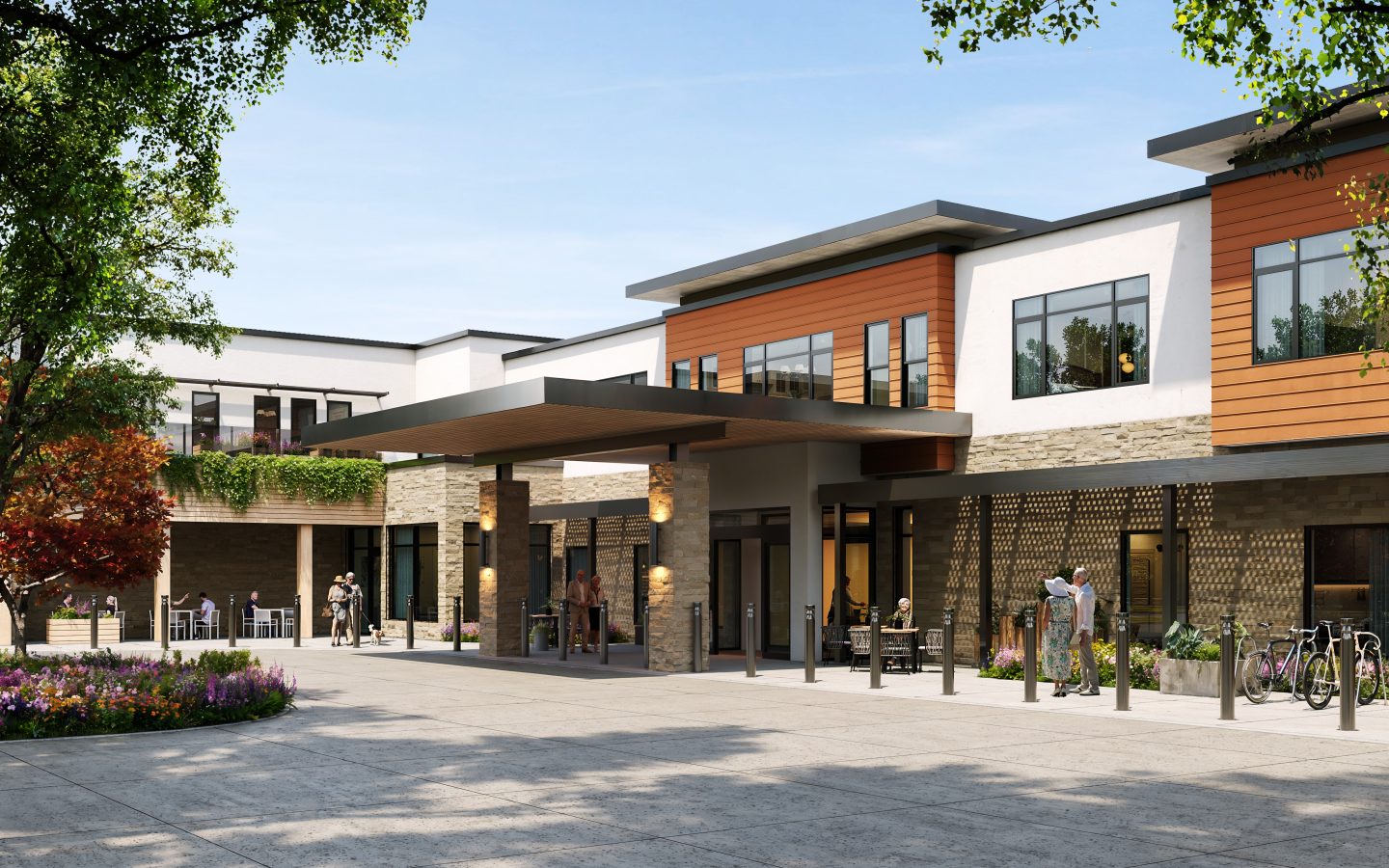
Moreover, the focus has moved from ‘care after decline’ to maintaining wellness, social vitality and independence. Hospitality-level dining and service used to be a differentiator—now it’s the entry price. The amenity mix itself has clearly shifted toward wellness—newer communities feature a meaningfully higher share of pools, spas, fitness centers and outdoor environments, including pickleball courts. The expectation is closer to a nice hotel and the goal is to avoid the feeling of ‘moving into a senior housing facility.’
Technology has gone from a nice-to-have to an expectation. Connectivity, family communication apps and safety monitoring are now assumed rather than marketed as extras. The other real shift is around privacy and care integration.
In many instances, the competitive edge is no longer the building itself, but the experience platform including culinary, wellness, programming, hospitality, concierge services and technology.
With new communities expected to serve residents for years from now, how do you future-proof a project for the expectations and needs that may not yet be fully known?
Johnson: Two things drive this: Firstly, the building must physically accommodate residents who will be older and of higher acuity than today’s, and secondly, it has to accommodate technology we can’t fully predict yet. On the first point, we design deliberately for the full-care continuum rather than a single acuity level, because the incoming cohort is arriving later in life and with fewer built-in family caregivers than prior generations—lower marriage rates and more adults without children nearby—which points toward more demand for assisted living- and memory care-capable product relative to pure lifestyle independent living.
On technology, we do not bet the building on any single system. We build the infrastructure—connectivity, sensor-ready unit wiring, a data backbone—and treat individual point solutions such as fall detection, remote monitoring, telehealth and staffing platforms as swappable layers on top of it. That’s the way to stay current when the specific technology in favor five years from now likely doesn’t exist yet.
What lesson from the pandemic will have the greatest influence on senior housing development decisions over the next decade?
Johnson: The clearest lesson is that this is an operating business first, overlayed on a real asset. The pandemic punished anyone who forgot or did not acknowledge that. National occupancy levels quickly dropped 1,000 basis points, while owners and operators were simultaneously forced into expensive contract labor just to keep communities staffed, equating to margin pressure from both directions at once.
And the recovery has been just as instructive—NICMAP reported 20 consecutive quarters of occupancy growth through the second quarter of 2026. That validates the needs-based demand thesis, but the winners and losers within that recovery were not random.
The next disruption won’t look like COVID-19, but the assets and capital structures built to withstand a labor and/or occupancy shock will be the ones that prevail on a relative and absolute basis.