Breathing New Life Into Older Apartment Properties
Tips for value-add upgrades that will make aging communities competitive in a tough climate.
These days, ground-up investment and development of new multifamily properties is proving to be an increasingly difficult endeavor. High interest rates, a shortage of available debt, as well as shortages of labor and construction materials, have further complicated the process.
In light of these struggles, value-add projects and financial models are often attractive options. If investors can find the right properties in need of upgrades and make aesthetic and functional changes that appeal to renters, they can often achieve significant boosts to their resident profiles and asking rents. At the same time, they can keep the properties’ affordability and accessibility intact.


Signage and sightings
With these issues in mind, aesthetic appeal and branding are the name of the game, and many aspects of it are low-hanging fruit for attracting renters. “We want to be outward facing, so that people walking by or looking at us online immediately see the enhancements that we have made,” explained Jariel Bortnick, Founder & Principal of Quad Property Group.
For Quad Property Group, these cosmetic upgrades take the form of new signage and landscaping upgrades, as well as freshening amenity spaces, leasing offices and clubhouses. These upgrades have a distinct advantage in attracting renters due to their “surety of execution” and their relative immunity to permitting delays and labor availability, according to Bortnick.
Tyler McWilliams, Chief Operating of Ashland Greene, sees exterior and branding upgrades as important as unit improvements, particularly in a market as competitive as Dallas-Fort Worth, where most of the firm’s investments are located. “When a renter pulls up into an apartment complex, and they see siding falling off, paint that looks really bad, branding that doesn’t draw them in and shingles falling off a roof, that’s their first impression of the property,” he told MHN. “They are not going to walk into a leasing office and pay a premium for the unit that we just renovated.”


Enhancing interiors
In the same vein, quality of life investments are necessary to create properties that offer long-term appeal to renters, and a nuanced look at why the competition can charge higher rents is vital for value-add investors.
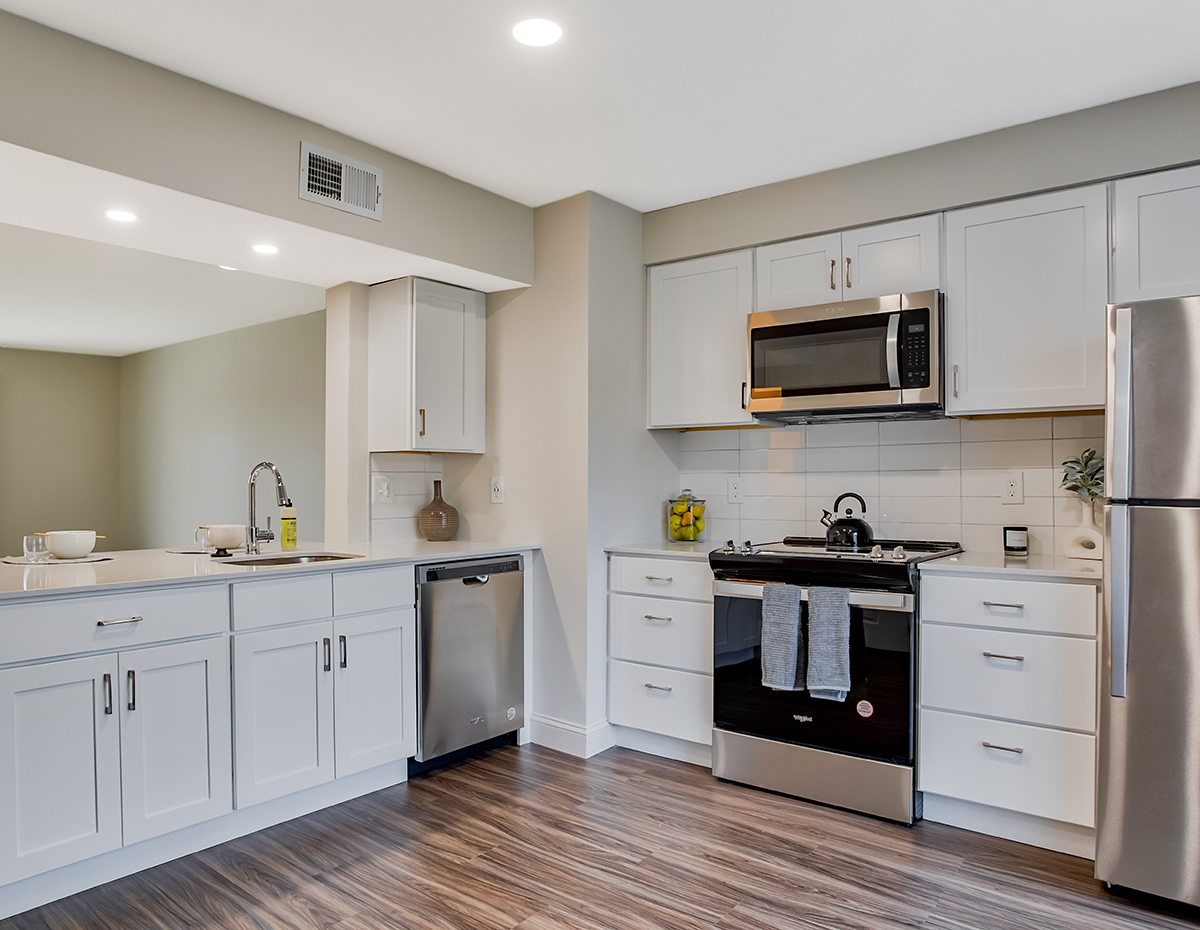
“If the kitchens at competing properties have granite countertops and stainless steel appliances and are receiving $200 to $300 higher monthly rents than our property, then we will seek to add those types of enhancements,” said Eric Henrickson, vice president of acquisitions at CREC Real Estate.
As such, the countertops have become important, but so too have the way they complement the space. When GID changes a countertop, often topping one with quartz, they also lower them, giving way to a more open space between a kitchen and living area. As an example, “Someone could be cooking and engaging with family members or friends who are sitting and watching TV in the living room,” Grossman noted.
In the kitchen, the new owners often replace yellowing laminated wooden cabinets with painted boxes and replace the cabinet doors with painted fronts. That gives the interiors a warmer, more relaxing feeling. Larger, single-bowl sinks often replace dual-bowl setups to better accommodate pots and pans.
Around the units, renovations include installing wooden plank—style flooring, a fixture of higher-end communities. “We find that it saves on operating expenses going forward, because the hard-surface flooring does not need to be cleaned or replaced nearly as often as carpet,” Grossman reported.

Smart amenities
When selecting amenities, combining new offerings with the tried-and true is a successful strategy. A cinema may look nice in a property brochure, but larger gym space may be more attractive to renters. Understanding this, GID removed the theater in the gym at one property, making room for a larger fitness area. “It was a smaller gym, and nobody was using the theater, and we have created a bigger (one) with all kinds of equipment that tenants think is fantastic,” Palmer said.
Similarly, outdoor amenity spaces are evolving as well, reflecting both newer and longstanding recreational habits. Pickleball courts remain a winner, and pet parks make a good enhancement to underutilized yard space. Both upgrades are both relatively quick and inexpensive.
“You find a patch of grass, spend about $10,000 on fencing and $5,000 on pet equipment, and you have a very popular amenity,” Bortnick reported. GID shares this approach, often tackling landscaping as the first action item of a value-add. A similar exterior aesthetic improvement: private, fenced-in yards. “If there is a nice flat area outside of a patio, we (can) fence that in and add nine to ten feet of grass, and that will be a personal private yard,” Palmer said.


Grounded in reality
Despite the allure that a full property facelift presents for value-add investors, the projects are not without struggles. In light of several high-profile bank failures earlier this year, coupled with borrowing costs frequently exceed cap rates, investors have financed recent value-add deals with agency lending, on top of preferred equity. “The bridge product is challenged, to put it mildly,” Bortnick pointed out.
From the lender’s perspective, agency lending is often preferred. “The reason we underwrite based on agency loans is due to the regional banks’ appetite for commercial loans,” said Marcia Kaufman, CEO of Bayport Funding.
Labor and material shortages can also hamper value-add projects. Hiring local contractors is often a way to save time and money. “Whenever we install cabinets, our vendors are cutting them on-site,” reported McWilliams of Ashland Greene.
For its part, Quad Property Group sometimes runs into countertop shortages. The solution? “Make sure that it’s available in bulk, and budget accordingly with a healthy reserve,” Bortnick advised.