Why Nuveen Sees a Self Storage Investment Window Opening
As fundamentals stabilize, two executives discuss opportunities, risks and preferred markets in the sector’s next phase.

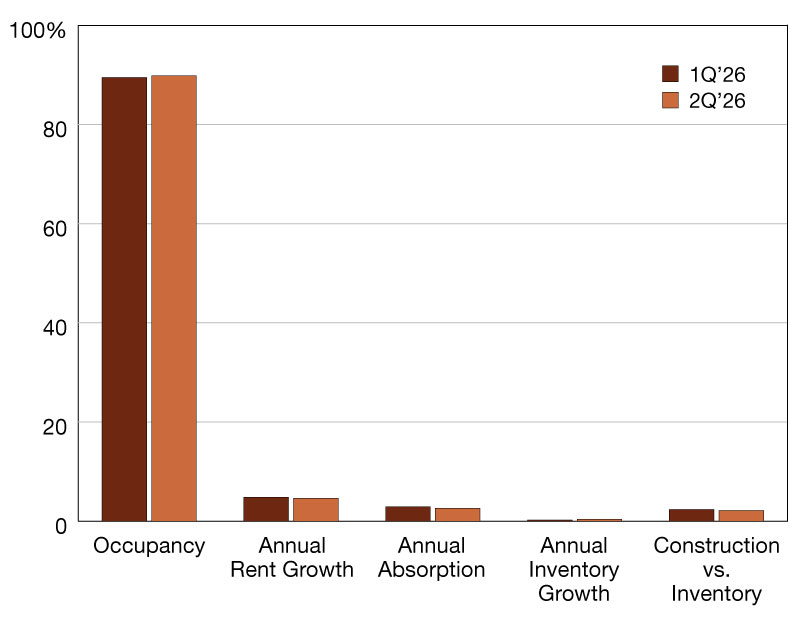
The self storage sector is showing signs of improvement, supported by stabilized occupancy, in-place rent growth and a slowing development pipeline.
Average advertised street rates per square foot for the 10×10 non-climate and climate-controlled units combined rose 1.0 percent to $16.22 per square foot as of April, according to the latest Yardi Matrix report. Meanwhile, the national under-construction pipeline was down 30 basis points year-over-year.
Together, these self storage market trends could create opportunities for investors looking to enter or expand their presence in the sector. One such investor is Nuveen Real Estate. The TIAA subsidiary has been active in self storage since 2003 and today manages $3.7 billion in such assets across the U.S. Recent initiatives include the partnership with MyPlace and the closing of a $166.6 million self storage investment fund.
Multi-Housing News spoke with Senior Director Matthew Neary and Portfolio Manager Melissa Reagen about self storage investment opportunities, what risks owners should pay close attention to and how technology is influencing the evolution of self storage.
READ ALSO: Where Are the Best Self Storage Opportunities?
According to your researchers, this year could mark an inflection point for self storage. How is that outlook shaping your investment strategy?
Neary: The market outlook is telling us to lean into acquisition opportunities this year. Historically speaking, self storage has been one of the strongest-performing property types during both periods of economic expansion and contraction, and our research supports that values are stabilizing across the sector. We anticipate this recovery to continue over the next couple of years.
Further, in the current cycle, we are also finding attractive opportunities at reset values and with reset operating metrics. Over the last few years, we have primarily acquired one-off deals. However, given today’s market opportunity, we are also actively seeking portfolios that make strategic sense as well.
Tell us more about those one-off deals. What makes them attractive and how do you determine which ones are worth pursuing?
Reagen: Generally speaking, we believe one-off acquisitions from smaller sellers can offer real advantages over large portfolio transactions. When you’re dealing with an individual seller, the ability to execute quickly and cleanly—tighter diligence timelines, limited financing contingencies, no syndication required—is often what wins the deal.
What we really value is the discipline that comes with one-offs. There is almost always another deal in the one-off space, which means we’re very rarely in a position where we feel pressured to stretch on pricing or take on risk that we’re not comfortable with. It also gives us much greater control over how we construct the portfolio. We can be selective across geography, vintage, product type and occupancy levels in a way that larger portfolio transactions simply don’t allow for, even when the headline return profiles might look relatively similar.
We evaluate these smaller, one-off acquisitions by applying disciplined performance criteria across key factors including geography, submarket conditions, operating efficiencies and asset size. We also typically group risk into three main categories: rent roll risk, market risk and physical plant risk. Buying individual deals allows us to more judiciously balance these risks and levers that can be harder to manage in bulk acquisitions.
READ ALSO: Top Markets for Self Storage Transactions
Speaking of risks, what are the main warning signs you’re paying close attention to when considering new acquisitions in the sector?
Reagen: The primary risks tend to focus on new supply, acquisition cap rates and growth outlook. As institutional capital increasingly seeks deals in attractive markets like the Midwest for example, cap rate compression becomes a meaningful concern by potentially reducing returns for investors who entered later in the cycle. Simultaneously, a surge in new construction could oversupply local markets, putting pressure on occupancy and rental rates.
In today’s market we have more visibility into new construction, but as the sector has experienced a reset in fundamentals, understanding acquisition rent rolls and leasing trends in specific submarkets remain paramount. It’s important to know if you are buying a rent roll that is potentially trending lower and why, as well as figuring out if the new management team you are installing can drive further growth or not.

Are there any particular self storage investment markets you’re favoring? If so, why those specific ones?
Neary: We’ve identified the Midwest as a key pillar of our strategy from a proprietary market analysis that evaluated factors like home inventory, post-rate-hike affordability, income levels and new storage supply. What that work told us was that the Midwest was best insulated from declining for-sale activity, offered higher starting cap rates relative to other regions, and presented stronger realized growth potential with fewer competing buyers.
We’re also balancing the Midwest with a handful of more gateway and Sun Belt markets, particularly those that offer specific state incentives that drive other income. These markets historically have garnered more institutional interest, which is further conviction toward our goal of building and aggregating strong and well-balanced portfolios.
Which market characteristics matter most when choosing where to expand?
Neary: Like the analysis that pointed us toward the Midwest, we’ve run similar research to help us understand when trends may be reversing to highlight optimal sell points, as well as when to scale more meaningfully into other markets. In today’s economy, we’re closely monitoring trends related to a broader “K-shaped” recovery where individuals and areas with better income durability may perform better or differently. As the world changes, our outlook will change with it.
READ ALSO: Top 10 Emerging Self Storage Markets of 2026
How are technology, data and AI changing the way self storage investments are evaluated and operated?
Reagen: The most effective operators are integrating revenue management and digital marketing into unified systems that connect pricing, advertising, and tenant conversion data, recognizing that competitive rental rates mean little if prospective tenants can’t find the facility in the first place.
AI is accelerating this shift by reshaping how consumers search for storage, influencing which facilities get surfaced and recommended, and enabling more sophisticated analysis around rate-setting and rent increases. Operators who leverage these tools can better track where prospective renters are searching, optimize pricing in real time, and measure the full cost of conversion.

Once tenants are in place, technology can help operators strike the right balance between occupancy, in-place rent growth, and attrition management, hence reducing costly turnover and the need to repeatedly spend to refill vacant units.
We view the operators who can embrace this data-driven, technology-enabled approach as best positioned to generate meaningful gains in both top-line revenue and bottom-line performance across the sector.
Looking ahead, what trends do you believe will shape self storage investment over the next few years?
Reagen: The technology tested today will help drive the trends of tomorrow. This is true across both hardware and software. A lot of this technology is also dependent on access to data and by virtue of that, on scale too, which we believe is one of the biggest continued trends.
Interestingly, if you look at Europe, a lot of self storage is just getting built for the first time. In those markets, many operators do not use a call center nor do they have onsite staff. Mostly everything is driven by online tools or conversational AI. Further, most storage users today in the U.S. are already Millennials or Gen Z, and as the user base continues to trend younger, we believe the renter’s willingness to adopt more technology will accelerate. In the U.S., there’s been inertia needed to overcome legacy assets with legacy tech.
We also anticipate continued consolidation within the sector. Both with mom & pop owners electing to either sell to an institutional group or utilize their third-party property management services going forward, and with mid-size private operators who grew meaningfully while values were peak from 2021 to 2023 that may struggle to grow further given track-record constraints.