Why Private Credit Has Staying Power
Debt funds emerged as a fix for multifamily borrowers. They're quickly becoming a fixture in capital stacks—and in investor portfolios.

If you haven’t encountered private credit as a borrower or as an investor, there’s a good chance you will soon.
More and more investors are turning to the debt market, including CMBS, for its comparably higher returns, lower risk and strong demand. The result for borrowers has been new and ample sources of funds that often provide greater flexibility as well as competitive pricing.
“We think the market underestimates the strong foundation that the debt markets are on right now, especially in the multifamily sector,” said Rich Hill, senior vice president & head of real estate strategy and research for Principal Asset Management.
Why debt funds are gaining traction
Private debt’s rise has been largely fueled by commercial real estate’s vast refinancing needs. According to MBA, $875 billion of loans, including 13 percent of all multifamily mortgages, will mature in 2026; $652 billion will mature in 2027. This has created an opportunity for private lenders like debt funds to offer borrowers a higher-leverage and higher-priced alternative to banks.
The MBA’s Quarterly Survey also reported that commercial and multifamily mortgage loan originations were 16 percent higher in the second quarter of 2026 compared to a year earlier and increased 12 percent from the first quarter of 2026.
Mark Fitzgerald, head of research for Affinius Capital, noted that commercial real estate debt transactions in 2021-22 totaled roughly $719 billion and occurred at sub-4 percent cap rates, with 93 percent of that activity concentrated in multifamily and industrial. Multifamily construction starts also ran at more than twice their prior 20-year average during those two years.
“Those loans are maturing today in a different rate environment,” he remarked, “and that creates a substantial pipeline of financing opportunities, even as traditional lending markets normalize.”
Sponsors are increasingly choosing debt funds because they are willing to provide customized financing solutions, particularly for transitional assets and business plans that may not fit traditional bank or agency requirements, said Tom Lorenzini, senior vice president at Tremont Realty Capital, a division of The RMR Group.
LIKE THIS CONTENT? Subscribe to MHN’s Finance & Investment Newsletter

He noted that historically, many real estate investors had a long-term view—10 to 20 years. Today, they are seeking shorter commitments, which also has increased the use of closed-end funds and put more emphasis on a strong business plan.
Bank lending policies also remain selective and conservative, particularly for transitional and construction loans, but generally provide multifamily borrowers a 6 to 6.5 percent fixed rate at 50 percent loan-to-value for a period of 5 to 10 years. Private loans, on the other hand, often feature floating rates, short horizons, and mandatory equity gaps, reported Collateral Partners.
Debt funds here to stay
Jay Maddox, principal in Capital Markets, at Avison Young, said there isn’t a comprehensive industry estimate isolating multifamily’s share of all debt-fund capital, but multifamily remains the most favored institutional property type due to strong housing fundamentals, attractive risk-adjusted returns and the support of agency housing finance programs, such as Fannie Mae, Freddie Mac and HUD.
Private lenders now account for 47.2 percent of non-agency loan closings, up from 20.2 percent a year ago, Hill said. Private debt funds represented about 15 percent of total loans in 2025, up from 10 percent in 2024, and roughly 5 percent in 2019, and they are expected to maintain this share of the market in 2026.
The growth of debt sources, including private equity and products such as multifamily-backed CMBS, is a win-win for the market, said Paul Fiorilla, director of research at Yardi Matrix. “Each debt source fills different niches in the capital stack, providing borrowers and investors with choices and flexibility in structure, leverage and pricing,” Fiorilla said.

While the wall of maturing debt may have kick-started the growth trend in debt fund financing, experts expect debt funds to continue growing their market share.
As evidence of strong demand, they pointed to PGIM raising more than $19 billion in real estate debt capital over the past five years, Blackstone’s real estate debt platform managing roughly $77 billion, and Benefit Street Partners raising $10 billion for a fund with a particular emphasis on multifamily.
The fundamental backdrop driving the high level of multifamily investment is the rapidly receding supply wave at a time when multifamily demand remains strong. Fitzgerald said that this should allow many properties currently in lease-up or stabilization to move into an environment with substantially less new competition, supporting occupancy and, ultimately, rent growth.
Kathy Corton, head of commercial real estate at Saluda Grade, an investment firm specializing in asset-based credit, concurred that borrower demand for bridge loans and continued capital deployment by investors supports a robust outlook for investors. But U.S. macroeconomics, including the interest rate environment and inflation, will be a factor in determining transaction volume going forward, she suggested.
Why investors favor multifamily debt
Attractive yields are a major draw for investors, said Shlomi Ronen, founder & managing principal of Dekel Capital. “The yields investors get on debt relative to the pricing on properties right now makes it a very attractive proposition, especially on a risk-adjusted basis because you’re not taking last dollar risk on these assets,” he noted.
But yield is only part of the appeal, Fitzgerald noted. Multifamily debt also offers current income, a reduced J-curve relative to higher-yielding equity strategies, some inflation-hedging characteristics through the underlying real estate, and exposure to a sector where there is still a structural shortage of the right types of rental housing. At the same time, the reset in property values has created a more attractive entry point for investors.
“That combination has helped sustain allocations even as overall private real estate fundraising has moderated,” he said.
The attraction, however, also varies by investor, according to an Affinius analysis of investor types. Insurance companies, for example, are generally drawn to contractual income, capital efficiency and the ability to match longer-duration liabilities, while pensions and other institutional investors may view real estate debt as a way to retain exposure to real estate while moving higher in the capital structure.
Securitization extends the opportunity
A number of private credit investors have been flocking to multifamily-specific securitizations. The CMBS market, however, has undergone a notable shift from traditional 10-year fixed-rate financing toward shorter-duration, five-year structures over the last several years, Lorenzini said.
“Although CMBS volume is tracking ahead of last year’s pace, many borrowers remain reluctant to lock in fixed-rate debt at today’s elevated interest rates,” he added. Instead, borrower and credit-investor demand for shorter-term CLO and SASB (single-asset, single-borrower) financing is dominating the market.

A change in Freddie Mac’s strategy is fueling a resurgence of multifamily CMBS, noted Fiorilla. He explained that Freddie stopped selling junior “B-piece” tranches of its K-Series securitizations to high-yield commercial real estate investors, instead offering junior credit-linked notes that are not secured by properties and attract a different type of investor.
“That opened the door for partnerships between CMBS shops and B-piece buyers looking for high-yield multifamily investments,” Fiorilla said. One example is D2 AssetFanagement, which was founded by former Freddie Mac CEO David Brickman and French bank Natixis, underwriting multifamily loans, with Natixis funding the senior portion of the loan and D2 holding the junior slice.
He noted that this program attracts borrowers looking for higher leverage, up to 75 percent of property value, albeit at a high interest rate, with a loan spread 50 to 75 bps higher than the agency rate.
JPMorgan and MF1, a specialty lender operated by Berkshire Residential and Limekiln Real Estate, however, were the first out with a multifamily-only CMBS, issuing a $734.2 million deal in May. Other partnerships that pair CMBS shops with B-piece buyers include Barclays and 400 Capital Management, Citigroup and Greystar, Morgan Stanley and Torchlight Investors, the Bank of Montreal and Morgan Properties, and Wells Fargo and Bridge Investment Group.
Debt funds are also willing to provide higher leverage than banks on refinance deals because valuations have already fallen significantly over the last couple of years, reducing the risk of loss on newly originated loans.
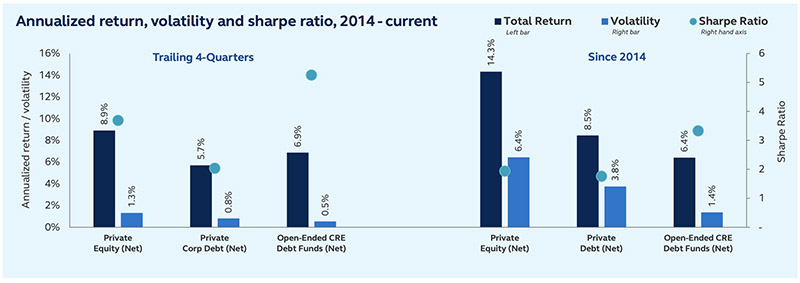
This is especially true for private series debt funds, which provide volatility-adjusted returns in the high single-digit to low double-digit range, with roughly 90 percent coming from income.
“That is much more attractive than the returns in the public REIT market, private series equity, or CMBS,” contended Hill. “As a proxy, if we’re using round numbers to say private series debt funds have generated 10 percent annualized total returns, private series equity has been less than 5 percent, so they’ve generated double the return.”
“In a world where many investment alternatives are more uncertain than in the past, that certainty is quite attractive for investors.”
READ ALSO: Why the Mortgage Market Is Looking Stable
The MBA estimates total multifamily mortgage debt outstanding at approximately $2.32 trillion, underscoring both the depth of the market and continued investor demand, noted David DiRienzo, senior director of business development at Talonvest Capital.
“Many lenders are structuring their portfolios with bank warehouse or repo lines and tapping into the CLO markets,” he said. This provides scalable liquidity and efficient access to capital, enabling lenders to offer competitive executions to borrowers.
An evolving alternative
Private debt has already shown signs of maturing. Following the pandemic, there was a flurry of fundraising activity by debt funds. Now, a lot of the investors are consolidating their investments across both debt and equity commercial real estate funds and are gravitating towards some of the larger investment management firms, Ronen said.

Debt funds are also becoming increasingly sophisticated and flexible, engineering creative financing solutions that enable borrowers to preserve and protect their property investment, Maddox said.
They not only act as full-service alternative lenders—now providing senior bridge loans, mezzanine financing, preferred equity, construction financing, rescue capital and structured financing solutions—but as strategic capital partners capable of solving increasingly complex transaction challenges.”
“There seems to be a new fund created every day,” he continued, noting that competition among funds is driving tighter pricing and, in some cases, more aggressive underwriting.
As such, borrowers can be a lot more selective about which lenders they go to, how those lenders are underwriting the loans and the amount and type of debt they’re seeking, noted Hill.
And the competition is not just benefiting borrowers on price. “We are negotiating leverage across proceeds, loan structure, flexibility and execution certainty as lenders compete harder to win quality deals,” DiRienzo said.
DiRienzo cited a portfolio deal where he negotiated a 45-basis-point decrease in spread with six fewer months of minimum interest and a 24-month cash-management holiday, giving the borrowers greater latitude to execute their business plan.
He also saved a client $500,000 of interest expense by forcing the incumbent lender to compete, bringing in new lenders with strong pricing that pushed the existing lender, a life company, from a mid-100s to low-100s spread.
Fitzgerald noted that, according to Real Capital Analytics, debt funds represented approximately 36 percent of multifamily construction lending in 2025 overall—50 percent in the Northeast region, substantially higher than their 15 percent share of overall lending.
Additionally, borrower requests are evolving because multifamily assets are taking longer to reach an exit. “Properties that might otherwise have sold or refinanced after an initial bridge loan are increasingly requiring another period of transitional financing as their existing debt matures,” said Fitzgerald.
“In effect, this gives lenders another bite at the apple, providing borrowers a second bridge or recapitalization for assets that may be fundamentally performing but cannot yet achieve the proceeds required from a permanent loan or sale.”