USA Properties Fund Debuts Affordable California Community
Development costs clocked in at $79.5 million.

USA Properties Fund has opened College Creek, a $79.5 million, 164-unit affordable housing community in Santa Rosa, Calif.
The developer’s in-house construction crew served as the general contractor while LPAS Architecture & Design drew the project’s blueprints. The team broke ground in 2022.
College Creek comprises one four-story and two three-story buildings. These encompass one- to three-bedroom floorplans that range from 577 to 1,158 square feet. Units feature patios or balconies and energy-efficient appliances, as well as light fixtures and ceiling fans, among others.
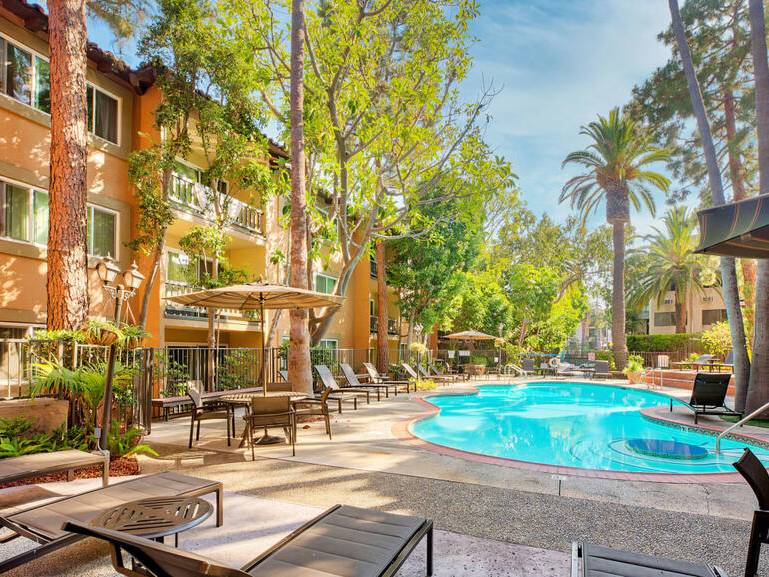
The community amenities include a basketball court, a playground, computer workstations, a gym, a clubhouse and a swimming pool, as well as a bike storage and repair station.
READ ALSO: How Teamwork Can Push Affordable Housing Projects Across the Finish Line
Of the 164 apartments, 17 units are reserved for residents earning at or below 30 percent of Area Median Income, 43 units are restricted for households earning up to 50 percent AMI and 42 units are set aside for residents earning at or below 60 percent AMI. The remaining 61 apartments are reserved for households earning up to 70 percent AMI.
Located at 2156 W. College Ave., the community is about 3 miles from downtown Santa Rosa. Within 2 miles, residents can access parks, retail options, schools and transit options, as well as a public library.
A public-private partnership for affordable housing
Following a rezoning to multifamily residential in 2013, the 7.4-acre site changed hands, with the Sonoma County Community Development Commission taking ownership. Five years later, the County Board of Supervisors selected USA Properties as the preferred developer and sold the site to the company. As part of the sale, a Disposition Development Agreement between the county and USA Properties emerged. Through it, a seller carryback loan in the amount of $4.4 million funded the development.
Financing for the project also included two tax-exempt construction bonds amounting to $33.1 million and $2.7 million issued by the California Housing Finance Agency with Bank of America as trustee, Yardi Matrix data shows, as well as a $28.1 million tax-exempt permanent loan originated by CalHFA.
Additional funding consisted of a $12 million construction loan issued by Bank of America, the same source reveals. The owner also secured $24 million in equity from the 4 percent federal LIHTC program and $6.3 million in state tax credits.