2025 Single-Family Rental Index
Key takeaways from a recent Cotality report.
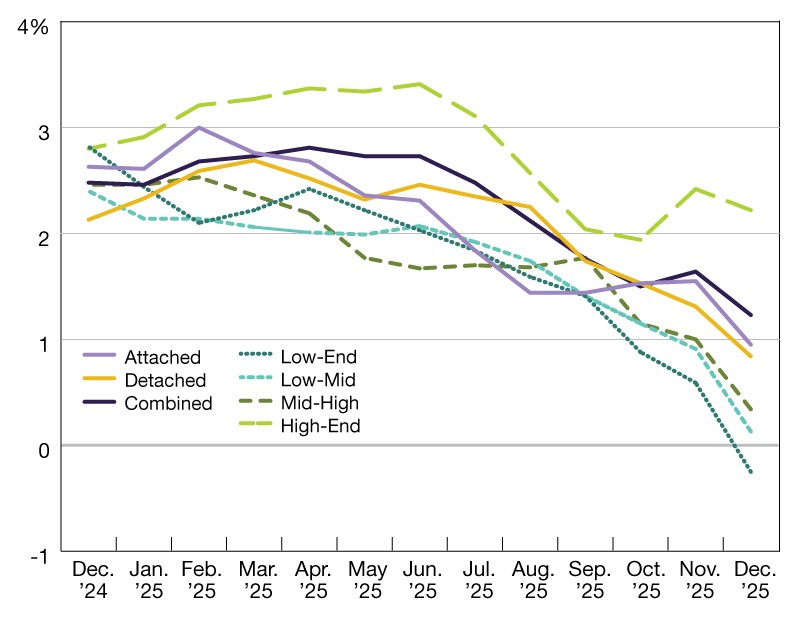
Single-family rent prices in December 2025 increased 1.2 percent year over year. This increase is a drop-off from the 2.5 percent increase we saw between December 2023 and 2024.
The single-family rental market ended 2025 on a notably softer trajectory. 35 of the 50 largest metros posted slower annual rent growth in December 2025 than in December 2024, and 18 recorded outright annual declines—including eight in Florida, three in Texas, and two in Arizona. In several of these markets, persistently high multifamily vacancy rates are giving renters meaningful leverage, softening rents, even in the single family segment. Overall rent growth remains near 15 year lows, yet the high priced tier continues to track close to its long run trend, underscoring the K shaped dynamics shaping today’s housing market. Affordability pressures remain front of mind for budget-constrained renters as these conditions persist.
Rent for high-end properties increased 2.2 percent year over year in December 2025, a drop from the 2.8 percent gain recorded in December 2024. Low-end property prices decreased by –0.3 percent in December 2025, a significant drop from a 2.8 percent gain in December 2024.
Rent growth for detached rentals was once again 0.8 percent in December 2025, while it increased 0.9 percent for attached rentals.
National trends remained mostly unchanged from the previous months in December 2025. Chicago remained at the top of the list for the highest rent growth, at 4.8 percent in December 2025. Philadelphia had the second-highest rent growth at 3.3 percent, followed by Detroit (3.1 percent), New York-Jersey City-White Plains (2.5 percent) and Los Angeles (2.4 percent). Rent growth in Dallas remained negative, with the metroplex posting –1.2 percent, followed by Miami (-1 percent) and Houston (-0.3 percent).
—Posted on Feb. 27, 2026
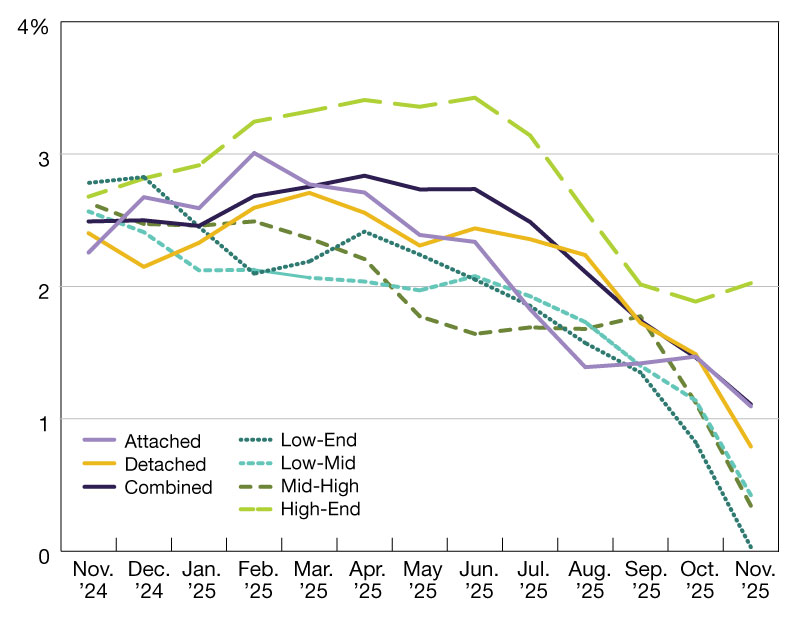
Single-family rent prices in November 2025 increased 1.1 percent year over year. This increase is a drop-off from the 2.5 percent increase seen between November 2023 and 2024.
Rent growth slowed to its weakest pace in more than 15 years, signaling a broad-based cooling across the U.S. rental market as the market is adjusting after years of rapid increases. While Miami, Houston, and Dallas posted annual declines, rents remain significantly higher than five years ago. Miami alone is up 51 percent, nearly double the national average of 27 percent. The slowdown in rent growth is widespread: 43 of the 50 largest metros are seeing weaker growth than a year ago, and 16 are registering outright decreases. Florida leads in annual declines, while Chicagoland metros top the list for increases. Even high-end rentals, which posted the strongest annual gains, show long-term growth converging across all price tiers, reflecting normalization across segments.
Rent for high-end properties increased 2 percent year over year in November 2025, a drop from the 2.7 percent gain recorded in November 2024. Low-end property prices showed no annual increase in November 2025, a drop from a 2.8 percent gain in November 2024.
Rent growth for detached rentals was once again 0.8 percent in November 2025, while it increased 1.1 percent for attached rentals. While annual rent growth is different across price and property-type tiers, it has consistently risen over the last five years. Low-price rentals saw a cumulative increase of 28 percent, while all other price and property type tiers experienced a similar 27 percent increase. For renters, this means affordability challenges are widespread and not concentrated in lower-priced units. For landlords, the trend signals stable revenue growth across segments and broad-based demand.
Although annual rent growth has slowed to low single digits nationally, trends vary significantly across metro areas. Among the 10 largest metro areas, Chicago remained at the top of the list for the highest rent growth, at 4.2 percent in November 2025. Philadelphia, Pa., had the second-highest rent growth at 2.8 percent, followed by Detroit, Mich. (2.7 percent), New York-Jersey City-White Plains, (2.3 percent), and Los Angeles, CA (2.1 percent). Rent growth in Dallas, TX, remained negative, with the metroplex posting -0.8 percent, followed by Houston, Texas (-0.7 percent) and Miami, Fla. (-0.5 percent).
—Posted on January 29, 2026
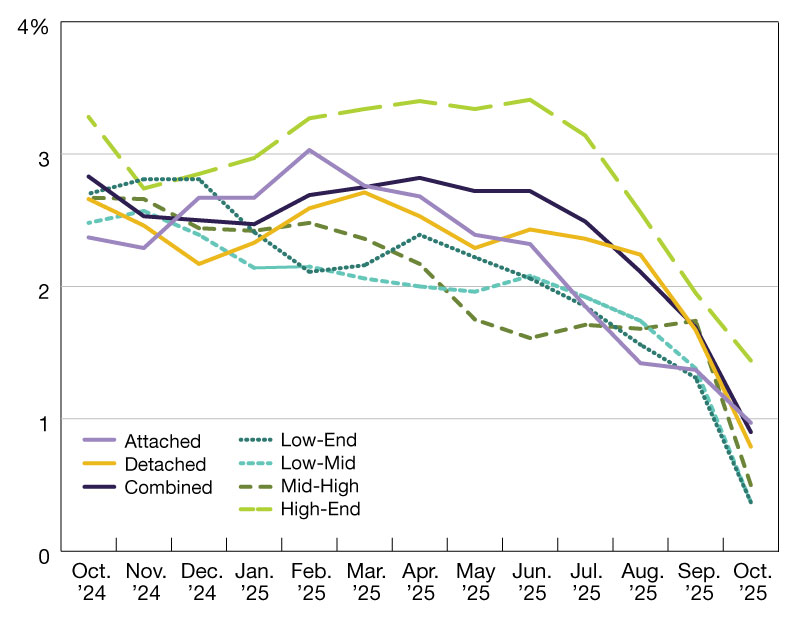
Single-family rent prices in October 2025 increased 0.9 percent from October 2024, which is significantly less than the 2.8 percent increase recorded between October 2023 and October 2024.
Forty of the largest 50 metros posted lower annual rent growth compared to October 2024. Eighteen metros saw outright year-over-year declines in the Single-Family Rent Index, with half of those declines occurring in Florida. While this moderation is notable, rents remain elevated compared to pre-pandemic levels. Annual growth peaked in March 2022, and even after three years of slowing, the national index in October was still 9 percent higher than the 2022 average level. This trend reflects a normalization process rather than a reversal, as affordability challenges and regional dynamics continue to shape rent performance.
Rent for high-end properties increased 1.4 percent year over year in October 2025, a drop from the 3.3 percent gain recorded in October 2024. Low-end property prices increased 0.4 percent year over year in October 2025, a drop from a 2.7 percent gain in October 2024.
Rent growth for detached rentals went up 0.8 percent in October 2025, while it increased 1 percent for attached rentals.
The ongoing slowdown in single-family rent growth reflects broader market adjustments. While national growth remains positive, regional differences are increasingly clear. Florida metros, including Cape Coral and North Port, posted two consecutive years of annual declines, signaling a correction in markets that previously experienced outsized gains. In contrast, Midwest metros such as Chicago and Detroit continue to demonstrate resilience.
Price segment performance highlights shifting dynamics in demand for rentals. While both high-end and lower-end rentals have slowed, deceleration is more pronounced for lower-end properties. This suggests that affordability challenges and economic pressures weigh more heavily on budget-conscious renters, while demand for higher-priced rentals, though moderating, remains relatively more resilient.
Among the 10 largest metro areas, Chicago remained at the top of the list for the highest rent growth, at 4.6 percent in October 2025. Washington, D.C., and Detroit, MI, were significantly behind Chicago with rent growth at 2.4 percent year over year. Philadelphia (2.2 percent) and Los Angeles (0.6 percent) rounded up the top 5 cities with the highest rent growth in October 2025. Dallas continues to have the lowest rent growth in the nation, with rents declining -1.3 percent.
—Posted on December 30, 2025
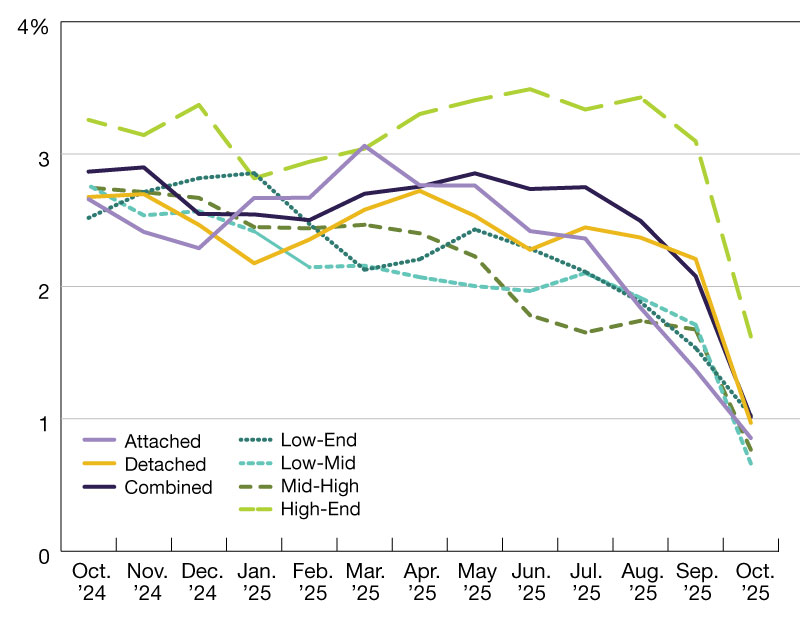
Single-family rent prices in September 2025 increased 1 percent from September 2024.
The story of the single-family rental market is one of deceleration at the national level, but with significant local nuances. Annual single-family rent growth in September hit its lowest point in over 15 years—since June 2010. This is welcome news for renters struggling with affordability.
READ ALSO: Stumbling Blocks to Ownership Still Boosting BTR
However, despite this slowdown, single-family rents are still substantially higher, up 29 percent over the past five years, adding about $7,300 per year to the national average rental bill, a financial burden that has consumed about one-third of the increase in median family income over that time.
Rent for high-end properties increased 1.3 percent year over year in September 2025, a drop from the 3.2 percent gain recorded in September 2024. Low-end property prices increased 1 percent year-over-year in September 2025, a drop from a 2.5 percent gain in September 2024.
The national slowing does not tell the whole story. In many large metros, market conditions have shifted enough to cause rent declines, with 26 percent of the largest 50 metros seeing decreases in our Single-Family Rent Index.
Rents across large metros
Markets like Dallas and Miami showed large decreases in the SFRI. Yet, for renters in these markets, the historical pain remains acute, as five-year rent increases in Miami and Dallas were $850 and $610 per month, respectively. This underscores the challenge: while the pace of growth is easing and even falling, the cumulative impact of past rent hikes continues to put immense pressure on household budgets.
Among the 10 largest metro areas, Chicago remained at the top of the list for the highest rent growth, at 4.3 percent in September 2025. Washington, D.C. increased by 3.1 percent, followed by Philadelphia where increases were 2 percent and Los Angeles where rents rose 1.5 percent. Dallas recorded a -1.1 percent decline in rent growth in September 2025, keeping it at the lowest rental growth in the nation.
—Posted on November 28, 2025
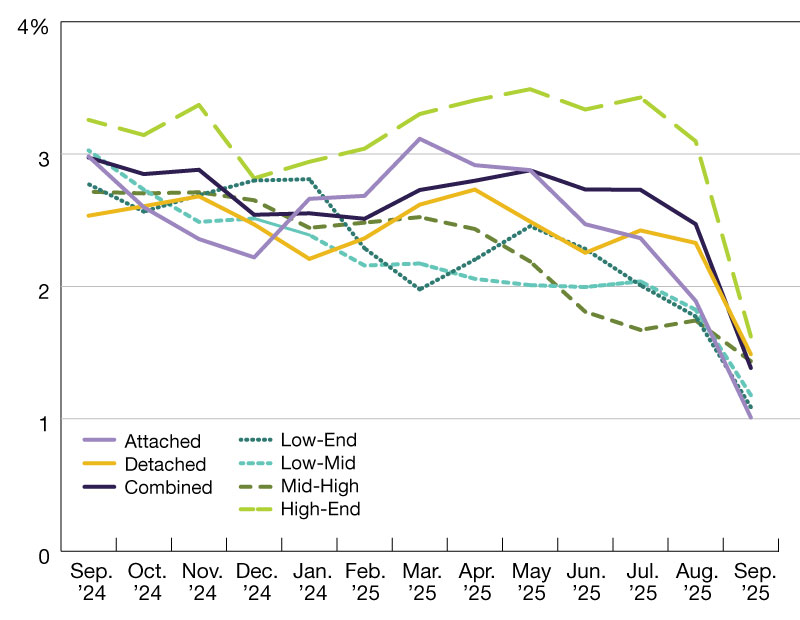
Annual single-family rent growth fell to its lowest level in more than 15 years this August, highlighting a notable shift in the rental market. That said, not all areas are following the same pattern. Atlanta, Philadelphia and Los Angeles continue to show stronger rent growth, with Los Angeles now only slightly above its pre-wildfire level from January.
READ ALSO: Stumbling Blocks to Ownership Still Boosting BTR
Los Angeles ranks second among the top 10 metros for rent growth, suggesting that local conditions such as recovery efforts, limited housing supply, and regional economic factors can still influence rental trends even as national price growth moderates.
Rent in both high-end and low-end price tiers climbed just slightly year over year. High-end properties saw strong growth for the last several months. Rent prices for high-end properties increased 1.6 percent year over year in August 2025, a drop from the year-over-year gain of 3.3 percent in August 2024.
Low-end rent prices increased 1.1 percent year over year in August 2025, down from a 2.8 percent gain in August 2024. Rent for detached rentals grew by 1.5 percent, and attached rental rates rose by 1 percent in August 2025.
Rents across top metros
Among the largest 10 metro areas, Chicago remained at the top of the list for the highest rent growth at 4.7 percent in August 2025. Los Angeles followed at 2.8 percent, Philadelphia rose 2.7 percent, Washington, D.C., was up 2.6 percent, and Atlanta rents climbed 1.9 percent.
Dallas recorded a 0.6 percent decline in rent growth in August 2025, making it the lowest in the nation. Single-family rent growth in the Dallas metro area has been mostly hovering around 0 percent for the past year thanks to a large number of multifamily rental units coming online and giving renters some bargaining power.
—Posted on October 31, 2025

Single-family rent prices in July 2025 increased 2.3 percent from July 2024, which is less than the 3.1 percent average increase a year ago.
The monthly growth rate came in at just 0.2 percent, well below the historical July average of 0.7 percent, and is a notable shift from the stronger-than-usual monthly gains recorded earlier in 2025. Even markets like Los Angeles, which had been buoyed by post-wildfire demand, are now cooling off. Chicago stands out as the exception, leading the nation in rent growth amid tight inventory and resilient demand.”
READ ALSO: Stumbling Blocks to Ownership Still Boosting BTR
Annual growth in July dipped below the lower bound of the 10-year average range established in the decade leading up to the pandemic. While rents continued to climb, Cotality saw annual rent growth weaken at all price levels in July. In past months, higher-priced tiers saw stronger growth.
Rent prices for high-end properties increased 2.9 percent year over year in July 2025, a slowdown from the year-over-year gain of 3.2 percent in July 2024. Low-end rent prices increased 1.6 percent year over year in July 2025, down from a 2.8 percent gain in July 2024.
Rent for detached rentals grew by 2.2 percent, and attached rental rates rose by 1.8 percent in July 2025.
Top metros for single-family rent growth
Among the largest 10 metros areas, Chicago moved to the top of this list for the highest rent growth at 5.1 percent in July 2025. New York-New Jersey-White Plains, N.Y.-N.J., remained in the second spot with rent growth at 3.7 percent. Philadelphia, Los Angeles and Washington, D.C., rounded out the top five locations for rent growth.
Los Angeles’ growth is slowing as the demand from the January wildfires dissipates. Miami, where annual rent growth topped 40 percent in 2022, had the lowest rent growth recorded in July 2025 at 0 percent.
—Posted on September 26, 2025

Single-family rent prices in June 2025 increased 2.9 percent from June 2024, slightly less than the 3.1 percent average increase a year ago. Single-family rent growth appears to have stabilized slightly under the pre-pandemic average.
Annual single-family rent growth appears to have stabilized just shy of 3 percent in 2025, approaching the long-run average of 3.4 percent seen before the pandemic. The monthly growth rate in June was close to the historical average for that month and has been above the seasonal trend for nearly every month of 2025.
READ ALSO: Many Big Builders Are Stepping Back From BTR. This One’s Still All In
While rent growth weakened in most large metropolitan areas in June, exceptions included New York, Philadelphia, and Los Angeles. In Los Angeles, increased rent growth is likely due to the dissipating effects of the January wildfires. The rising rent growth in Northeast markets like New York and Philadelphia could be a spillover effect from the home sales market, where strengthening home prices may be pricing out potential buyers.
Single-family rental prices by metro
Rent prices for high-end properties increased 3.7 percent year over year in June 2025, a pickup from the year-over-year gain of 3.2 percent in June 2024. Low-end rent prices increased 1.7 percent year over year in June 2025, a drop off from the 3 percent gain in June 2024.
Rent for detached rentals grew by 2.6 percent, and attached rental rates rose by 2.4 percent in June 2025. Chicago saw the highest rent growth, moving to the top of the SFRI at 5.7 percent in June 2025. New York-New Jersey-White Plains, NY-NJ dropped to the second spot with rent growth at 5.5 percent. Philadelphia, Los Angeles, and Detroit round out the top five locations with rent growth. Miami had the lowest rent growth recorded in June 2025 at -0.5 percent. Dallas moved out of the bottom spot, but only saw rent growth of 0.5 percent.
—Posted on August 26, 2025

Single-family rent prices in May 2025 increased 1.1 percent from the previous month, faster than the 0.9 percent increase last year and closer to the average May change before the pandemic.
Compared to last May, rents increased by 3.1 percent, compared to 3 percent in May 2024. This trend continues from the past few months as prices return to pre-pandemic rates of growth at 3.4 percent.
READ ALSO: BTR Townhomes Take Off
“Annual single-family rent growth accelerated in May for the fourth consecutive month, signaling sustained momentum in the rental market. While rent growth increases have been gradual, they stand in stark contrast to the cooling trend in home price growth, which has been slowing throughout 2025,” said Molly Boesel, Cotality senior principal economist.
“This divergence isn’t surprising—many would-be buyers, deterred by elevated home prices and interest rates, are staying in the rental market, driving up demand. Monthly gains in the single-family rent index have consistently outpaced seasonal norms this year, suggesting that annual rent growth for 2025 is on track to exceed 3 percent.”
A breakdown of rent prices by property type
Rent prices for high-end properties increased 3.8 percent year-over-year in May 2025, a pickup from the year-over-year gain of 3 percent in May 2024. Low-end rent prices increased 2.3 percent year-over-year in May 2025, a decrease from the 2.9 percent gain in May 2024.
Rent for detached rentals grew by 2.6 percent, and attached rental rates rose by 2.8 percent in May 2025. New York-Jersey City-White Plains, NY-NJ saw the highest rent growth, moving to the top of the SFRI at 6.4 percent in May 2025. It was followed closely by Chicago at 6.2 percent. Los Angeles dropped to the sixth spot as the impact of the January wildfires dissipates.
Dallas continues to have the lowest rent growth in the nation, posting 0.3 percent in May. The index shows a decrease in rents for attached rentals in Dallas, while it shows an increase in rents for detached rentals as attached rentals compete with the increased supply of multifamily rentals in that metro.
—Posted on July 30, 2025

Single-family rent prices in April 2025 increased 0.8 percent from the previous month, slightly faster than the 0.7 percent increase last year or average April change before the pandemic.
Compared to last April, rents were up 2.9 percent. Last year at this time, annual rent increases were growing at 3.1 percent before slowing at the end of 2024. Now, prices are trending back up to the pre-pandemic growth rate of 3.4 percent.
“Annual single-family rent growth mostly moved sideways in April, increasing by 2.9 percent year over year for the second consecutive month. Rents increased the most in the Northeast, Midwest, and Mid-Atlantic. They increased the least in the South, which is a similar pattern to home price growth. This could be an indication that the limited supply of for-sale homes, which is pushing up for-sale prices, is spilling over into the rental market as would-be buyers remain renters,” said Molly Boesel, Cotality senior principal economist.
Rent prices for high-end properties increased 3.5 percent year over year in April 2025, an acceleration from the year-over-year gain of 3 percent in April 2024. Low-end rent prices increased 2.5 percent year over year in April 2025, which is a drop off from the gain of 3.2 percent in April 2024.
Rent for detached rentals grew by 2.4 percent, and attached rental rates rose 2.7 percent in April 2025.
New York-Jersey City-White Plains, NY-NJ saw the highest rent growth, moving to the top of the SFRI at 5.4 percent in April 2025. It was followed closely by Chicago at 5.3 percent and Detroit at 5.1 percent. Los Angeles dropped to the fourth spot after topping the list for two months following the January 2025 wildfires. The lowest rent price growth in the nation was in Dallas where rents continued along a negative trend of -0.4 percent decline in April. The area continues to see increases in overall rental supply. Rent growth continued to stay low in Miami at 0.6 percent.
The next Cotality Single-Family Rent Index will be released July 17, featuring data for May 2025. For ongoing housing trends and data, visit the Cotality Insights blog.
—Posted on June 30, 2025

Single-family rent growth picked up for the third consecutive month in March, appearing to have bottomed out in December of last year. National trends are firming, and markets with large numbers of new rental units coming online showed softness in single-family rents, as these new units give renters some bargaining power. This can be seen in the single-family rent growth in Dallas, which showed an annual decrease of 0.5 percent in March.
Rent prices for high-end properties increased 3.5 percent year over year in March 2025, an increase from the gain of 2.9 percent year over year in March 2024. In contrast, low-end rent prices only increased 2.1 percent year over year in March 2025, which is a drop off from the gain of 2.7 percent seen in March 2024.
Rent for both detached and attached rentals grew by 2.8 percent in March 2025.
Rent growth remained high in Los Angeles following the January wildfires, topping the SFRI at 6.8 percent in March 2025. Washington, D.C. was not far behind at 6 percent. The lowest rent growth in the nation was in Dallas where it declined -0.5 percent for March. This is most likely due to an increase in available rentals. Rent growth continued to stay low in Miami at 1.5 percent.
—Posted on May 29, 2025

Single-family rent prices increased 2.9 percent year over year in February 2025. This is a slight increase from February 2024, when rent prices grew 2.8 percent year over year.
Los Angeles, California, had the highest year-over-year price increases at 7.2 percent, as thousands of residents were displaced by the devastating wildfires in Pacific Palisades and Eaton that destroyed nearly 20,000 properties. The increase was most pronounced in high-end rentals. Compared to the previous year, when high-end rentals increased an average of 2.6 percent, February saw the price of these top-tier rentals increase 9.1 percent.
The monthly growth rate for February was 1%, which was above the average of 0.2% for February from 2004-2019, marking the second consecutive month of above-trend seasonal growth.
Single-family rent growth strengthened in February, continuing a trend of higher annual gains. The monthly increases in the single-family rent index were above the seasonal trend as well, which contrasts with those recorded by the home price index. While economic uncertainty may be putting a damper on the home purchase market, it may have the opposite effect on the rental market as renters may choose to stay put.
Rent prices for high-end properties increased 3.7 percent year over year in February, a gain from the 2.9 percent growth seen at the same time last year. In contrast, low-end rent prices increased 2 percent year over year in February, a slowdown from the gain of 2.9 percent seen in February 2024.
Rent growth across property types ticked up in February 2025, with both detached and attached rentals experiencing a growth rate of 3 percent.
While Los Angeles’ 7.2 percent single-family rent growth topped the charts in February 2025, Chicago once again followed closely behind at 7.1 percent growth. Dallas continued to have the lowest growth at just 0.3 percent in February 2025, followed by Houston at 2 percent and Miami at 2.1 percent.
—Posted on April 29, 2025

Single-family rent prices increased 2.4 percent year over year in January 2025, up from the previous
month’s 2.1 percent. This is down from January 2024, when rent prices grew 2.6 percent. Prior to 2020, single-family rent growth increased in the range of 2-4 percent for nearly a decade and averaged 3.5 percent.
The monthly growth rate for January was 0.4 percent, which was above the average of 0.1 percent for January from 2004-2019, marking the first month since mid-2024 that monthly growth has been above the seasonal trend. After a period of slowing annual growth, single-family rent increases are firming up. Annual single-family rent growth in January ticked up from what may have been the cycle low point in December.
Furthermore, January’s monthly increase was above what is typically recorded in the winter
months, and it was the first above-trend monthly increase since mid-2024. This uptick signals
renewed pressure on renters, potentially exacerbating the housing affordability crisis.
Sector-specific rent growth
Rent prices for high-end properties increased 3.2 percent year over year in January, a gain from the 2.5 percent growth seen at the same time last year. In contrast, low-end rent prices increased 1.9 percent year over year in January, a slowdown from the gain of 2.8 percent seen in January 2024.
Rent growth across property types ticked up in January 2025, with detached rentals experiencing
a growth of 2.3 percent and attached rentals growing 2.6 percent.
Washington, D.C., posted the highest year-over-year increase in single-family rents in January
2025 at 6.4 percent. Chicago followed closely behind at 6 percent growth. Dallas continued to have the
lowest growth at just 0.3 percent in January 2025, followed by Miami at 1.4 percent and Atlanta at 1.5 percent.
While Washington, DC, and Chicago had the highest growth in January, the Florida markets saw the
highest growth since 2020. Single-family rent in Miami is up 52 percent, while Washington, DC grew 30 percent and Chicago grew 25 percent.
—Posted on March 31, 2025