2026 Single-Family Rental Index
Key takeaways from a recent Cotality report.
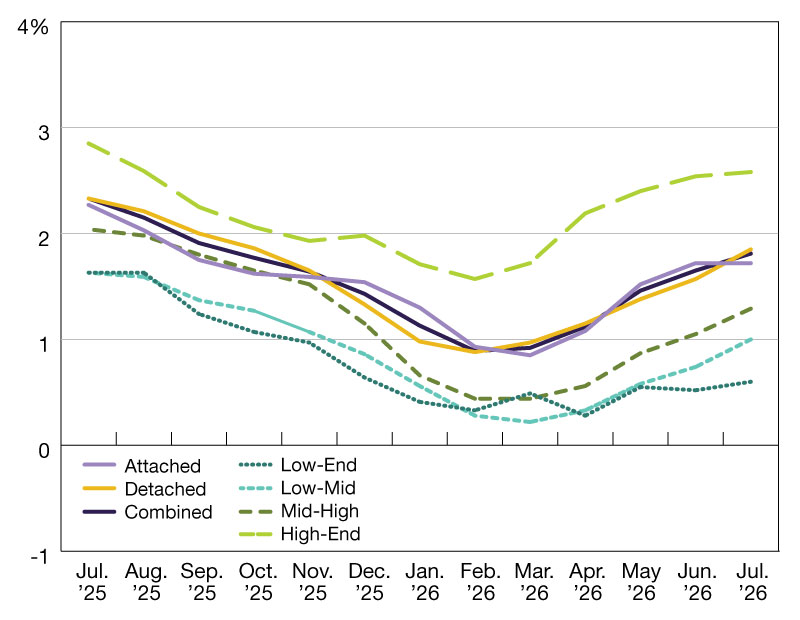
Single-family rent prices in July 2026 increased by 1.8 percent year-over-year, which is lower than last year’s annual increase of 2.3 percent. The July monthly increase of 0.4 percent continued a return to normal seasonal patterns that took hold in early 2026 after nearly a year of below-trend growth, which kept national rent growth under historic averages.
While single-family rent growth continued to strengthen in July, the growth varied considerably across price tiers. High-priced single-family rentals posted a 2.6 percent annual increase, while low-priced rentals rose just 0.6 percent, widening the gap between the two segments.
READ ALSO: 21st Century ROAD to Housing Act Crosses the Finish Line
The recent divergence should be viewed in a longer-term context. Over the past five years, rents for the low-price tier increased 26 percent, slightly more than the 24 percent gain for high-priced rentals. That suggests recent strength at the upper end may be less of a fundamental shift in demand and more of a catch-up period, as cumulative rent growth remains higher in the low-price tier despite the recent slowdown.
Rent growth for detached rentals (1.9 percent) slightly outpaced that of attached rentals (1.7 percent).
The Midwest continues to see the strongest rental growth in the nation, Chicago saw price growth of 5.0 percent, followed by Detroit (3.7 percent), Philadelphia (3.5 percent), New York (3.3 percent) and Miami (1.2 percent). Chicago has topped the list for rent growth since March 2025. Meanwhile, rent price growth remains slowest in the southern U.S. Houston, Texas posted the lowest price growth for the sixth consecutive month at 0.2 percent, followed by Washington, D.C., and Dallas which both saw 0.6 percent growth. In the largest 50 markets, four markets, all in Florida, saw annual decreases in the Cotality SFRI.
—Posted on Sept. 25, 2026
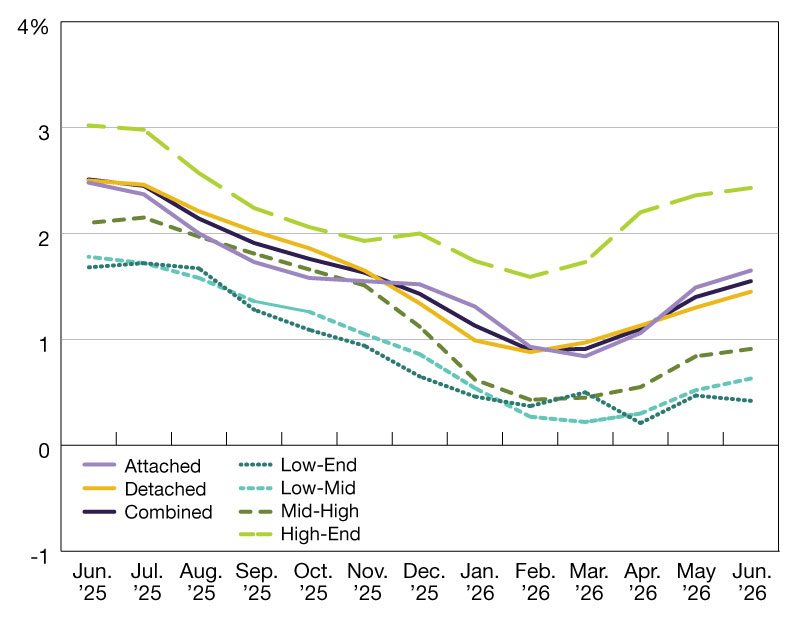
Single-family rent prices in June 2026 increased by 1.5 percent year-over-year, which is a decrease from last year’s annual increase of 2.5 percent. However, monthly rent growth has been increasing at a typical seasonal pattern for most of 2026 after a year of below-trend growth.
National single-family rent growth increased to 1.5 percent in June, marking the fourth consecutive month of stronger annual gains and the highest growth rate since late 2025. While rents are rising a bit faster than they were earlier this year, the market remains much different from the rapid growth environment seen in recent years.
Pricing performance continues to vary across both regions and price tiers, with higher-end rentals posting stronger gains than lower-end properties. At the local level, Midwestern markets continue to lead rent price growth, while some Sun Belt markets remain comparatively soft. Overall, June’s results point to a market that is slowly increasing rather than broadly accelerating.
READ ALSO: Cracking the Homeownership Question
The disparities between high-end and low-end price increases continued in June 2026, high-end prices continued to show strong growth, increasing by 2.4 percent while low-end prices were much weaker, increasing by just 0.4 percent for the second month in a row. However, growth in both tiers decreased was lower than a year earlier. Rent growth for detached rentals increased by 1.4% in June 2026, while it increased 1.6 percent for attached rentals.
Rent growth across the nation continues to be the strongest in the Midwest, where Chicago led price growth at 5.0%, followed by Detroit percent, Philadelphia percent, New York percent, and Atlanta percent. Rent price growth remains slowest in the Southern U.S. Houston, TX posted negative price growth for the fifth consecutive month at -0.2 percent, followed by Dallas, TX which posted 0.2 percent growth. Los Angeles saw the largest slowdown in year-over-year growth for the fourth consecutive month, dropping from 4.7 percent to 0.6 percent.
—Posted on August 18, 2026
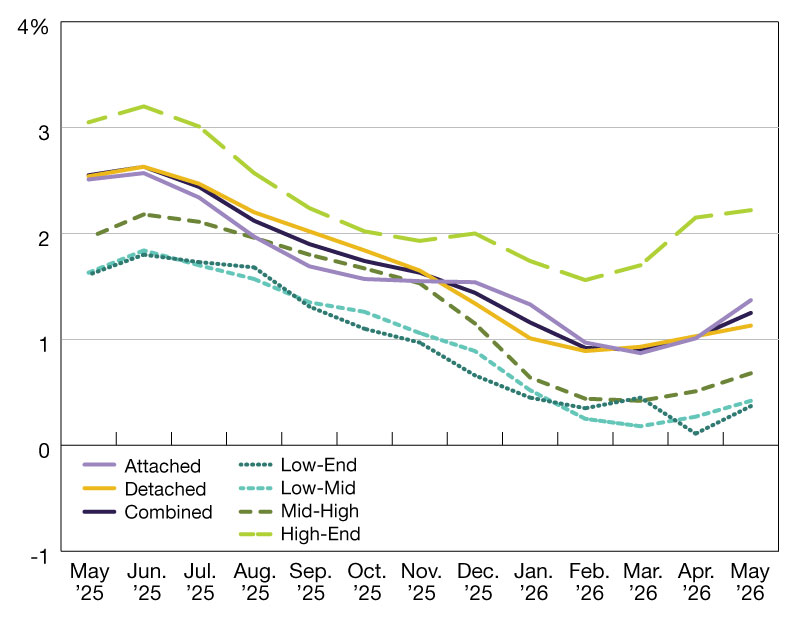
Single-family rent prices in May 2026 increased by 1.3 percent year-over-year, marking a growth decline from May 2025, when rent prices increased by 2.6 percent.
Spring rent growth strengthened in 2026, with rents increasing 2.2 percent between February and May. That compares with gains of 1.9 percent during the same period in 2025 and 1.4 percent in 2024.
The May data tells two different stories. While annual single-family rent growth remained subdued at 1.3 percent, rents increased 2.2 percent between February and May, a stronger-than-typical spring gain that signals improving momentum. When we look beneath the national average, the market is becoming increasingly fragmented.
READ ALSO: 21st Century ROAD to Housing Act Crosses the Finish Line
Florida accounted for more than half of the annual declines among the largest metros, while rent growth in parts of the Midwest and Northeast remained several times the national rate. Though some markets that continue to post annual declines recorded positive spring gains, suggesting local conditions are beginning to shift despite still-soft year-over-year trends.
Rent for high-end properties increased 2.2 percent year over year in May 2026, a drop from the 3.1 percent gain recorded last year. Meanwhile, we continued to see low-end property prices accelerating much more slowly. Low-end rents increased by only 0.4 percent year-over-year, a drop from a 1.6 percent gain in May 2025, and a 1.8 percentage point gap from high-end prices—suggesting continued affordability pressures. Rent growth for detached rentals increased by 1.1 percent in May 2026, while it increased 1.4 percent for attached rentals.
Strongest and weakest rent growth
Rent growth remains strongest in the Midwest and Northeast. Chicago (4.8 percent), Detroit (3.5 percent), Philadelphia (2.9 percent) and New York (2.8 percent) saw the highest year-over-year gains.
Rent price growth remained weakest in parts of Texas and Florida. Among the 10 largest metros, Houston (-0.5 percent) and Dallas (-0.2 percent) posted annual rent declines in May.
Looking across the 50 largest U.S. metros, 13 recorded annual declines, including seven in Florida. Meanwhile, 42 metros saw slower annual rent growth than a year earlier. Los Angeles recorded the largest year-over-year slowdown for the second consecutive month, with rent growth falling from 5.3 percent in May 2025 to 0.0 percent in May 2026.
—Posted on July 27, 2026
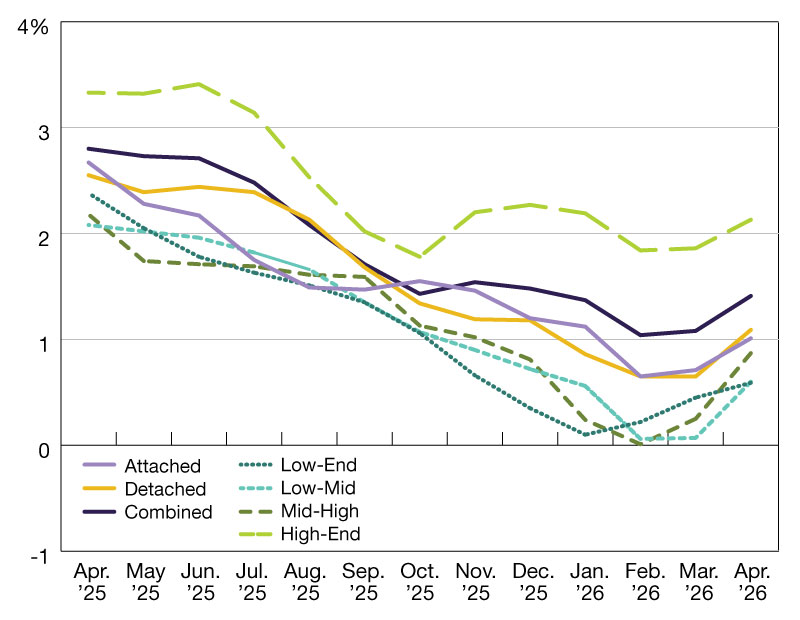
Single-family rent prices in April 2026 increased 1.4 percent year-over-year, a continued deceleration year-over-year when rent prices increased by 2.8 percent in April 2025.
Single-family rent growth has shifted into a slower gear, with annual gains continuing to ease even as monthly increases remain in line with typical seasonal patterns. Since Fall 2025, annual rent growth has held within a narrow range of about 1 percent to 1.5 percent, signaling that the market has settled into a more stable phase after the sharper deceleration seen earlier.
READ ALSO: Harvard Housing Study: The Nation’s Market Stays Subdued
Growth continues to diverge by segment and region, with higher-priced rentals still outperforming lower-priced homes. Regionally, Midwestern and Northeastern markets such as Chicago, Philadelphia and New York are driving stronger gains, with Chicago up 5.5 percent year over year, while some Sun Belt markets, including Miami and Los Angeles, are flat or declining. With annual gains remaining subdued and fewer markets posting declines, rent growth appears to be holding steady at a low level rather than building momentum going forward.
Rent for high-end properties increased 2.1 percent year over year in April 2026, a drop from the 3.3 percent gain recorded last year. However, high-end rental growth remains higher than that of low-end properties, a sign that demand in the demographic remains more resilient. Low-end property prices increased 0.6 percent year over year, a drop from a 2.4 percent gain in April 2025, as affordability pressure may be limiting growth in this tier. Rent growth for detached rentals increased by 1.1 percent in April 2026, while it increased 1.0 percent for attached rentals.
Rent growth by metro
Rent growth continues to be regionally impacted as metros in the Midwest and Northeast, including Chicago (5.5 percent), Philadelphia (3 percent), New York (2.6 percent), and Detroit (1.8 percent) lead year-over-year gains. Meanwhile, metros in the Sun Belt including Los Angeles (-0.5 percent), Miami (-0.4 percent), Houston (0.1 percent), and Dallas (0.6 percent) stabilized or softened after years of outsized growth.
Rent price growth continues to decelerate in many other areas across the country, with 11 of the 50 largest U.S. metros seeing annual decreases—eight of those happening in Florida. A total of 36 metros saw slowdowns in annual rent growth compared with the prior year, with the largest being Los Angeles, which dropped from 5.2 percent in April 2025 to -0.5 percent in April 2026. Washington, D.C., saw the next largest slowdown of 4.4 percent to 0.8 percent year-over-year.
—Posted on June 26, 2026
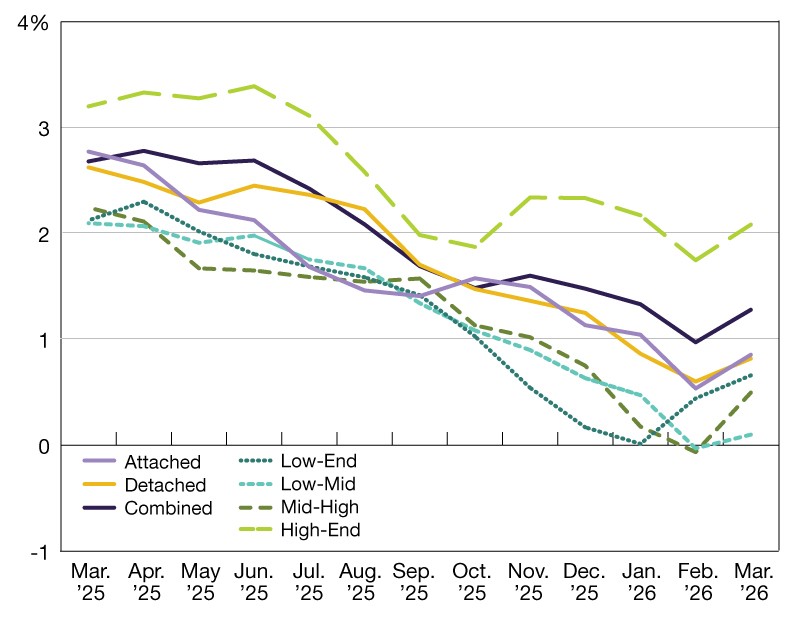
Single-family rent prices in March 2026 increased 1.3 percent year over year. This increase is a drop-off from the 2.7 percent increase we saw between March 2024 and 2025.
Although rent growth remained subdued in March—with growth now at about one-third of its pre-pandemic pace and well below last year’s levels—month-over-month trends indicate some near-term strengthening, as rents rose 1 percent in March, outpacing the typical seasonal increase.
READ ALSO: Built to Last: Lafayette’s Long-Term Bet on SFR
Market conditions beneath the national average remain highly uneven. Rent growth has slowed in 70 percent of large metros, but the number of outright declines decreased in March, suggesting that geographic softening may be stabilizing. As in previous months, declines were concentrated in Florida, which had 10 of the 16 declines. Chicago and Philadelphia continue to see some of the strongest gains, while Los Angeles recorded its second annual decline since the 2025 wildfires, indicating that rents are continuing to normalize after earlier disruptions.
Rent for high-end properties increased 2.1 percent year-over-year in March 2026, a drop from the 3.2 percent gain recorded last year. Low-end property prices increased 0.7 percent year-over-year, a drop from a 2.1 percent gain in March 2025. Rent growth for detached rentals was once again 0.8 percent in March 2026, while it increased 0.9 percent for attached rentals.
Rent growth by metro
From a monthly view, rent growth appears to be picking up. Rents increased at a slightly faster clip than the seasonal average, but there is significant variation between regions. Among the 10 largest metro areas, Chicago remained at the top of the list for the highest rent growth, at 4.9 percent in March 2026.
Philadelphia is once again posting the second-highest rent growth at 4.7 percent, followed by New York (3.2 percent), Detroit (2.9 percent) and Atlanta (0.9 percent). Rent growth in Dallas and Houston was essentially unchanged, with the major Texas metros posting 0.1 percent and 0.02 percent growth, respectively.
Outside of the major metros, there are clear pockets of deceleration. Florida once again topped the list, with 10 metros posting declines. Arizona had two. Los Angeles also saw a 1.2 percent decline in rents, which is a 7.1 percentage point change from the same time last year. However, that decline is an indication of stabilization following price hikes after the 2025 wildfires.
—Posted on May 27, 2026
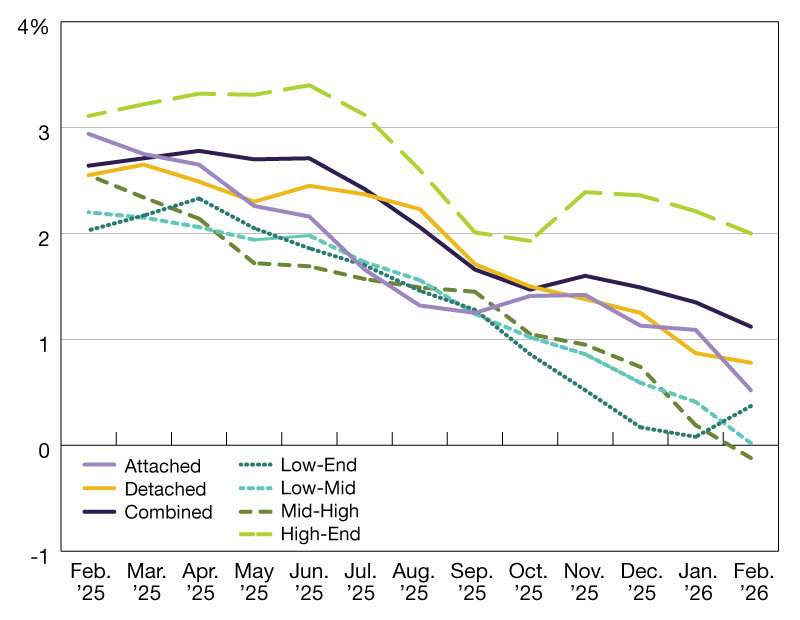
Single-family rent prices in February 2026 increased 1.1 percent year over year. This increase is a pronounced slowdown in pace from the 2.6 percent increase we saw between February 2024 and 2025, and it is one-third of the pre-2020 average of 3.3 percent.
Rent for high-priced properties increased 2 percent year-over-year in February 2026, a drop from the 3.1 percent gain recorded in February 2025. Low-priced rents increased by 0.4 percent in February 2026, a drop from a 2 percent gain in February 2025. Rent growth for detached rentals in February 2026 was 0.8 percent, while attached rentals saw a 0.5 percent increase. The widening affordability gap is putting more pressure on lower-income renters, while higher-income renters are better able to absorb rising costs.
READ ALSO: Forward Purchase Models: The Next Stage in BTR’s Evolution
While it looks like rent increases have slowed significantly more for lower-income renters, when you look back at the last five years, rent growth is similar across all price tiers, highlighting how broadly gains were distributed earlier in the cycle. Higher-end rentals continue to show comparatively more stability, with prices rising 2.0 percent year-over-year despite ongoing deceleration. Geographic differences remain substantial, but deceleration is becoming less widespread, with fewer metros seeing annual declines and slowdowns than last month. Los Angeles posted its first annual decline since the 2025 wildfires, signaling rents are beginning to trend back toward pre‑wildfire levels.
Los Angeles’ price decline was the second lowest in the nation, while Miami, FL, showed the slowest growth at -1.2 percent. Meanwhile, Chicago and Philadelphia, PA saw the highest rent growth at 4.8 percent in February 2026, followed by Detroit, MI (3.7 percent), New York-New Jersey (2.5 percent), and Washington, D.C. (0.6 percent).
—Posted on April 27, 2025
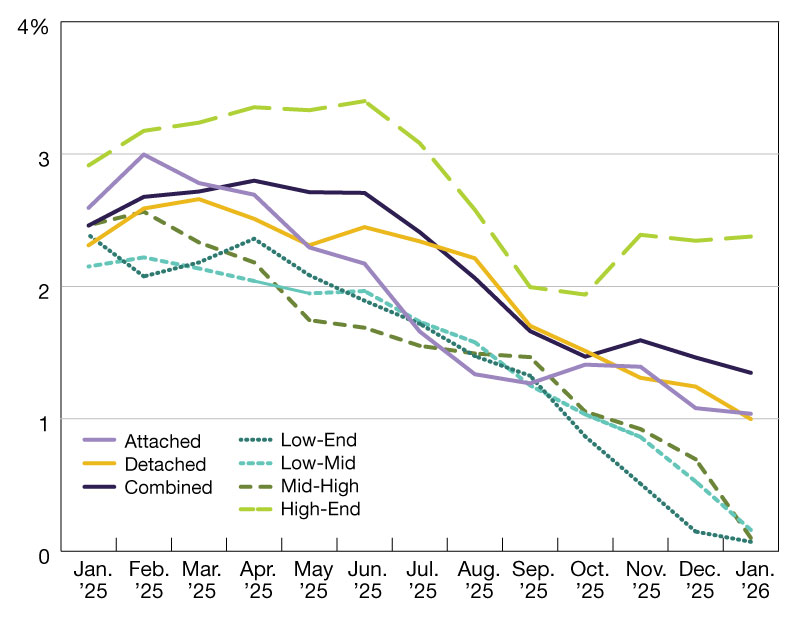
Single-family rent prices in January 2026 increased by 1.3 percent year-over-year. This increase is a drop-off from the 2.5 percent increase we saw between January 2024 and 2025.
Single-family rent growth continued to cool in January, rising just 1.3 percent year over year—half the pace recorded a year earlier and well below the long‑term average of 3.4 percent. Yet even with this moderation, affordability pressures remain elevated. Since 2020, rents have increased 32 percent, adding roughly $600 per month, and are still up 11 percent, about $300, after growth peaked in 2022.
READ ALSO: How SFR Returns Are Dipping Across the US
Regionally, markets such as Chicago and Philadelphia led national gains in January, while several Florida markets, including Miami, posted year‑over‑year declines. But even in Miami, where rent growth has softened or even decreased since 2023, cumulative increases have pushed single-family rents up 51 percent, or roughly $900 per month, since the end of 2019.
Single-family rent trends also varied by price tier. Rent for high-priced properties increased 2.4 percent year over year in January 2026, a drop from the 2.9 percent gain recorded in January 2025. Low-priced rents increased by 0.1 percent in January 2026, a drop from a 2.4 percent gain in January 2025. Over the long run, the increase in both price tiers has been similar. Rent growth for both detached and attached rentals was 1 percent in January 2026.
Single-family rent growth slows
The slowdown in single-family rent growth continued to broaden in January. The share of metropolitan areas with weaker annual rent growth increased from 68 percent in December to 74 percent in January, and the share showing an annual decline in rents rose from 26 percent in December to 38 percent in January.
Even so, Cotality data show regional increases trending the same way in January as in the last several months. Chicago remained at the top of the list for the highest rent growth, at 4.6 percent in January 2026. Philadelphia had the second-highest rent growth at 3.5 percent, followed by New York (3.4 percent), Detroit (3.3 percent), and Washington, D.C. (1.8 percent). Rent growth in Miami dropped the most significantly at -1.3 percent, followed by Dallas (-1.0 percent) and Houston (-0.2 percent).
For ongoing housing trends and data, visit the Cotality Insights blog.
—Posted on March 27, 2025