Residents Are Wary of AI. Here’s How to Get Them on Board.
Experts on a RETTC webinar panel emphasized the need for the technology to produce tangible benefits.
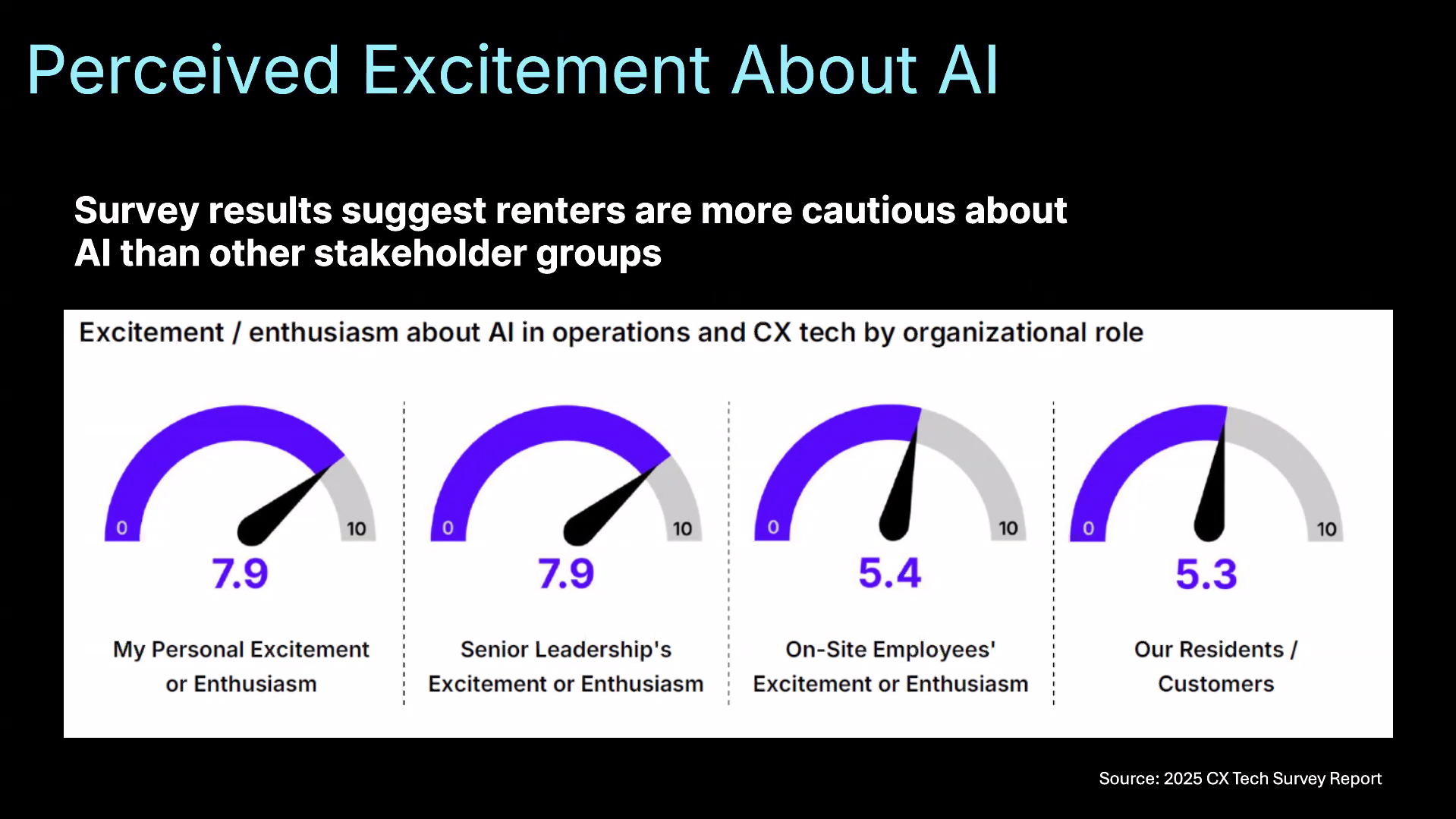
While senior multifamily executives are broadly excited by artificial intelligence’s potential to improve operations, residents and on-site employees remain more cautious or skeptical.
That’s according to the Real Estate Technology & Transformation Center and Newmark RF’s 2025 Customer Experience Technology Survey Report, which was highlighted in a recent RETTC FutureStack webinar on AI and the future of resident experience. The survey asked property owners and managers for their views on how AI is poised to shake up the multifamily renter experience.
The key, according to Continental Properties Chief Customer Experience Officer Garrett Hrncir, is to make sure that an AI tool is improving the experience of the renter—not just using AI for AI’s sake.
READ ALSO: How to Rope In Renters With Amenities
“I don’t think the average resident really cares whether something is AI,” Hrncir said. “They care whether they can get an answer quickly, whether they can complete a task like scheduling a tour quickly.”
If a resident can feel benefits from using a new AI tool—such as increased speed, convenience or control—then they’ll likely be more receptive to the technology.
AI and ‘hearing’ your residents
One of AI’s most underrated applications to multifamily is being able to better understand resident satisfaction, Hrncir said. Continental Properties has begun using AI to analyze customer concerns from a wide variety of sources including internal surveys, public review platforms, CRM and phone call notes, as well as service requests.
“The biggest challenge we have is that those signals often sit in a ton of different places,” Hrncir explained, “and AI is really incredible at giving us a way to connect all those signals and look for the patterns that are really hard for a person to see manually.”
This goes beyond simply summarizing the complaints. AI tools can help connect the dots between different types of feedback and reveal the underlying issues that may need addressing.
How AI has impacted lead quality
Justin Godwin, senior director of marketing at Cushman & Wakefield, said that because more prospects are using AI to inform their apartment search, lead quality has risen.

“We’re seeing that the traffic that is coming into our properties is much higher intent,” Godwin said. “They’re much more educated. They’re much more refined, as in they have narrowed it down to your property matches exactly what they’re looking for.”
While the overall number of leads has decreased, the marketer said this is not a negative outcome, because “what we really care about is traffic that converts into leases.”
However, other contemporary applications of AI in leasing may not be ready for prime time. Godwin gave the example of a property he cold-called that was utilizing an AI phone agent that would take up to 10 seconds to respond to questions. When Godwin was finally transferred to a human, he had to begin the entire conversation all over again.
This kind of experience frustrates prospects and is what may lead them to swear off AI altogether, and Godwin said it demonstrates the balance of making leasing teams’ lives easier while still creating a positive prospect experience.
Concrete savings
To shine a light on some tangible benefits her firm has seen from AI, Christina Steeg, senior vice president of marketing and communications at Waterton, offered some metrics.
Rent collections by month-end, she said, increased by 2.8 percent quarter-over-quarter after introducing AI into the process. From March 2025 to March 2026, collections went from 93 to 97.3 percent.
And on the maintenance side, Waterton processed nearly 10,000 maintenance requests with AI in the first quarter of 2026, a 3 percent increase from the prior quarter. Four thousand of those were after-hours calls, and AI was able to reduce after-hours escalations by 38 percent.
“We’re saving expenses there, and we’re also having our maintenance teams stay at home with their families,” Steeg said. “So that’s been a huge improvement, and we’ve added a lot of value.”