4 Strategies to Make Your Apartment Brand Pop in the AI Age
In a crowded field, here's what works.

When prospective renters conduct an apartment search online, they’re likely to look for “luxury apartments near me” or “apartments in Dallas that allow pets.” And, if you’ve done your job right, they’ll end up on your community website. But what about other apartment stakeholders such as investors, job seekers, lenders or even acquisition targets? They’re not as interested in your communities as they are in the company that owns or manages them. And for them to be able to find you, you need to pay attention to your corporate brand as well—particularly today in the age of artificial intelligence.
Here’s why: Brand visibility is evolving due to the increased use of AI for searching. In the past, someone looking for an apartment—or a potential investor, employee or vendor—would do a Google search and then click on the links that populate. But, today, Google searches don’t just bring up link results. They also include an AI Overview, which is a summary of search results that often includes company recommendations.
That means that no matter how good your SEO is, and how highly you rank, the person searching for you may never end up on your website and may make decisions based solely on the AI Overview. Last year, Pew Research Center conducted an analysis that found that Google searchers who encountered an AI Overview clicked on the traditional search results in only 8 percent of all visits. This underscores the importance of your company being included in the AI Overview with accurate, positive and differentiating information.

Despite this, Ellen Thompson, co-founder & CEO of Respage, a provider of AI multifamily marketing and leasing solutions, said that of her hundreds of clients, none have asked her to optimize their brand online. “It’s a lost opportunity,” she said. “People are very proud of their brand—the colors, the logos, what the website looks like—but that’s not enough. They’re not doing any of the things that are important for artificial intelligence optimization.”
People are very proud of their brand—the colors, the logos, what the website looks like—but that’s not enough. They’re not doing any of the things that are important for AIO.
—Ellen Thompson, Co-Founder & CEO, Respage
Why your corporate brand matters
Hopefully, you’ve optimized your community websites and successfully convert prospective renters who visit them. But there are some who might be checking out your corporate brand instead of your individual communities.
Jonathan Starzyk, director of marketing for Bonaventure, is spearheading initiatives to brand his company to attract investors and new deals. “We work with high-net-worth accredited investors, family offices, institutional investors, RIAs and broker-dealers, so we have a ton of different audiences we’re trying to speak to,” he said. “I have to custom-tailor my messaging to speak to all of those difference audiences, each of which has different motivations.”

To discover a company brand, a user won’t search for “luxury apartments near me.” Instead, an investor might search for “What are the best apartment companies in Austin” or “Which REIT or owner-operator has a strong ESG reputation?” For searches like that, the AI Overview will be based on information contained on your website and social media, as well as Reddit, LinkedIn, Glassdoor and, perhaps most importantly, your Google Business Profile, so it’s essential to keep information on the latter current and accurate and to especially include positive reviews.
Similarly, a prospective employee who wants to know about working for your company may search for the company name on LinkedIn or Glassdoor to see what current and former employees say about it. Be sure to ask employees to post positive reviews about the company not only on those sites, but also on your Google Business Profile, to increase the likelihood of those positive reviews ending up in an AI Overview.
The vast majority of our clients have no idea what their own brand is or what it promises. You need to define a clear brand promise and then execute it across all your properties for clients or investors in different regions.
—Kyle Jones, Search Manager, REACH by RentCafe
How to stand out
If you and your competitors are all using generative AI, how can you make your company and its brand stand out?

Define your brand promise. “The vast majority of our clients have no idea what their own brand is or what it promises,” said Kyle Jones, search manager at REACH by RentCafe. “Is it that your properties are defined by the convenience of the neighborhood or the responsiveness of the maintenance staff? You need to define a clear brand promise and then execute it across all your properties for clients or investors in different regions.” Be consistent, as well. If your website talks about the amazing experience your residents have or how your on-site staff engages well, but your Instagram page hasn’t been updated in three years, that’s a disconnect, Jones commented.
Avoid generic content. How many apartment companies describe themselves as a “vertically integrated real estate investment firm” or say they provide “best-in-class service”? While these terms may accurately reflect your company, the language is too common to differentiate yourself in a very crowded space. Instead, focus on what makes your company unique.
Rather than of saying you provide an exceptional resident experience, brag about your 95 percent retention rate, your glowing online reviews or the awards you’ve won. On your About page, include executive bios that demonstrate your leaders’ experience, awards and speaking engagements. Include a News page to show off earned media coverage.
Earned media is important because it is an unbiased third-party source that bears more weight in GEO. It doesn’t weigh me talking about myself on TylerGMount.com as highly as Forbes talking about me.
—Tyler Mount, Real Estate Branding and Marketing Expert
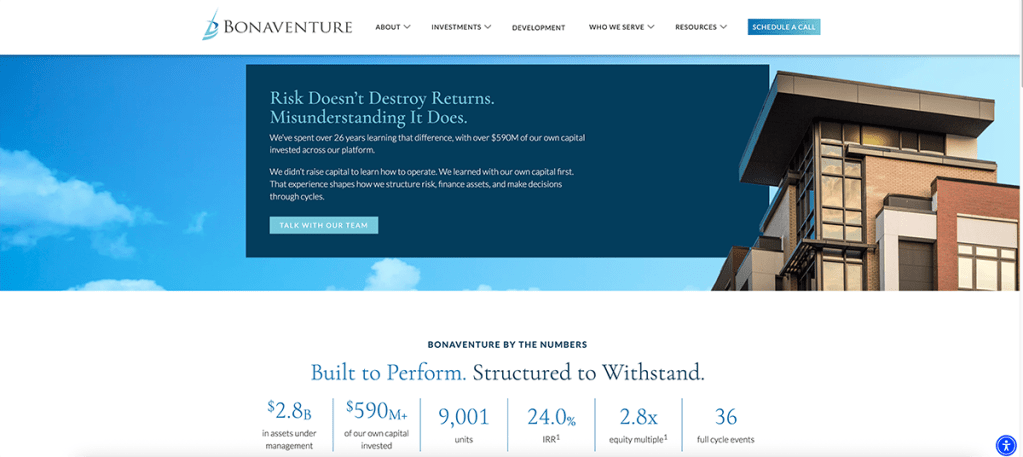
One example: Bonaventure’s home page talks about the company’s 26 years of experience and $590 million of its own capital that the firm has invested. It includes numbers specific to the company—$2.8 billion in assets under management, 9,001 units, a 24 percent IRR and a 2.8x equity multiple—and it touts the 8.4 percent three-year annualized return of the Bonaventure Multifamily Income Trust. Those details differentiate the company from competitors.

Seek out earned media. Earned media is unpaid content found in a newspaper or other publication that’s relied upon by AI platforms because it comes from a trusted data source. “Earned media is important because it is an unbiased third-party source that bears more weight in GEO,” said Tyler Mount, an expert in real estate branding and marketing. “It doesn’t weigh me talking about myself on TylerGMount.com as highly as Forbes talking about me.” (Remember that the next time a reporter calls asking to interview you!)
Update your metrics. If you’re trying to determine whether an apartment community website is working well, you may analyze the number of tours scheduled, applications started or leases signed. But for a corporate site, that data is not helpful. Instead, Dustin Lacey, chief technology officer of Mark-Taylor Cos., suggests looking at how much of the traffic on any given day comes organically—via unpaid search engine results. “If you look at our website’s performance, 50 percent of it is organic, and another 20 percent is direct, meaning that someone has either bookmarked or typed in our domain directly into the search field,” he said. Lacey attributes the strong performance of the Mark-Taylor.com website to the company’s successful use of the four pillars of Google’s developer tool Lighthouse: performance, accessibility, best practices and SEO. Be sure to track your conversions, no matter what you deem them to be. If you’re seeking investors, one metric may be the number of website visitors who submitted a request for information or called the company.