Reimagining Everett: From Industrial Past to Residential Future
The Architectural Team's Tom Schultz on how this multifamily project embodies the city’s shift toward walkable, mixed-use living.

Just 5 miles north of downtown Boston, Everett, Mass., is redefining itself. Once known for its industrial roots, the city is rapidly transforming into a sought-after residential destination. Among the first projects to shape this new identity is A.W. Perry’s mixed-use development along the Second Street corridor, part of a wave of investment transforming the area.
Set to break ground next year, the developer plans to turn a former industrial parcel into a 273-unit community, helping to expand Greater Boston’s housing supply. The Architectural Team, known for its expertise in conversions and adaptive-reuse projects, is leading the design for the 400,000-square-foot development at 373-383 Second St.
“What was once a brick quarry and, most recently, a small-scale industrial site and parking lot, will now contribute directly to Everett’s growth with exactly the kind of mixed-income, transit-oriented housing that is needed across the country,” said TAT Principal Tom Schultz. Here’s what else he shared with Multi-Housing News about the project and Everett’s broader transformation.
READ ALSO: John Cetra on One of NYC’s Largest Residential Conversions
Tell us a bit about Everett’s efforts to shed its industrial image and become a more residential-friendly area of Greater Boston.
Schultz: Everett is a city just outside Boston, with large tracts of land associated with formerly industrial uses. Thanks to forward-looking elected officials and creative public-private partnerships, it has, in fact, become one of the region’s biggest success stories from a housing production standpoint. Local leaders have embraced opportunity zones, facilitated community and data-driven housing production plans, and created special zoning districts—all of which incentivize brownfield redevelopment, encourage mixed-income housing and support public realm improvements, transit connections and related initiatives that foster the growth of real neighborhoods.
The upshot of this approach is that Everett has permitted more than 1,500 new homes in the last five years alone. Over the past decade, TAT has designed more than 4,400 apartments in Everett, including those now underway or units that will soon be in construction.
This latest project with developer A.W. Perry is a perfect example of what success looks like today. We’re set to break ground in early 2026 on the 273-unit mixed-use hub within the city’s Commercial Triangle District, a special zone established to encourage high-quality, high-density housing and commercial opportunities.
In what ways will this project blend into the broader suburban Boston landscape?
Schultz: I think the key aspect of this project is that it takes a deep urban approach to redeveloping an industrial zone. This approach is not just about the building itself, but also about how it relates to its existing and anticipated future surroundings and, in that vein, how the project contributes holistically to the city’s broader vision of transformation.
It was very important to us that we could find ways to leverage the ground plane, for instance, to help support Everett’s goal of building the Commercial Triangle District into a vibrant mixed-use neighborhood—so we worked closely with A.W. Perry and the City to incorporate a large easement for a new bike path and bus route, along with public open space. From our perspective as architects and urbanists, a development that feels closely integrated into its community will always be the most successful.

Rendering courtesy of The Architectural Team
How many units will serve as workforce housing? What kind of shared amenities will the development feature?
Schultz: The exact breakdown is still being worked out, but we anticipate a minimum of 5 percent of the units will serve as workforce housing with rents capped at about 80 percent of AMI. In terms of amenities, our interior design team always works very closely with the client to help shape our buildings’ programmatic focus and design approach in a way that reflects and supports how people live today. In this case, the development will offer a range of different resident lounge areas, a dining room, work pods, fitness center with yoga studio, a dog spa and an array of outdoor venues including a pool, more contemplative landscapes areas and publicly accessible green space.
What role does sustainability play in such redevelopment projects? Are there any opportunities for innovation there?
Schultz: We are longstanding advocates of urban infill projects like this one. Strategically adding density and new multifamily housing in areas that are well-served by public transit is a deeply impactful tool for enhancing sustainability and reducing carbon emissions on a regional scale. Even a few years ago, someone commuting to Boston might only find accessible housing options well outside the public transit network and would be resigned to driving into work every day—not to mention using their car for errands, social outings and the like.
Now, with municipalities such as Everett dramatically increasing their housing production, that same person can live in a building like 373-383 Second St. and take advantage of a walkable community with access to bus lines, rail transit and a growing network of bike lanes. The positive feedback loop of sustainable urban development patterns is very strong, and we see opportunity for substantial innovation in the future, including through Passive House construction methods, building electrification and other approaches that increase energy efficiency, as well as new approaches to materials that boost sustainability, such as mass timber, high-recycled-content steel and low-carbon concrete.
Everett is undergoing a major transformation, but its industrial past remains an important part of its character. How does the new project acknowledge or incorporate those roots?
Schultz: Everett’s Commercial Triangle District is rapidly evolving into a true mixed-use neighborhood. This is one of several significant developments underway right now within a 10-minute walking radius, and by the time our building opens a few years from now there will be a critical mass of new uses here.
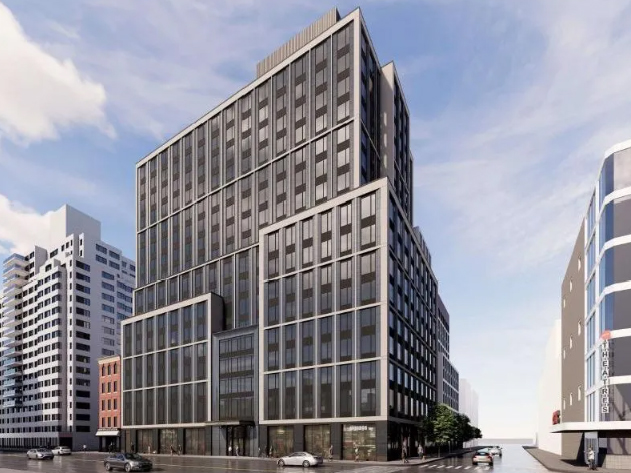
That said, our team pays close attention to the urban design component of every project. In this case, we saw opportunities to enhance the public realm and proactively catalyze a sense of this area as more than simply a former industrial zone with new apartments. For example, we’ve designed a number of public plazas with extensive street tree plantings and other landscape elements, and the building itself offers a permeable street presence with a predominantly glass approach to the residential lobby and retail storefronts. Taken together, we think these moves will help create a rich and inviting pedestrian experience that future developments can take as a model.
And yet, we do also want to respect the industrial heritage of Everett and this district in particular. The building’s scale and architectural vocabulary reflects that goal, with industrial-inspired metal frame elements and a gridded facade using different masonry types and patterns that recall the area’s older industrial structures. Alternating receding and extending façade patterns on the building’s upper stories will offer visual variety and create a sense of place with a strong urban identity that still feels contextually appropriate.
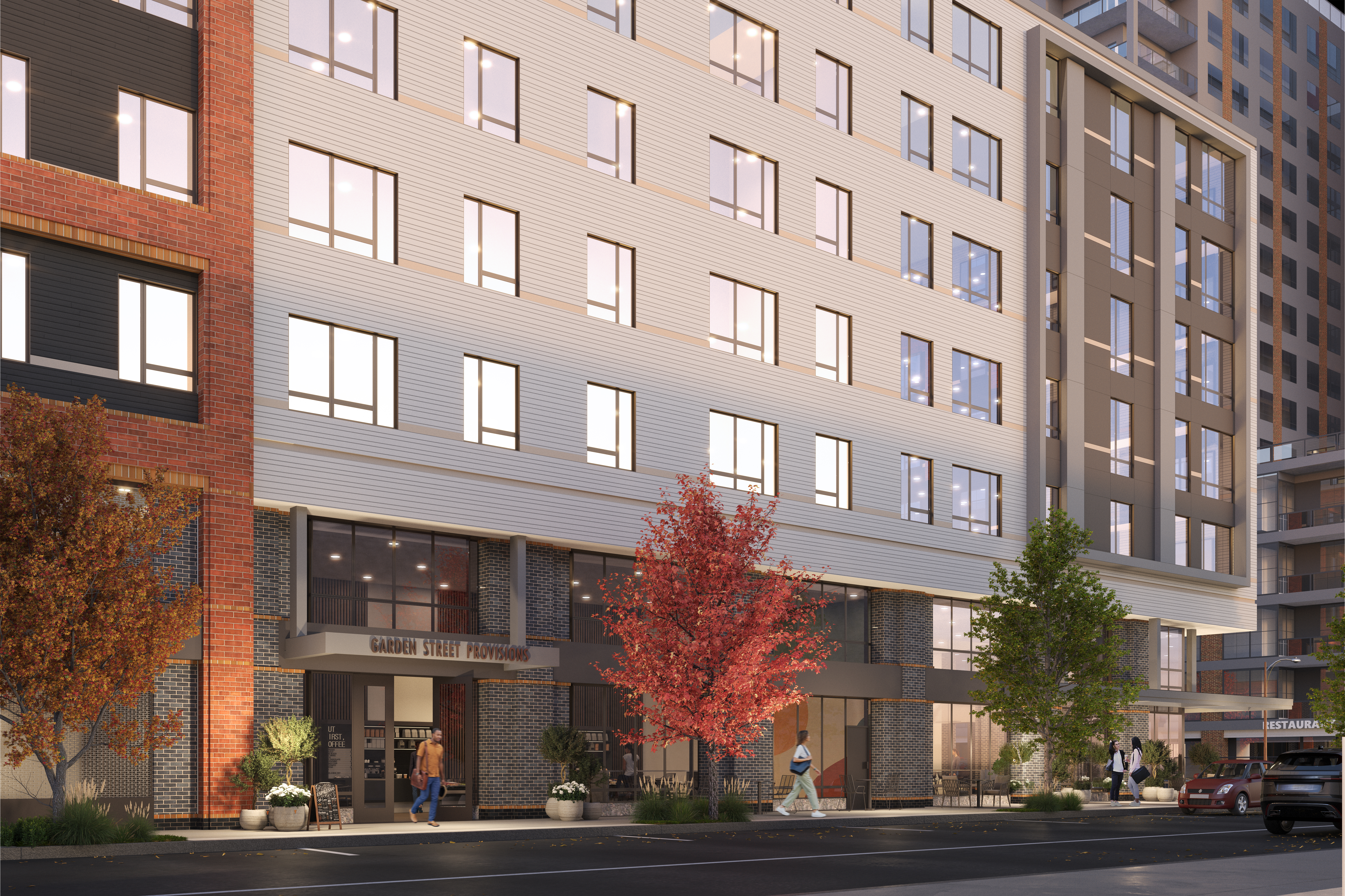
Rendering courtesy of The Architectural Team
Across Greater Boston suburbs, many former industrial areas are starting to mix in housing. Is this part of a larger shift toward a new kind of urban identity for these communities?
Schultz: Absolutely, and this is a very important point. Across Greater Boston and throughout all of Massachusetts, there is widespread recognition that housing production is necessary and that new multifamily developments can in fact benefit communities or districts that have typically not seen much new residential construction, or that have been known for other uses.
A good proof point underlining this shift is the Healey-Driscoll Administration’s 2025 Housing Choice Community designation report, which was released this July and recognizes communities across Massachusetts that are adopting policies to support increased housing production and help lower costs, in turn unlocking state funding opportunities. This year, 43 municipalities were recognized in the report, including a number of suburban, exurban and rural towns that have met specific housing production benchmarks for the first time, and former industrial hubs such as Everett and Lowell that continue to integrate new housing.
The fact that such a broad array of communities across the state—from Everett to Nantucket—are focusing so intently on housing shows that while there is still a lot of work to be done, addressing the housing shortage is at the forefront of the public consciousness.
In what ways do you expect this trend to evolve?
Schultz: We have architects who are licensed in 28 states and across all of these markets we are seeing a serious commitment to housing development. Real estate leaders, elected officials and community stakeholders recognize that the need for housing demands action and creativity, and the result is a lot of momentum for new projects.
Worcester, Mass., is a good example of how this trend is playing out in markets with underutilized buildings and sites. Over the past two-plus decades, TAT has completed more than a dozen projects in this formerly industrial city. For a long time, most of our work in Worcester involved adaptive reuse and converting older industrial or institutional buildings for residential use. Now, we’re starting to design a greater number of new construction apartment communities in Worcester as well—like our recent 173-unit project called The Cove, which opened this year.
We expect this trend to gain momentum, with both adaptive reuse and new construction helping to fill a need in markets where one or the other has been more prevalent.
Another accelerating trend is that defunct strip malls and shopping malls are being studied as sites for housing redevelopment. Real estate leaders and local stakeholders are talking about these projects in a lot of the markets where we’re working. In some cases, large-scale planning efforts are underway to revitalize entire commercial districts that are based around defunct malls.
We’re also seeing a lot more housing activity on underutilized sites in communities that haven’t experienced much multifamily development before. For instance, our team has recently completed a few projects on former commercial sites in suburban and exurban New Jersey that bring hundreds of new apartments to areas where housing production has stagnated for decades. I think this is an important trend that will continue to gain momentum, in which a broader range of communities step up to do their part in addressing the housing shortage.