OPTECH Special Report: Intelligent Automation
There's been a significant shift in how multifamily owners and operators think about AI usage. What fueled the change?
The artificial intelligence-fueled transformation of proptech and nearly every aspect of multifamily operations is in full swing, but the industry’s embrace of the technology has been rooted more in discipline and restraint than a desire for raw efficiency, as of late.
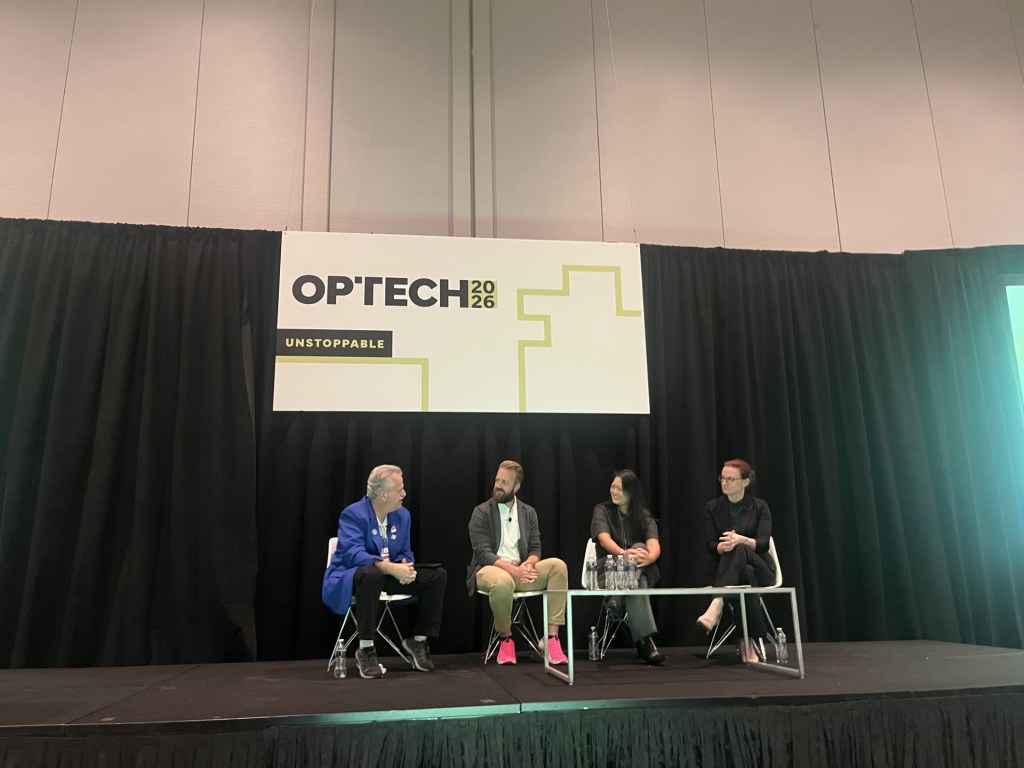
Speakers on the first day of OPTECH 2026, hosted in Las Vegas by the Real Estate Technology and Transformation Center, drove this point home when discussing their own firms’ uses of AI, and where they draw the line with respect to company security, authenticity and transparency with renters and employees alike.
Owner-operators, property managers and vendors recognize the reality that even though many workflows are becoming increasingly automated, their end users and business goals will always be human.
Discipline and data
Of all the places where you might expect to see a highly restrained, human-centric approach to AI, data governance and analytics turns out to be the place where stakeholders take this approach the most seriously.
“Everything that we have right now is being created by humans for humans,” said Xiyao Yang, Senior Vice President of Digital Marketing at Bozzuto, during a panel discussion titled It’s All About the Data. “An invoice is not going to be for a machine, and a lease itself is a whole document for people to read,” Yang added, likening her company’s approach to a more of a “harnessing” of the technology than a form of outsourcing. “Start small, identify one business case, align with your executives and work from there,” she advised.
It may seem a little paradoxical at first, especially considering what some companies’ stated end goals are. “(Our) ultimate goal is to create an ecosystem for our data so that we can pass it back and forth between systems with minimal human intervention,” said Anne Hollander, Vice President of AI & Innovation at the same discussion.
READ ALSO: AI Answered the Lead. Now Who’s Going to Lease the Apartment?
But in practice, WinnCompanies’ enterprise AI strategy doesn’t rely on people manually uploading individual documents into an AI agent. “Every single one of our technical projects is tied to specific business outcomes and clear value. Eliminating manual data inputs is one of those values.”
Discipline also takes the form of self-awareness, and knowing when it’s appropriate to build a piece of technology from the ground up, buy it from a vendor or to partner with a developer on a specific use case. “When you build, you host and maintain, when you buy, it’s part of whatever model you go through and when you partner, it’s like signing a prenup, where you have to know about the data and where it lives,” Yang said.
Being bold, yet sensible
When outlining use cases for their generative and agentic systems, panelists pointed to the idea of semantic modeling being at the forefront of their decision-making. It’s the divide between the data and its business purpose, and these often vary significantly by company. Examples talked about by Yang, Hollander and others include occupancy rates, total units and missed calls from leads.
One example cited by Donald Davidoff, CEO of Real Estate Business Analytics is whether to count a move-out day as being unoccupied and giving this interpretation to an agent or GPT embedded in property management software. “Even for something as simple as this, it’s surprisingly difficult to be flexible,” Davidoff noted.
Giving the AI the how and the why behind the data is of utmost importance when it comes to not only using the technology optimally, but also safely, according to Tyler Christiansen, CEO of software company Funnel. “As AI gets more powerful and takes on more tasks, it becomes even more important to be clear about what your data means and how you want it used,” he emphasized.
And the speed at which the technology is advancing is a double-edged sword; even though AI tools enable great efficiency and nuanced communication, security and privacy have complicated things on the data front. “AI is going to make it easier for bad actors to commit fraud at scale, but using (it) doesn’t shift the responsibility; you still need to verify who you’re dealing with and protect the data people trust you with,” Christiansen said.
The new rules of marketing

Another unexpected, yet unsurprising revelation in approaches to automation came from the marketing side. In one RETTC Committee meeting centered around AI-generated and altered property images, panelists highlighted how to both adapt to changing perceptions on part of lawmakers and residents alike.
Some states, like California, require owners, leasing agents and property managers to disclose when an image has been altered with AI, and this often leads to immense scrutiny over the amount of risk some companies are willing to take on.
No matter the use case, the panelists advised knowing exactly what a given state’s present and future laws on AI-altered images are, alongside being as transparent with current and prospective renters as possible. “I would review all of your operating procedures and supplier contracts and strive for a standard practice that any new content you create automatically comes back with the originals,” advised Greg Benson, Managing Director of Marketing at Greystar. “Surveys indicate that people have positive sentiment towards AI-created or -altered images when they are relevant to them but expect transparency and disclosure as identifying modified content can be difficult.” Honesty about what they are looking at goes a long way, according to Benson. “We should aim for a uniform standard.”