National Student Housing Report – August 2026
Preleasing approached 90 percent, while annual rent growth accelerated, according to Yardi Matrix.

Surveyed preleasing across Yardi 200 universities reached an estimated 89.1 percent in July for the 2026-2027 academic year, 100 basis points above the revised July 2025 level, according to the latest Yardi Matrix student housing report.
The July reading marked an improvement from earlier in the leasing season, when the sector began to trail prior-year performance. Most Yardi 200 markets were keeping pace with or exceeding last year’s results, although performance continued to vary considerably.
A total of 117 markets were at or above their July 2025 preleasing levels. Of these, 35 were more than 10 percentage points ahead, while 20 were estimated to be at least 99 percent preleased. Conversely, 25 markets were at least 10 percentage points behind last year and 35 remained below 80 percent preleased.
The Midwest led the country at 90.9 percent preleased, up 230 basis points year-over-year. The Southeast reached 88.9 percent, 100 basis points ahead of last year, while the Northeast remained flat at 89.1 percent. The West was the only region behind its prior-year pace, declining 40 basis points to 87 percent.
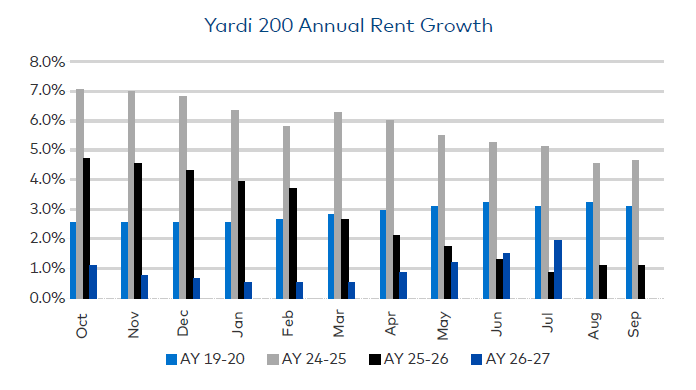
Advertised rents across the Yardi 200 averaged $930 per bed in July, remaining unchanged for a sixth consecutive month. Annual rent growth accelerated for the fourth straight month to 2 percent, largely reflecting rent declines recorded between March and August 2025 rather than renewed monthly gains.
Since October 2025, annual rent growth has averaged 1 percent, compared with 2.7 percent during the 2024-2025 leasing season and 5.9 percent in 2023-2024.
Regional results highlight uneven performance
Several university markets posted strong leasing results. As of July, Western Carolina was 99.8 percent preleased, Central Michigan reached 99.4 percent, the University of Maryland registered 97.9 percent and Boise State stood at 96.3 percent. In terms of year-over-year growth, Kent State (17.6 percent) and North Carolina Wilmington (16.9 percent) took the lead nationally.
Other large markets continued to lag. North Carolina State was 78.5 percent preleased—15.9 percentage points behind last year. Purdue reached 81.4 percent, down 10.3 percent, while Arizona State was 81.9 percent preleased, 8.1 points behind. Delaware registered 71.1 percent, down 16.3 points.
New supply is increasingly concentrated in larger student housing markets, placing pressure on schools with the most dedicated off-campus beds and weighing more heavily on national performance. Several underperforming markets also have sizable construction pipelines, including Arizona State, Purdue and North Carolina State.
Fall 2026 enrollment data were not yet available, but there are indications of declines in international student enrollment. Some challenged markets serve universities with large international populations, including Arizona, Arizona State, Michigan and Purdue.
The Northeast and Midwest led regional rent growth. Northeast rents increased 3 percent year-over-year to $1,039 per bed, while Midwest rents rose 2.5 percent to $873. Southeast rents increased 1.6 percent to $882, while the West remained the most expensive region at $1,094 per bed, up 1.4 percent.
Despite several years of deceleration, advertised rents remain at a record high, increasing 8.1 percent over the past three years and 21.9 percent over the past five years.