Refinancing Challenges Continue Despite Ample Liquidity
Starting early will give borrowers a slight edge over uncertainties.

As the year reaches a close, we we should lean into hindsight and foresight in equal measure. The past year started off optimistic, with global events shifting most of us to a more pessimistic outlook by the end of first quarter. Rates became volatile again. Inflation persistent. Markets disrupted. Across it all, one thing held true that will continue forward. Multifamily maintained its status as the leading and most active CRE asset class, embraced by both investors and lenders.
Looking ahead, optimists will be encouraged that we remain in an active, accessible and highly liquid debt climate. In that climate, multifamily also enjoys the widest range of lenders and debt options of any asset class. Pessimists will remind us that the apartment markets continue to face some real challenges, beginning with rate disparities at maturity, rising operational costs, and, for some markets, softening of demand (many major urban CBDs) or new construction absorption (sunbelt markets) pressuring rents.
Regardless of your status as an optimist, pessimist or hybrid (like most), we should expect some consistency in conditions from late 2026 carrying over into 2027. A form of stability in what remains an uncertain marketplace. That being said, here are some thoughts on general market conditions to start conversations as we look to the year ahead.
Sustained rate volatility
The headwinds for rate setting benchmarks that applied upward pressures in 2026 remain moving into 2027. These forces include expectations for a renewed Federal Reserve tightening cycle to offset persistent inflation, a growing national debt requiring increased government borrowing, a revised and still highly partisan political landscape, trade policy uncertainties, and the strains of geopolitical conflicts and subsequent energy market disruption.
Moderating these pressures across all categories is highly unlikely. While any relief will be welcomed, expectations should hold for Treasury yields staying heightened for fixed-rate programs in the year to come with the chances for spreads to widen if market volatility increases or deteriorating fundamentals emerge and a rising SOFR for floating-rate loans parallel to any of the future Fed Funds rate increases set to curtail inflation.
Refinancing challenges will persist

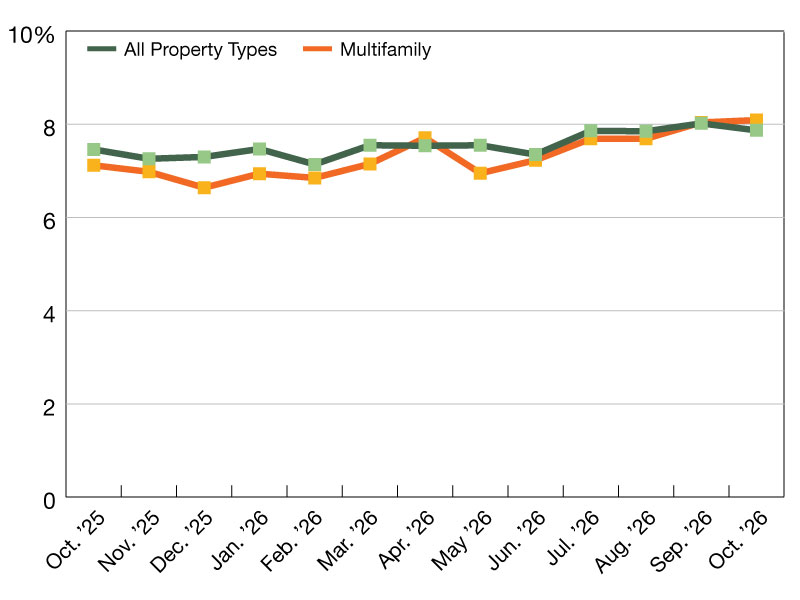
Sustained rate volatility and the current “higher for longer” reality that started in 2022 will continue to be a challenge for refinancing multifamily properties financed in 2021 or earlier, with Yardi Matrix pointing to approximately $116 billion of anticipated multifamily maturities in its database scheduled for 2027. Of that total, reporting from CRED iQ expects 57 percent of maturing apartment debt from deals done in 2021 and early 2022 will require a cash infusion to rightsize debt service. Solving for debt service deficiencies will be the defining challenge and goal of 2027 for all loans.
Different lenders are approaching this climate with creative solutions, including stretch senior loans, bridge-to-bridge structures, interest-only underwriting from CMBS and preferred equity or participation loan structures. Many are also becoming flexible during underwriting for their best and most qualified borrowers. Start the process early for known maturities. Timing remains of the essence and waiting on a hopeful rate shift to start the process later can limit time to underwrite an already existing solution.
Substantial liquidity available
The bright spot heading into the headwinds of 2027 continues to be accessibility to active debt markets with abundant liquidity to deploy. This is generating a competitive mindset amongst lenders for higher quality loans. We are not capital constrained, and it is keeping spreads compressed on permanent debt. Most lenders are having challenges reaching their current allocation targets, but the pursuit of yield in a higher rate climate and sustained refinance demand has most anticipating maintaining or even increasing their targets in the year ahead.
Agencies aggressive with expanded caps
Agencies are working from their expanded caps and have been challenged to meet their deployment goals. Volume caps of $88 billion for each GSE will be unchanged in 2027 with loans exempted on workforce housing properties. While they can lend up to 80 percent LTV in theory, debt service is the main obstacle for underwriting to maximum proceeds. Timing is also of the essence here for new agency borrowers as the timeline for initial approval has extended the underwriting process.
Since these loans require a heavier lift for approval and don’t immediately lock rate at application, continued volatility will challenge final proceeds for some borrowers as the process unfolds. Still, for permanent debt, the agencies will remain a primary consideration for borrowers financing stabilized assets with an emphasis on mission-driven affordable housing. Despite the changing domestic political landscape in the last few months, there is an opportunity for commonality to address affordable housing in a meaningful way through the agencies and other government programs.
Insurance lenders continue to shine
Insurance lenders will continue to be the most competitive source for lower leverage permanent financing on stabilized assets. Long-term permanent debt allocations meet their appetite for far-horizon returns in a meaningful way and risk is mitigated by their lower leverage requirements. The ability for an insurance lender to lock rate at application, sometimes with forwards months in advance, with a streamlined underwriting process provide borrowers with both confidence and stability for certainty of execution.
The competitive nature of today’s market has encouraged them to offer the lowest spreads on low leverage loans to experienced sponsors. They are competing with prepayment options in longer dated loans, interest-only terms when underwritten to amortized debt service and borrower satisfaction from their reputation for attentive servicing with balance sheet flexibility.
CMBS remains a viable non-recourse option
The ability for CMBS to underwrite to interest-only debt service will be appealing to some borrowers who need to reach as far into the capital stack as possible to retire existing maturities from a previous rate cycle. This is often seen as the option of last resort for permanent debt when all the other non-recourse options are exhausted.
These loans can be creative to underwrite and rigid in servicing. Rate volatility has the greatest impact on final proceeds as these loans will not set rate until closing and pricing of the B-piece can upend a transaction well into underwriting if a market cannot be made at offered terms. Spreads have been primarily consistent, but if rate volatility increases and concern over larger Wall Street disruptions mount, we may see spreads widen as a result.
Banks are back and competing aggressively
Banks are more active and remain a competitive source for five-year and bridge lending. They are also sometimes the only source for older properties and properties outside a primary or secondary trade area. They often target a floating-rate structure and remain essentially a recourse driven lender. While most have shored up balance sheets and moved past their liquidity crunch from 2025, they will continue to face regulatory and balance-sheet constraints, limiting their ability to lend without significant depository relationships in place.
Bridge an option for assets still in transition
Bridge lending has grown in popularity as a solution for loans unable to meet performance targets and debt service thresholds as permanent lenders continue to pursue yield in a competitive marketplace. Insurance lenders have joined the bridge lender set in a meaningful way, competing with active banks and debt funds. Banks may offer the best-priced options for bridge loans, but debt funds have proven to be the most flexible in customizing terms to circumstances. Insurance lenders continue to be conservative in the bridge space but offer tight spreads and fixed rates that will be attractive as an added consideration. For assets still in transition or nearing performance improvement, access to bridge debt in a bridge-to-bridge format should help ease a wave of potential distress.
Timing will continue to be of the essence
Ultimately, in a volatile cycle where assets are already challenged by refinancing into a higher rate climate, early movement on known maturities should be a paramount consideration in 2027. The ability to determine the best option well in advance of a maturity allows ample time to correct inconsistencies, improve performance and identify all available options in a broad marketplace to ensure an optimized rate.
Michael Heagerty is a principal & CFO for Gantry.
Please note: To become a Viewpoint writer, reach out to Therese Fitzgerald at therese.fitzgerald@cpe-mhn.com. All Viewpoints are copyright of Multi-Housing News 2026. We do not accept AI-written content.