National Multifamily Report – September 2026
Third-quarter advertised rents turned positive for the first time since 2022, even as September posted a slight pullback.
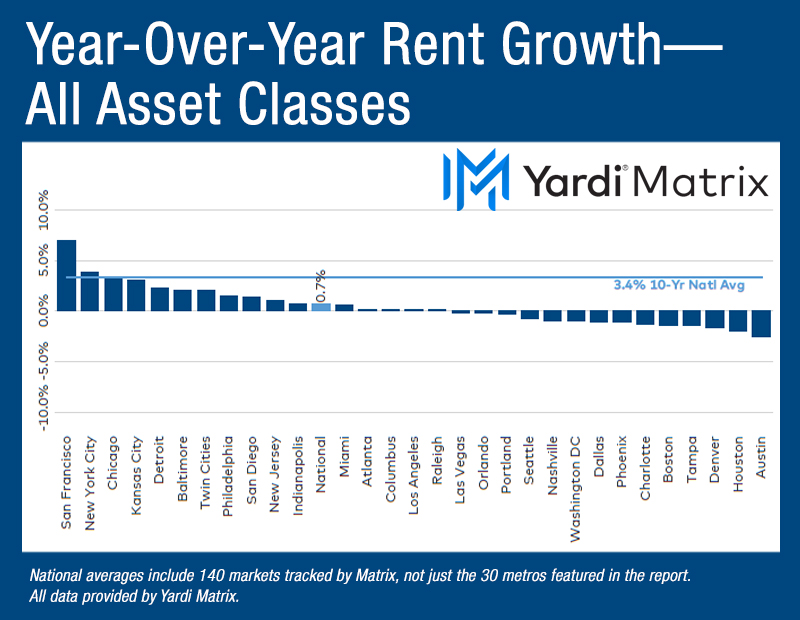
U.S. advertised asking rents slipped $1 in September to $1,775, while year-over-year growth improved 20 basis points to 0.7 percent, according to Yardi Matrix’s latest survey of 140 markets. The broader quarter was more encouraging: rents increased 0.3 percent, the first positive third-quarter result since 2022. Advertised rents are up 1.4 percent year-to-date through September, an indication that fundamentals may be stabilizing after years of supply-driven weakness. Single-family build-to-rent (BTR) rates fell $4 to $2,245, but annual growth improved to 0.8 percent.
Gateway and Midwest markets led annual rent growth, with San Francisco followed by New York City at 3.8 percent, Chicago at 3.2 percent, Kansas City at 3.1 percent and Detroit at 2.3 percent. Austin, Houston (-2.0 percent), Denver (-1.6 percent) and Tampa (-1.4 percent) remained among the weakest. Renewal rent growth also slowed to 1.7 percent nationally, its lowest level since before the pandemic and well below the 8.7 percent peak in early 2023. San Francisco renewals remained strong at 8.2 percent, while Austin and Phoenix were negative at -4.3 percent and -2.4 percent, respectively. Stabilized occupancy averaged 94.3 percent in August, down 30 basis points year-over-year, while the newly added total occupancy measure stood at 93.9 percent, up 10 basis points.
Third-quarter gain masks September pullback
Short-term performance reversed in September, with advertised rents down 0.1 percent and 18 of Matrix’s top 30 markets posting declines. Denver fell 0.8 percent, Boston and New York City declined 0.7 percent each, and Charlotte dropped 0.6 percent. San Francisco led monthly gains at 0.9 percent, followed by Baltimore at 0.8 percent and Indianapolis at 0.6 percent. Atlanta, Columbus, Dallas and Houston all finished above the national monthly result despite comparatively weak annual readings.
The occupancy methodology change adds another lens on supply absorption. Matrix now reports total occupancy, including lease-up properties, alongside stabilized occupancy. The national gap between the two narrowed to 0.4 percentage points from a peak of 0.9 percentage points in the second quarter of 2025. Total occupancy has climbed 50 basis points since January to 93.9 percent, including gains of 1.5 percentage points in Austin and 1.4 percentage points in Denver and Nashville.
BTR occupancy was 94.9 percent in August, down 20 basis points year-over-year. Miami led annual BTR rent growth at 6.2 percent, followed by Cleveland at 4.3 percent and Kansas City at 3.7 percent. San Antonio (-5.6 percent), Greenville and Houston (both -2.6 percent), Pensacola (-2.4 percent) and Phoenix (-1.8 percent) were the weakest. BTR growth of 0.8 percent narrowly outpaced multifamily’s 0.7 percent.