National Multifamily Report – July 2026
Could the recent sustained performance of advertised multifamily rents signal a turning point?
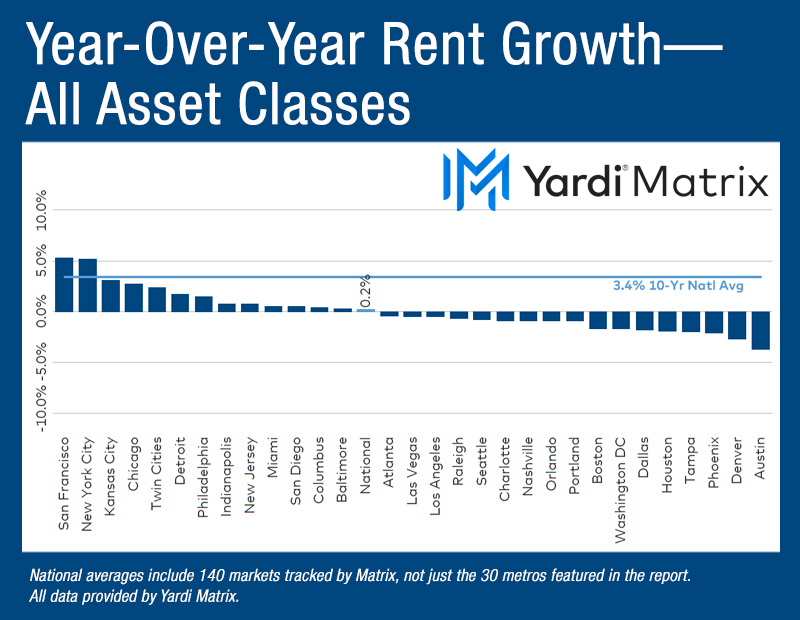
U.S. advertised asking rents ticked up $4 in July to $1,771, marking the best performance for the month since 2015 outside of early post-pandemic outliers, according to Yardi Matrix’s latest survey of 140 markets. The annual showing continued to exhibit a subdued 0.2 percent rate of growth. However, year-to-date growth was 1.3 percent, which marked a modest improvement compared to 2025. Single-family build-to-rent rates reached a new all-time high at $2,240 in July, marking a 0.3 percent year-over-year growth.
On an annual basis, Midwest and Gateway markets continued leading rent growth with San Francisco (5.3 percent) at the forefront, edging out New York City (5.2 percent), Kansas City, Mo. (3.1 percent) and Chicago (2.7 percent). High-supply metros logged negative rental movement, such as Austin, Texas, (-3.7 percent), Denver (-2.7 percent) and Phoenix (-2.1 percent). Occupancy levels dropped 60 basis points year-over-year to 94.1 percent in June. Of all major markets, San Francisco was the sole to record an increase.
Market-level performance mends across the Sun Belt
Monthly performance mirrored annual growth, having a 0.2 percent increase in July, with 80 percent of the Yardi Matrix top 30 metros registering short-term growth. Many Sun Belt metros posted upswings, suggesting that competitive pressures may soften as new completions ease.
The ROAD to Housing Act became law, easing new development through the elimination of certain environmental red tape and the reduction of specific building requirements that may soften construction costs. The bill empowers regional housing agencies to incentivize new construction through grants that aim to convert vacant and abandoned buildings into attainable housing. Additionally, Opportunity Zones were also addressed by permanently enshrining the tax incentive program.
Advertised single-family build-to-rent rates increased by $33 to $2,240 during the first seven months of 2026, outperforming the same period in 2025 and 2024. Rent growth varied widely across regions, with many of the leading markets clustered in the Midwest, including Indianapolis (4.1 percent), Chicago (3.8 percent), Cleveland-Akron (3.4 percent), and Kansas City (3.1 percent). Texas metros showed poor rental results, including San Antonio (-5.2 percent), Austin (-2.4 percent), Dallas and Houston (-1.8 percent each). The average U.S. occupancy rate clocked in at 94.7 percent in June, down 30 basis points year-over-year.