
NMHC Webinar: Short-Term Volatility, Longer-Term Opportunity
Demand can't keep up with supply in many markets, but demographic trends should ease some of these pressures.

As of mid-2026, the state of the U.S. multifamily market isn’t really one state at all, but a series of local variations, according to the participants at the National Multifamily Housing Council’s 2026 Q3 State of the Multifamily Market webinar.
“There are markets like San Francisco and the Bay Area, which are doing fantastic right now, seeing some of the best absorption in probably five to 10 years,” said Marcus & Millichap Chief Intelligence and Analytics Officer John Chang, who participated in the event along with NMHC Chief Economist Chris Bruen.
“At the other end of the spectrum, you have these massively overdeveloped markets where vacancies are still running high, their concessions are high and their rent growth is negative,” Chang said.
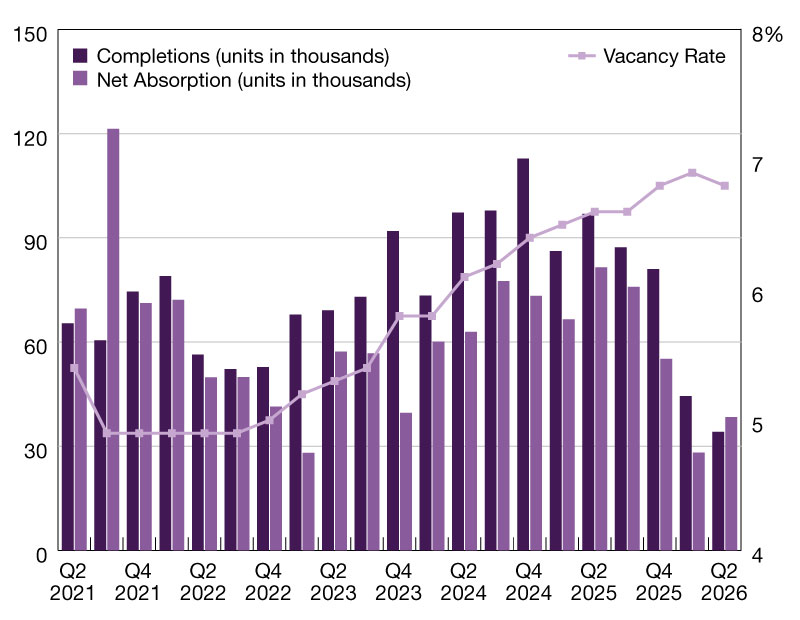
These are the high-growth Sun Belt metros — such as Austin, Phoenix, Dallas and parts of Florida — that are working through a short-term oversupply, Chang explained. They have seen recent double-digit percentage increases in inventory in very short timeframes, just as job growth has downshifted and household formation slowed. Thus new Class A buildings are competing aggressively for tenants and offering deep concessions, such as two, three or even four months of free rent.
Despite that localized oversupply, both speakers emphasized that the national housing shortage remains very much a reality. Recent multifamily development hasn’t eliminated the structural undersupply of housing in the U.S.
Rather, the country is experiencing a mismatch in timing and geography: too many units arriving at once in some markets—mostly the aforementioned Sun Belt metros—while more supply-constrained, regulation-heavy metros still need additional inventory but are difficult and slow to build in. Over time, Chang argued, the Sun Belt overhang will be absorbed given those regions’ population and job growth trajectories, but the digestion period will be uncomfortable, especially in the most heavily built-up submarkets.
A tightening market
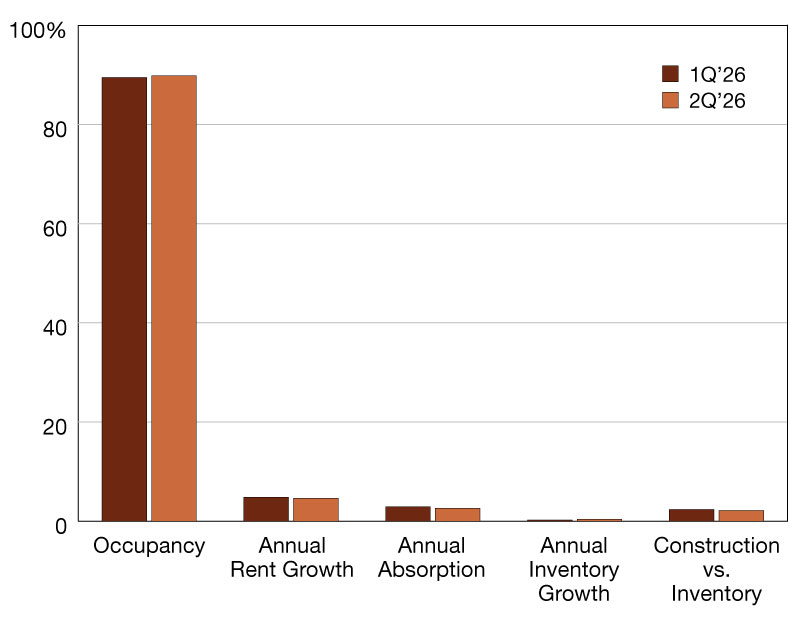
The U.S. multifamily market tightened somewhat during the second quarter of 2026, according to the organization’s July 2026 Quarterly Survey of Apartment Market Conditions, but by no means did it become a tight market. NMHC’s market tightness index came in at 57 at the end of the quarter, its first reading above 50 after three consecutive quarters of loosening conditions.
An index above 50 points to tighter markets: lower vacancy and faster rent growth compared with the previous quarter. Still, only 29 percent of respondents said markets were tighter, while 15 percent saw looser conditions. A majority (55 percent) perceived no change.
In the capital markets realm, NMHC’s July survey found the debt financing index at 46, signaling that, on balance, respondents see borrowing conditions as somewhat worse than three months ago. About 26 percent said it was a worse time to borrow, 17 percent saw improvement, and around half reported no change.
With the 10-year Treasury yield around 4.7 percent, near recent cycle highs, Chang expects more re-trading, tighter deal economics and potential upward pressure on cap rates as investors demand higher returns to compensate for higher financing costs. Yet he also noted that liquidity remains available: lenders, including banks, have capital to place, and prospective regulatory easing could further support lending capacity.
Equity capital is similarly cautious but not absent. The organization’s equity financing index came in at 44, with 65 percent of respondents saying equity conditions were unchanged. The sales volume index, also at 46, points to softer transaction activity: more respondents reported lower deal volume than higher.
Chang interpreted this not as a collapse in closings—many deals now closing were inked months ago—but as a lower propensity to put new deals under contract at today’s higher rates and uncertain macro backdrop. Even so, he characterized the current environment as a potential buying opportunity. If investors can accept thinner margins near term, they may benefit as supply tapers and demand accelerates in coming years.
Uncertain demand in the short run
While demographics seem to be on the side of multifamily demand in the long run, the short-term outlook is more dicey, according to the webinar participants.
Labor market dynamics are central to the demand outlook. The past year brought a soft patch in job creation, including a period when the U.S. actually lost about 68,000 jobs (between June 2025 and February 2026), before a notable pickup beginning in March. Chang noted that unusually large statistical revisions in recent government jobs data—nearly 35 percent variance between initial and revised figures in the post-pandemic era, more than double the pre-2020 norm—complicate forecasting.
Chang traced some of the hiring slowdown to policy-driven uncertainty, especially around shifting tariff regimes and war in the Middle East that push oil prices up and down, periodically weighing on business confidence and hiring plans.
READ ALSO: Multifamily Stabilizes as the K-Shaped Recovery Takes Hold
“Look at just this survey period, and the changes that we’ve experienced in the last three months,” Chang said. “The war in the Middle East is on. The price of oil shoots to $125 a barrel. It drops back down. We have a ceasefire. Now the war is back on again. Just that little variant right there can disrupt the entire market.”
Wider economic uncertainty is visible in the rising number of young adults living with family, now above even pandemic highs in absolute terms. Historically, the participants noted, periods of elevated uncertainty tend to delay household creation: would-be renters stay with parents or roommates instead of forming new households.
Longer-term demand
But there is a long-term upside for landlords to the dynamic. Chang said the delay has created “pent-up households” that will eventually “unlock,” triggering a new wave of apartment demand similar to the surge seen after the pandemic. Key signals to watch, he suggested, are sustained improvements in job growth and a meaningful upswing in consumer confidence.
Demographics and interest rates are working together to deepen the renter pool. The median age of a first-time homebuyer has climbed from 30 in 2010 to about 40 today, reflecting both higher mortgage rates and elevated home prices. That widens the cost spread between renting and owning, keeping renters in apartments longer—well into their 40s in many cases.
The millennial cohort is still in its peak housing-consumption years, while Gen Z is moving into prime renter age over the next five years. The combination of older first-time buyers, strong middle-aged renter cohorts and a younger generation entering the market underpins Chang’s view that multifamily remains structurally well-supported by long-term demand.
Bruen and Chang urged listeners to de-emphasize quarter-to-quarter volatility and survey noise. Indicators like NMHC’s indices and job reports might be useful for tactical decisions, but they are only smaller elements of a market characterized by chronic housing undersupply, aging into renting, delayed homeownership and substantial demographic tailwinds.
In fact, Breun said, investors should lean into uncertainty.
“It’s very difficult to make a decision with so many variables in play, but that historically has been the best time to make a decision,” Bruen said. “Go back to Covid or the financial crisis. As we navigated those periods of severe uncertainty, they included the opportunities when investments really delivered and generated some of the greatest returns in multifamily.”