Sizing Up LA’s Recovery From Last Year’s Wildfires
Policies are changing, but it may not be enough.
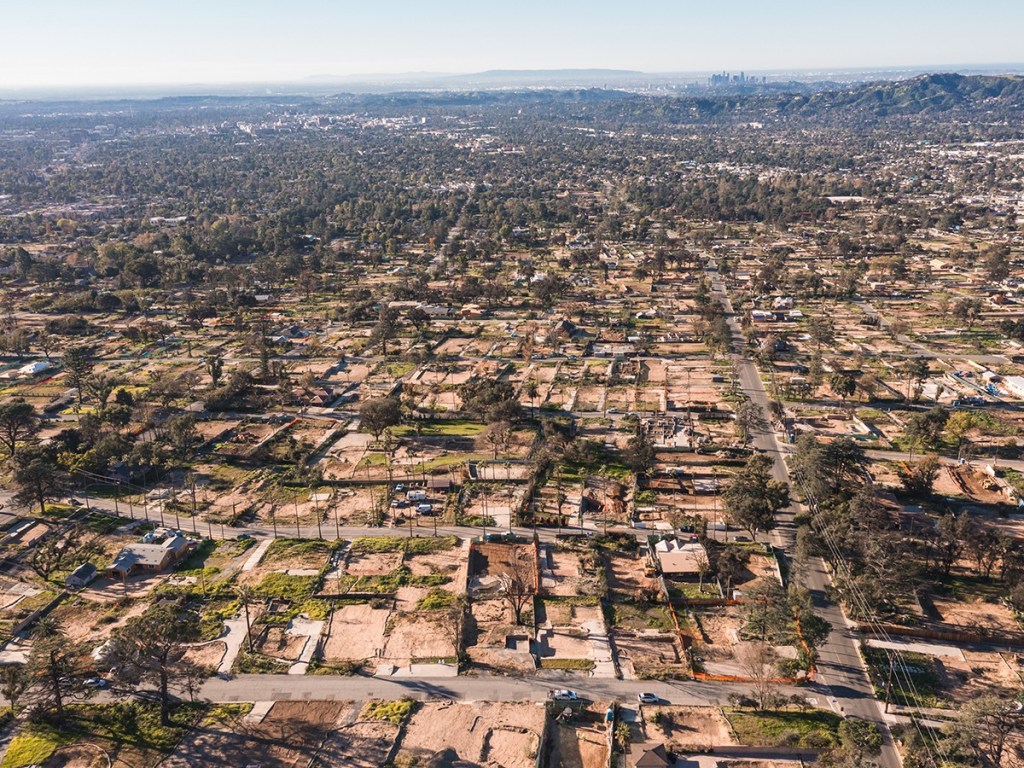
When the Palisades and Eaton Fires ripped through greater Los Angeles in early 2025, the disaster did more than destroy buildings and end lives. The destruction from the wildfires also represented a setback for workforce and affordable housing in Southern California in ways both direct and indirect.
The fires destroyed housing stock—most of it single-family, but also multifamily—with the total value of destroyed or damaged structures estimated at $9.6 billion, according to a recent study from the UCLA Anderson School of Management. However, that assessment doesn’t break down the loss according to market-rate housing, affordable and workforce.
Ratcheting up the pressure
Indirectly, the fires have upped demand by dispossessing people who cannot afford market-rate housing in a local environment where great demand is coupled with anemic new supply.
“In a region already facing a shortfall of nearly 486,000 homes for low-income renter households in Los Angeles County, any loss of housing supply further intensifies competition for lower-cost units,” Cotality Chief Economist Selma Hepp told Multi-Housing News.
Rebuilding in fire-affected areas is often delayed by underinsurance, high materials costs, labor shortages, infrastructure requirements and elevated insurance premiums—or, in some cases, the inability to secure adequate coverage. “So even when the destruction is concentrated in specific neighborhoods, the effects don’t stay local,” Hepp said. “They ripple through the system by displacing households, tightening nearby rental markets and increasing pressure on already limited lower-cost housing inventory.”
The fires further intensified the fragility of the region’s housing system, with workforce vacancy at about 3.5 percent. “Disasters like these expose the fact that Southern California doesn’t have much slack in the system, since there’s very little excess affordable housing capacity to absorb displaced households,” Hepp said. “And the rebuilding environment is difficult. Materials costs remain more than 40 percent above pre-pandemic levels, skilled labor is tight, and in high-risk areas, insurance premiums have surged as some carriers have pulled back from the market altogether.”
Post-disaster push
Though recovery for homeowners and commercial property owners is a long slog—as is the task at hand for workforce and affordable housing development—there seem to be a few glimmers of change. The disaster has inspired heightened urgency regarding development from private capital as well as the public sector.
“We’re seeing a growing opportunity in affordable housing, particularly in areas like Los Angeles, where a supportive policy environment and strong underlying demand are helping create a more attractive investment landscape,” said Parkview CEO Paul Rahimian. His company recently provided $10.6 million in construction financing for a 51-unit workforce development in Studio City, an L.A. neighborhood that is particularly short of such housing.
READ ALSO: Managing Fire Risk in Multifamily
“Everybody’s moving quickly and I think everybody’s interests are aligned to move quickly,” said GoSource President Melissa Dooley Kaspers, whose company specializes in AI-powered material procurement for construction. “Our goal in this effort is to make things as easy as possible for people to move forward with development.”
State-level action
A California state policy shift has been driven by the realization that affordability isn’t just a social issue but an economic and public health issue, according to Hepp. That has translated into more aggressive policies, including state-level housing mandates, pro-density legislation, streamlined approvals and stronger enforcement mechanisms for cities that fail to plan for sufficient housing.
In the first year or so after the fires, the state of California funded roughly 1,000 new affordable housing units in Greater Los Angeles. That inventory wasn’t focused on burn areas but was instead distributed more widely to relieve pressure on local housing supply. Under the program, fire survivors and other eligible residents have priority for units as they become available.
“Wildfire recovery creates significant challenges for multifamily builders, who must simultaneously navigate damaged infrastructure, strained rental markets and the urgent need to restore affordable units for survivors,” Tomiquia Moss, secretary of California’s Business, Consumer Services and Housing Agency, told MHN in an email message.
To accelerate rebuilding and recovery, Gov. Gavin Newsom issued dozens of emergency executive actions that streamlined permitting and suspended California Environmental Quality Act and Coastal Act requirements for wildfire-damaged properties. In addition to those actions, “The administration advanced a major disaster-recovery legislative package that strengthens tenant protections, stabilizes communities and codifies many of the streamlining actions in the governor’s executive orders that make it easier to rebuild housing following disasters,” Moss said.
The state has also expanded investments designed to accelerate new affordable and workforce rental housing production in fire-impacted communities, including the Multifamily Finance Super NOFA that provided over $100 million, she added.
Local policy moves
In April, the Los Angeles County Affordable Housing Solutions Agency authorized its first development funding round, approving $102 million to finance 10 income-restricted projects totaling 566 units across the metro.
LACAHSA assists projects that secured low-income housing tax credits but face funding gaps due to credit pricing, interest rates or construction costs. The agency also prioritizes non-LIHTC developments that qualify for tax-exempt bonds.
In Los Angeles, Executive Directive 1—issued in 2022 by Mayor Karen Bass’ administration—meant that by late 2025, about 490 projects representing more than 40,000 affordable units had moved through the streamlined process. Approval timelines had been reduced to 22 days to 45 days on average, down from six to nine months before the directive.
“The broader YIMBY movement has also changed the policy conversation by putting more pressure on local governments to allow housing in places that were historically resistant to growth,” Hepp said. The scale of the mandate is enormous; the city of Los Angeles must plan for 184,000 affordable units by 2029 and nearly 457,000 new housing units in all.
Development strides and challenges
On the private development side, there is also more momentum than in the past, though growth is still colored and constrained by economics.
At the end of 2025, Los Angeles developers had 25,754 units under construction, along with an additional 192,000 units in the planning and permitting stages, according to Yardi Matrix data. However, 2026 will likely see a softening of supply dynamics as developers remain focused on the upscale segment. Nearly two-thirds of all units underway were in upmarket projects, while units in fully affordable assets comprised 31.1 percent of the total.
Even so, workforce housing has become more attractive to investors, as it has shown stronger occupancy and more stable demand than higher-end product. That relative performance is visible in the vacancy gap between Class B/C and Class A properties, Hepp said. There is also growing participation from impact-investing and ESG-oriented capital focused on preservation and rehabilitation of affordable and workforce housing. “That said, stronger interest doesn’t automatically mean enough production,” Hepp noted.
READ ALSO: Why Insurance Costs Are No Longer High All Over
Compared with the 2022 peak, Los Angeles multifamily permitting was down 21 percent in 2023 and 40 percent in 2024. Even with the success of ED1 in moving development through approvals, only 44 of the 490 proposed projects had broken ground by December 2025.
“Because of everything that’s sort of happening at a macro level, with the rising fuel surcharges and other costs, it’s hard to make and stick to a plan when there’s a lot of external variables,” Kaspers said. “The last year has been a challenge across the board, in Southern California specifically, figuring out how to make the economics make sense to be able to support the demand and the need.”

Those other costs include land, which is exceptionally expensive, along with construction and labor costs. To top it off, financing has become more difficult in a higher-rate environment. In California, prevailing wage requirements can raise project costs, with some estimates putting the increase at 9 percent to 32 percent, or roughly $83,000 to $94,000 per unit in certain cases, Hepp said.
Local fees also matter. Los Angeles’s Affordable Housing Linkage Fee can run as high as $23.20 per square foot. Even when a project is approved, the gap between entitlement and groundbreaking can be substantial because capital stacks are hard to close.
The regulatory and political environment remains a factor in slowing development, regardless of the added post-fire urgency. Restrictive zoning, CEQA-related delays, and neighborhood opposition can slow projects for months or years. Rising insurance costs are also a complication, especially in fire-prone areas where there is the insurance and climate-risk dimension.
“When I look at the region, the central challenge is not a lack of recognition that more housing is needed,” Hepp said. “It’s that the economics, regulation, and risk environment still make it very hard to deliver affordable and workforce housing at the scale Southern California requires.”