Why Housing Gen Z Is a Challenge—and an Opportunity
This cohort is "slow-stepping" into adulthood, and that has implications.
If all young adults currently living with their parents or a roommate suddenly move into their own digs, housing demand would skyrocket, significantly worsening the housing shortage and affordability. But the shortage of housing that is affordable to this generation of young adults, the second-largest age cohort in U.S. history after Millennials, presents an opportunity for creative investors willing to accommodate their needs.
About one-third of the nearly 70 million young adults aged 18-34, or 32.2 percent, were living with their parents in 2024, according to the latest U.S. Census Community Survey, the National Association of Homebuilders reported. An additional 10 percent of adults in this age group were doubled-up with housemates who were not relatives, romantic partners or student roommates.
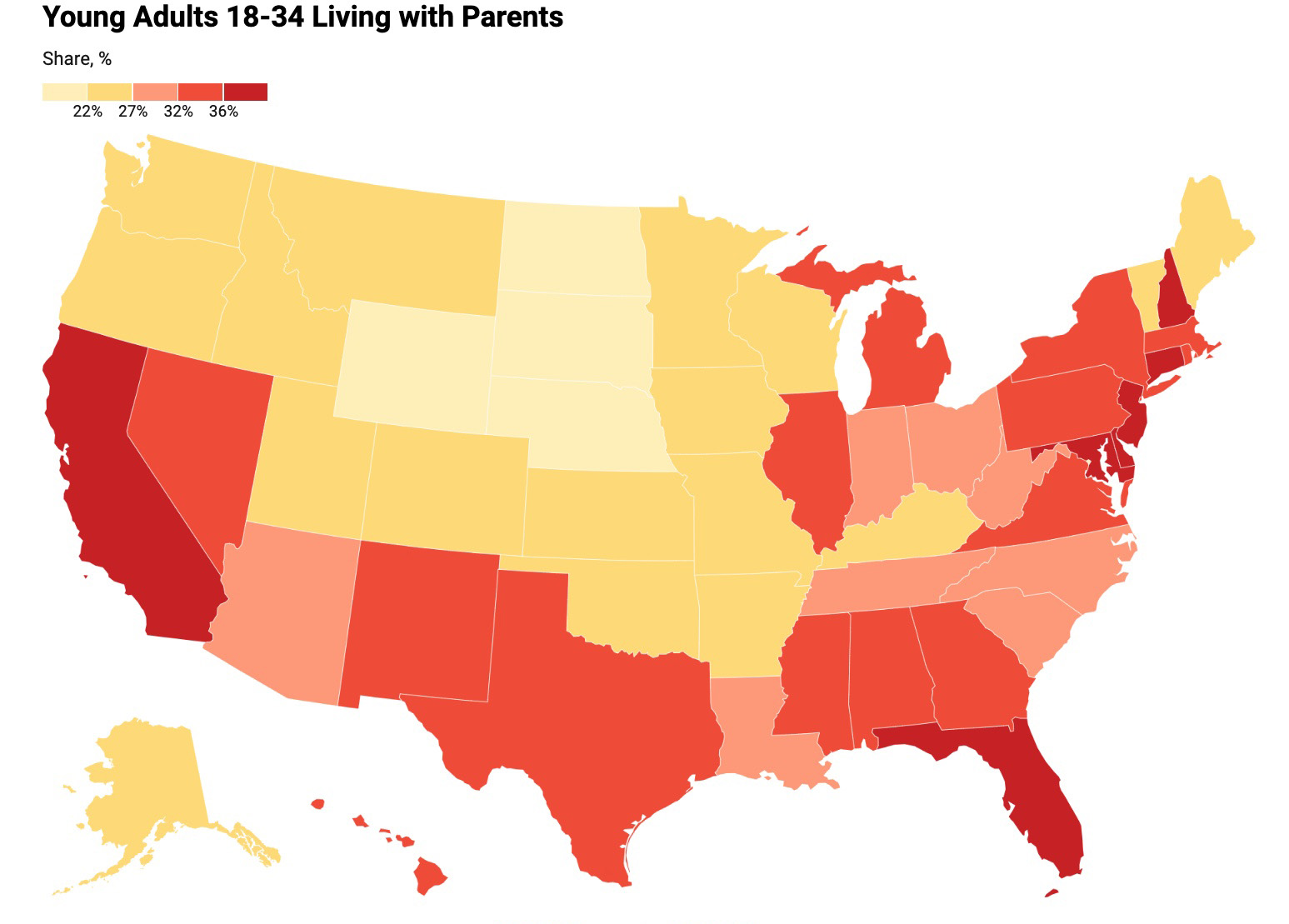
The share of young adults living with family is starting to tick up again after trending down from 2020 to 2023, according to Jay Parsons, economic advisor for JPI.
The reason 40 percent of young adults are living at home or with a housemate is economic—but not just economic, suggested Richard Fry, a senior economist at Pew Research Center. “Today’s 25-year-olds are significantly behind 25-year-olds of 40 years ago,” he said. “They have a different lifestyle.”
LIKE THIS CONTENT? Subscribe to MHN’s Finance & Investment Newsletter
More young adults living at home are male than female, Fry noted, because income for young male workers with less than a four-year college education has decreased, when adjusted for inflation, from 20 years ago. Add to that the rising unemployment rate for new college graduates (an average of 4.59 percent in 2025 versus 3.25 percent in 2019, according to the Bureau of Labor Statistics).
Fry, who conducted a survey of GenZers living with parents, noted that income for women of a similar age and educational level has remained flat, enabling more of them to afford their own living space or move in with a roommate.

Relative to 10 years ago, fewer young adults today are pursuing a four-year college education, but males are less likely to seek a bachelor’s degree than females, Fry added. The reasons they give are both financial and practical: “(I) don’t feel a bachelor’s degree is needed for the kind of work I want to do,” one respondent said.
“A majority of young adults living with a parent say the arrangement is good for their finances, but they’re less enthusiastic about its impact on their social life,” he continued.
As a result, this group is slow-stepping into adulthood, raising concerns that the delay in marriage and setting up an independent household will result in many in this age group never starting families, Fry said, noting that the birth rate is at a record low.
This phenomenon, however, varies by region, with young adults striking out on their own in regions with a lower cost of living, like the Midwest, or higher educational attainment compared to the national average, like the Pacific Northwest.
While this has implications for the nation’s housing markets, it has a broader impact on the economy since consumer spending drives 70 percent of U.S. economic growth, reported NPR. When a young adult sets up an independent household, Fry said, a lot of spending goes on, from purchases of furniture to household items like appliances, pots and pans and mops and brooms.
Meeting GenZ’s housing affordability
The need to make apartments more affordable for young adults and accommodate roommate living is driving unit design, size and creative leasing options, according to Dwight Dunton, founder, CEO & CIO of Bonaventure, a multifamily housing investor, developer and operator.
“We continue to see a strong emphasis on dual-bedroom layouts, particularly in two-bedroom units, where roommates have equal bedroom size, storage and bathroom access,” he said.
At the same time, developers are creating smaller units and deploying space efficiencies by shifting activities that traditionally took place inside the apartment to shared, “third-place” amenities to keep rents more attainable without sacrificing quality, Dunton continued.
“These shared spaces are increasingly important with remote and hybrid work more common than pre-COVID,” he added, noting that smaller living spaces are more acceptable when residents have access to shared fitness studios, coworking spaces, lounges and community rooms. “The unit may shrink slightly, but the overall experience expands through amenities.”

One growing trend in apartment development is microunits, typically under 500 square feet, aimed at young renters, noted David McCullough, principal architect at Southern California-based McCullough Landscape Architecture.
McCullough pointed to ELDA Developments’ microunit project in San Diego’s Bankers Hill neighborhood, which is located between the city’s downtown and uptown neighborhoods. ELDA is offering units as small as 320 square feet.
But, McCullough noted, developers in Berlin are going down to units of 250 square feet.
While apartment projects provide more amenities than ever before, McCullough said, “there is a general easing in this amenities race, with developers focusing on authenticity, community and social interaction.” This works well with affordability, but it means the development team needs to be more creative.
Creative housing strategies
Beyond microunits, other strategies being discussed include: coop-style or “social” housing, public/private partnerships that lower costs and risk exposure, more middle market/workforce housing and wealth building through the ownership of townhomes, condominiums and tiny homes.
“We also are seeing more apartment owners experimenting with per-room rental structures,” said Dunton. This model, which often is adopted by private developers of student housing, prices rents on a per-room basis and lets a lease for each individual occupant.
“That model can work for both sides,” Dunton noted. “Owners can achieve slightly higher total rents, while residents benefit from a lower cost than leasing a studio or one-bedroom on their own.”
However, there are real constraints to deploying this model since many lenders, including HUD, Fannie Mae, Freddie Mac and traditional banks, place restrictions on per-bedroom leasing in market-rate housing, noted Dunton. “So while the demand is there, broader adoption will require financial and capital markets’ innovation to support those structures,” he said.
These models tend to emerge first in less-affordable markets, where rent consumes a higher share of area median income. “When affordability breaks down, the market is forced to adapt,” Dunton said.
“Over time, this reinforces a focus on markets where affordability, supply constraints and long-term demand are aligned,” he added, noting this strategy enables his firm to stay flexible and resilent across real estate cycles.
Dunton noted that roommates are staying together longer, which is also reinforcing this trend.
A shift in apartment design
A U.S. Census Bureau Survey of Construction bears some evidence of the shift toward sharing. Forty-seven percent of new multi-housing units built last year had two-plus bedrooms, down just slightly from 48.9 percent in 2023, noted Tyler Sullivan, JLL senior manager of multi-housing capital markets research.
Sullivan also pointed to data from the U.S. Census and NAHB that shows the average new apartment size increased last year for the first time in a decade to 1,120 square feet after shrinking steadily from 1,200 square feet in 2015 to 1,024 square feet, indicating a preferences for more space.
Two main factors account for the reversal in sizing, Sullivan noted. Single-family housing is more unattainable than ever as more renters age into young-family status, and construction/labor costs are elevated, driving new product primarily into the high-end of the market, where the unit sizes are larger.
Developers are also creating a lot more one-bedroom units than they were 10 or 20 years ago. “And we’re actually seeing increased build-to-rent new supply absorb some of the multi-bedroom overflow, instead of (increasing supply of) larger multi-bedroom (apartment) units,” Sullivan said.
A potential ‘heyday’ for investors

Housing young adults and young families offers exceptional opportunities for multifamily investors, as this generation is renting longer than previous cohorts, creating durable demand. But that demand is colliding with significantly higher development costs, from land to labor to materials, Dunton said: “The result is a real affordability squeeze.”
Additionally, with remote and hybrid work, apartment dwellers are spending more time at home, he pointed out, contending that designing for residents who may spend 20 hours a day in their community, instead of 12 to 14 hours, is both a challenge and an opportunity. “That mindset benefits Gen Z today and future renter cohorts as well.”
Affordability today is less about cutting amenities and more about building smarter and cheaper, without compromising long-term livability, Dunton continued.
“Smaller units are part of the solution but are not sufficient on their own,” he said, noting that the bigger challenge is the high cost of producing housing. “That pushes developers to look for lower-cost land, alternative construction methods, and, in some cases, less-dense greenfield development, where per-unit costs can be lower.”
But, while some developers are building to cyclical margins, most investors continue to develop a diverse mix of units that will endure for decades.
“Developers are building for longer-term trends starting two-plus years out, so they’re always careful not to overreact to cyclical shifts, knowing things may change again by the time the property is completed and leased,” Parsons said.
Many learned this lesson the hard way in the early 2010s, Parsons continued. Developers built more studios and small one-bedroom units, thinking they would draw affordability-minded young renters. But those units often sat vacant longer, and they saw more demand for bigger units.
“I do think we could see a gradual shift toward larger units in the next cycle, particularly geared toward young families who want to live in urban areas,” he added. “It’s a growing niche.”
So, while young renters’ milestones may be delayed, it’s unlikely they are rejecting apartment living.
“This generation will still need housing—often for longer than prior generations,” Dunton said. “That creates an opportunity for investors who focus on durability, flexibility and long-term stewardship rather than short-term trend-chasing.”