Renters’ Top Priorities Today
How the economy, remote work and other major issues are reshaping the multifamily market.
A new survey from RCKRBX, a Washington, D.C.-based multifamily market intelligence platform, finds that renter demand and preferences have shifted significantly since the pandemic, with more than 40 percent of respondents are delaying homeownership because of current economic conditions.
Renter expectations continue to evolve and reshape the multifamily market, Michael Broder, CEO & co-founder of RCKRBX, said during a webinar Wednesday that highlighted findings of the firm’s inaugural National Renter Demand Indexing study.
In addition to gauging renter perceptions of the national economy and its impact on decision-making and rent budgets, the survey delved into the dynamics of teleworking compared to working full-time in the office and how that affects choices such as unit size. Spoiler alert – those surveyed with more flexible work arrangements are more likely to pay higher rent premiums and desire larger units. Broder also noted that the survey looks closely at the reshaping of unit demand going forward and how that impacts absorption and premiums.
On-the-ground insights
The survey of 2,342 prospective renters across the U.S. was completed in September and sought information on their economic outlook, lifestyle preferences, renting habits and behaviors. One of the takeaways Broder noted is that their research shows existing supply, new construction and recent deliveries remain out of sync with what renters want and how these markets will continue to evolve. He stated in prepared remarks developers and asset owners who deliver products more aligned with the new renter mindset will be poised for greater performance, resilience and value.
Kevin Hudak, RCKRBX chief research officer, started the webinar with a topic that was top of mind for many who voted in elections earlier this month and continues to get a lot of press coverage – the economy.
“Overall, we had 43 percent saying the economy is heading in the right direction, 39 percent heading in the wrong direction or down the wrong track,” Hudak noted.
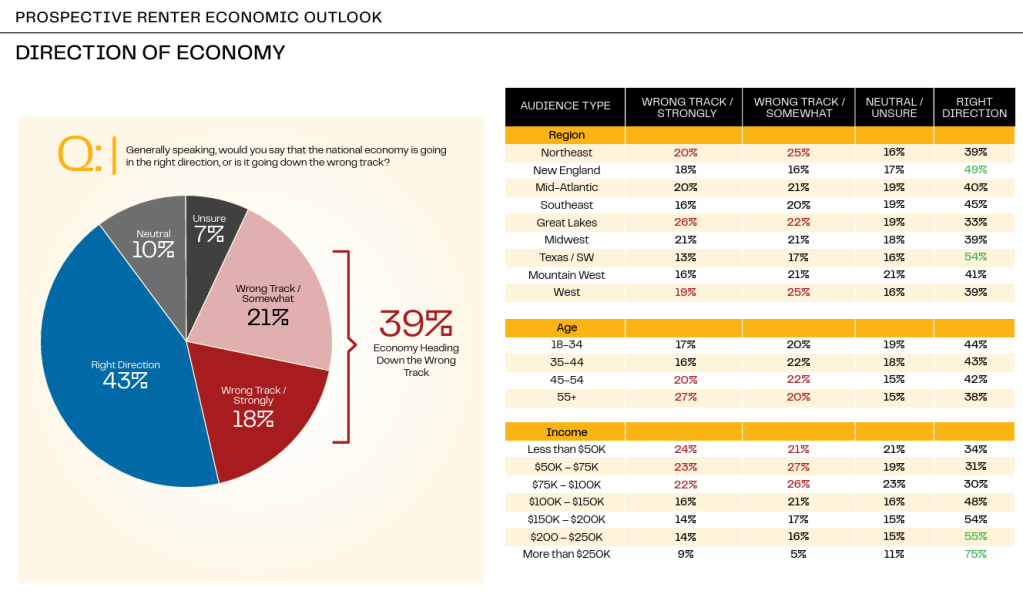
That suggests polarization among viewpoints but when the survey is broken down by the unit size respondents were seeking, Hudak said it was one-bedroom renters who have the highest pessimism and the lowest optimism. In that group, 49 percent of respondents said the economy is heading down the wrong track and 31 percent said it’s heading in the right direction. By comparison 44 percent of two-bedroom renters said the economy is heading down the wrong track, 10 percent were neutral, 7 percent were unsure and 39 percent said that it’s heading in the right direction.
“So obviously, renters’ views on the direction of the national economy will impact their budgets. And what is interesting is how this actually leads to more of an increase in rent budgets,” Hudak explained. “So even though we have 39 percent saying that the economy is heading in the wrong direction, we actually have 45 percent who said they’re increasing their rent budgets, agnostic of the direction\,” Hudak said.
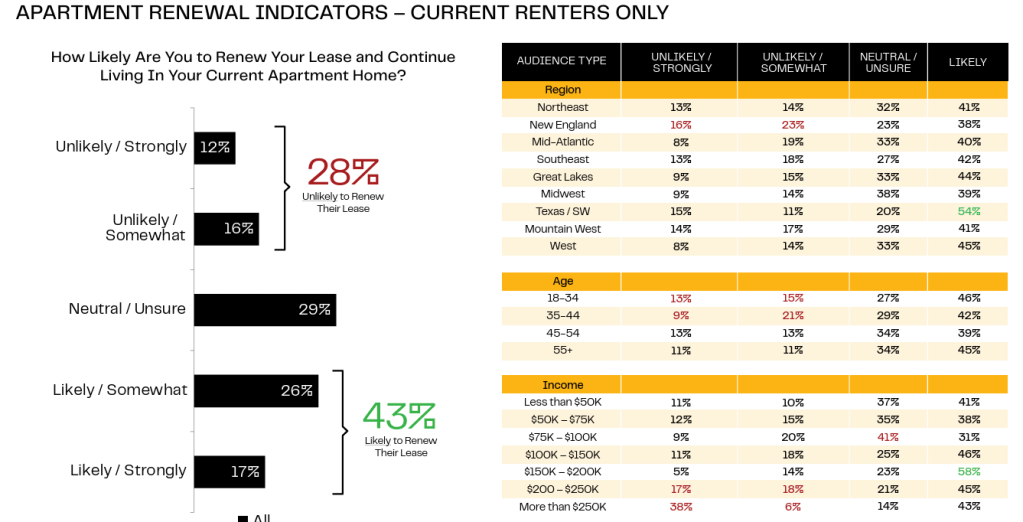
The survey found that as a result of recent economic conditions 46 percent of prospective renters say they’ll increase their rent budgets in the next move. However, just 20 percent planned to seek lower rents and 17 percent were firmly committed to renewing their leases. RCKRBX said despite the economic uncertainty, the higher number of those expecting to increase their budgets is an opportunity for apartment developers, owners and operators to match their products to renter demand for additional premiums. That trend is particularly driven by younger, economically mobile renters who remain open to exploring new housing options and redefining their priorities.
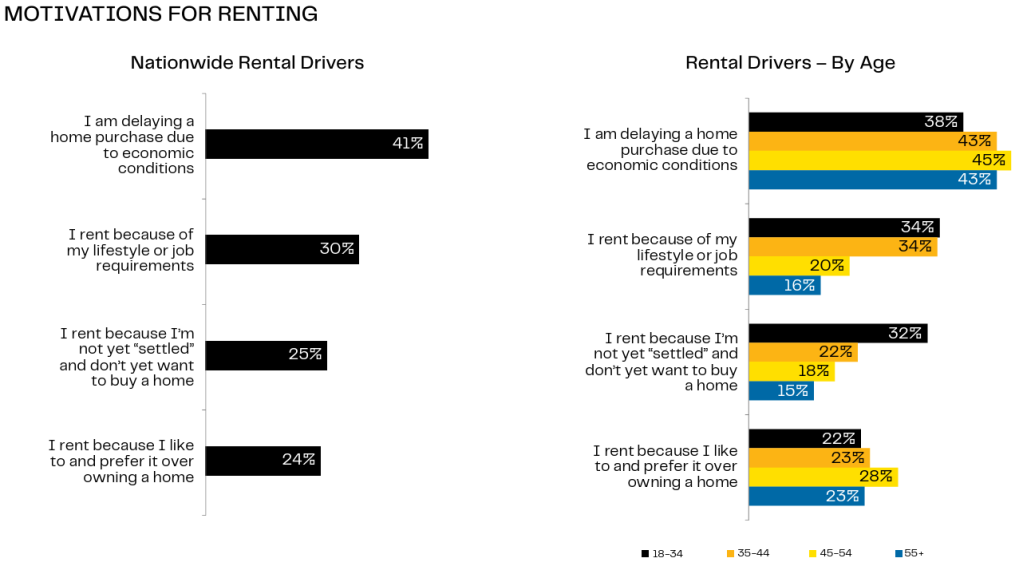
While 41 percent of respondents said they were renting and delaying homeownership due to economic conditions, 30 percent say they are renting because of lifestyle or job requirements; 25 percent reported that they don’t feel “settled” and 24 percent said the preferred renting over homeownership.
READ ALSO: National Multifamily Report – October 2025
“Keep that in mind when you are looking at developing and programming and leasing up your assets, that really a quarter of our renters are those who are truly renters by choice,” Hudak said. “You want to adapt your decision-making on programming and other elements based on those folks who are the renters by necessity, who make up a much larger segment of the potential renters.”
Impact of teleworking vs in-office work
The RCKRBX survey that found almost half of respondents—a total of 46 percent—were hybrid or remote workers, and those with more flexible work arrangements are more likely to pay higher rent premiums. The survey breakdown was: fully in office, 54 percent; hybrid, 3-4 days in office, 25 percent; hybrid, 1-2 days in office, 8 percent and fully remote, 13 percent.
Twenty-eight percent of renters between the ages of 35-44 were hybrid workers in the office three to four days. Of those surveyed, 23 percent of those 55 and up were fully remote. As for what part of the U.S. is in the office more – look to Texas and the Southwest, where 64 percent of the renters stated they work full time in their offices. By comparison, the Mid-Atlantic had the highest percentage of fully-remote workers surveyed – 18 percent.
“It shows that hybrid working and remote working is really here to stay now that we are essentially three to four years from post-pandemic impacts. And as a result, this data, I think, kind of begs owners, operators and developers to respond to that,” Hudak said.
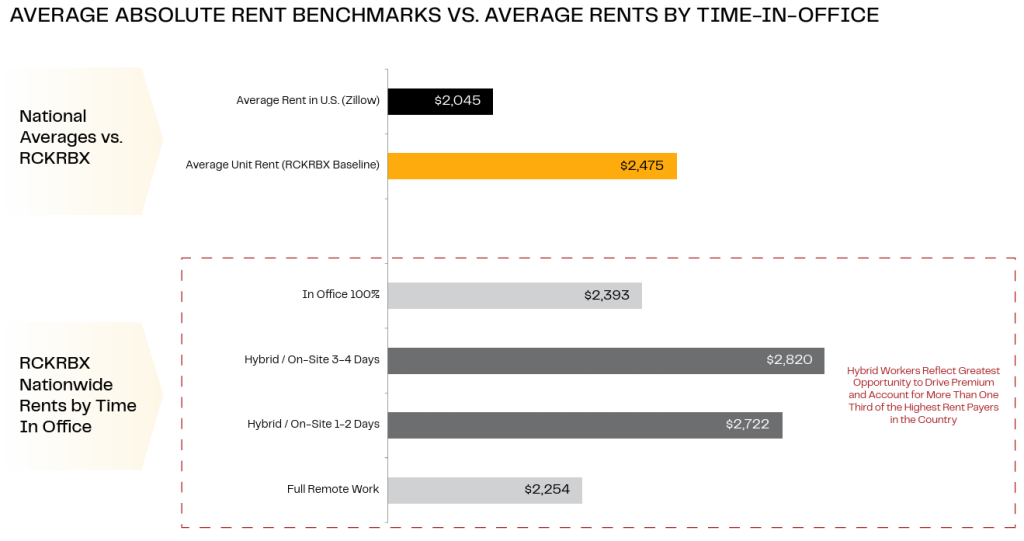
He said the number of hybrid workers represents an opportunity to start thinking about those next-generation building concepts, amenity concepts, and programming. They may also be more willing to pay for high-quality office space in their units because they are working in their apartment at least one to two days and “want something that’s comfortable (and) usable.”
The survey also found another interesting post-pandemic takeaway – a combination of 35 percent of respondents said safety and security were the most or second most impact factor for them while about 34 percent said rent and other monthly fees were their priorities.
“What we’ve seen since COVID is safety and security becoming the paramount issue in all of the markets we’re testing, whether it’s tied with rent and other monthly fees or even exceeds it by quite a bit as well. And this is a big shift and a challenge for multifamily owners and operators,” Hudak said.
Another challenge, particularly for investors and developers, could be that renters are seeking larger units and different configurations than are currently available. The study found there is significant untapped and underserved demand for two- and three-bedroom units at competitive and premium rental rates.
For example, 52 percent wanted two-bedroom or junior two-bedroom configurations versus 39 percent unit supply. There was 23 percent unit demand for three-bedroom units versus an 8 percent unit supply. Meanwhile, only 21 percent were seeking one-bedroom apartments, which have 41 percent unit supply.