Exponential Ecology Meets Student Housing at UC San Diego
Once a parking lot, this mixed-use property is now redefining campus living standards. HKS' Jeff Larsen expands.
What was once a parking lot on the University of California San Diego campus is now a mixed-use property that prioritizes sustainability, wellness and community. Spanning more than 1.4 million square feet, UCSD’s Theatre District Living and Learning Neighborhood brought roughly 2,000 new beds to the campus, along with 30,000 square feet of amenities.
Designed by HKS and EYRC Architects in collaboration with Kitchell and SWA, the five-building complex in La Jolla has ground-floor plazas with retail, dining and conference centers that transform the property into the area’s new central point. Completed last year, the 10-acre campus also includes an auditorium, administrative buildings and more than 33,000 square feet of community space.
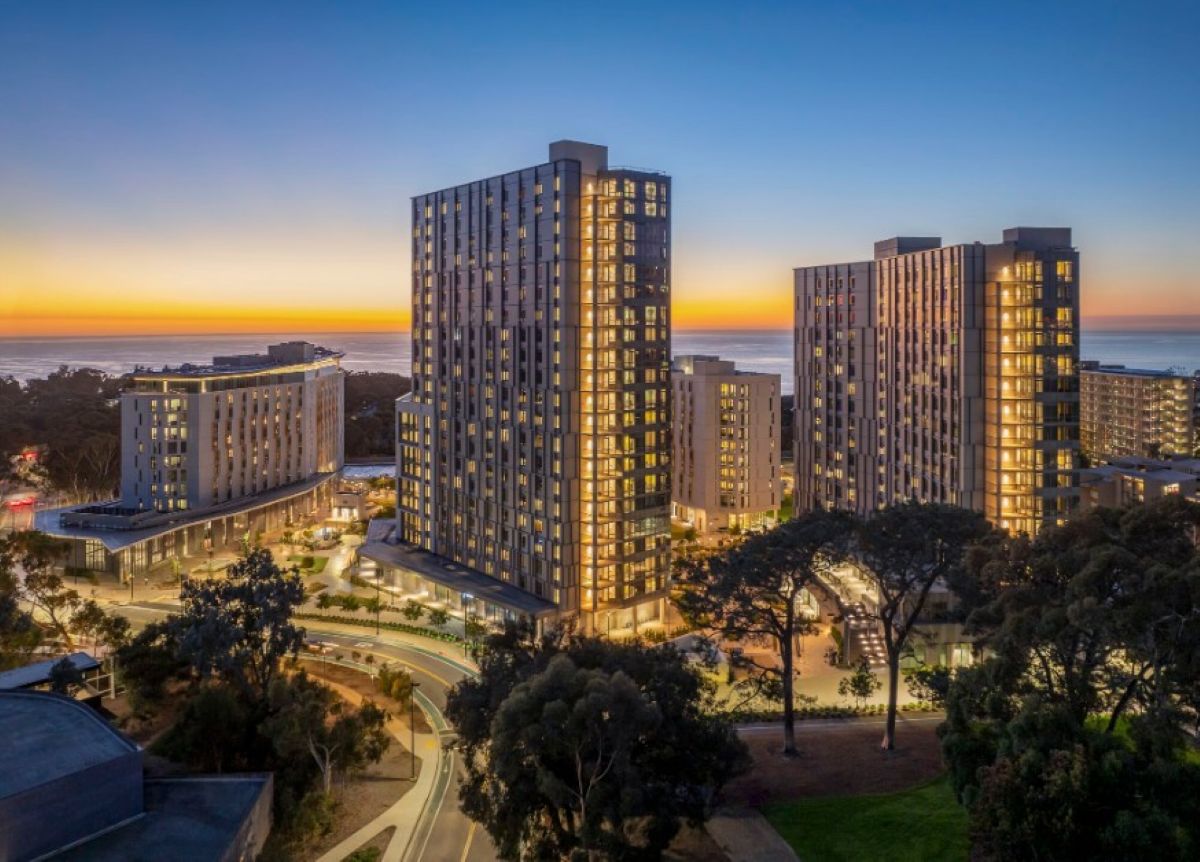
Guided by the principle of “exponential ecology,” the Theatre District Living and Learning Neighborhood intertwines nature and wellness into every component, fostering a sense of belonging and connection to the environment. Serrated towers maximize ocean breezes for natural ventilation, while The Ramble—a restored ecological corridor running through the site—connects students to green spaces, landscapes and meditation gardens.
HKS Principal & Regional Practice Director Jeff Larsen told Multi-Housing News why this student housing property is more than a place to sleep and study.
LISTEN TO: Student Housing Unlocked: Changing the Game Through Thoughtful Design
Please tell us more about what “exponential ecology” means for the Theatre District Living and Learning Neighborhood.

Larsen: The HKS and EYRC Architects design team identified that some of the primary impediments to student success are unprecedented increases in levels of anxiety, isolation and depression. ‘Exponential ecology’ means that we applied every design decision, at every scale, with holistic consideration of how students’ physical, social and emotional well-being connect with both the natural and built environment. The buildings and the land work together to keep residents constantly immersed in nature, setting in motion ‘virtuous cycles’ of well-being-oriented behaviors.
The clear parti—carved by the wind in the east-west direction and by water in the north-south direction—aids natural ventilation and offers views to nature while residents intuitively navigate a restorative landscape habitat. Amenities consciously speak to the mind, body and spirit, encouraging mindfulness, movement and reflection. Exponential ecology integrates human and building performance to foster student success.
Can you walk us through the design process of the residential component? What layout, colors, lighting and other specific elements did you opt for to appeal to students?
Larsen: The residential experience centers on the concept of a nested sense of belonging that creates scales of environments enabling incremental social engagement and development. Suites for six, eight or 10 students include shared kitchens and living rooms, which cultivate small-scale communities that encourage daily connections.
Each floor features community lounges and kitchens, providing larger spaces for gathering, learning and interaction. The first-floor design strategy intentionally places community-wide amenities such as laundry facilities nearby to study and social spaces to activate the arrival space for building residents.
The interiors draw inspiration from the campus’ Historic Grove and the coastal Sage Scrub Preserve that weaves around the site. Biophilic influences of smooth eucalyptus bark and lance-shaped leaves, cream and grey patchworks and muted green ribbons can be seen throughout in accent murals, unit entries and furnishings.
READ ALSO: Does Interior Design Really Impact Residents’ Health? Mary Cook Weighs In
What were the guiding principles behind the selection and design of the property’s amenities? Can you touch on the ones that stand out to you?
Larsen: We used an outcome-driven design approach where we first focused on working with UCSD to define desired outcomes for the project and then create design solutions to achieve them. Our two signature outcomes (are) centered around student well-being and connection to community.
Several of the most important amenities supporting student mental health, rejuvenation and mindfulness are a meditation pavilion and a tea house—beautiful, intimate structures that sit quietly in the landscape. The three interlocked curvilinear wood rooms of the meditation pavilion seemingly hover above a rock and bamboo garden, while the wood latticed tea house nestles into the edge of a bioswale. At night, these structures glow like comforting lanterns among the trees, flowers and vegetation, inviting people to connect with nature and providing a sense of transport to another place.

Shared kitchens in the Theatre District Living and Learning Neighborhood serve as social hubs, featuring roll-up glass doors that connect indoor cooking areas to outdoor courtyards. All images by Lawrence Anderson, courtesy of HKS + EYRC 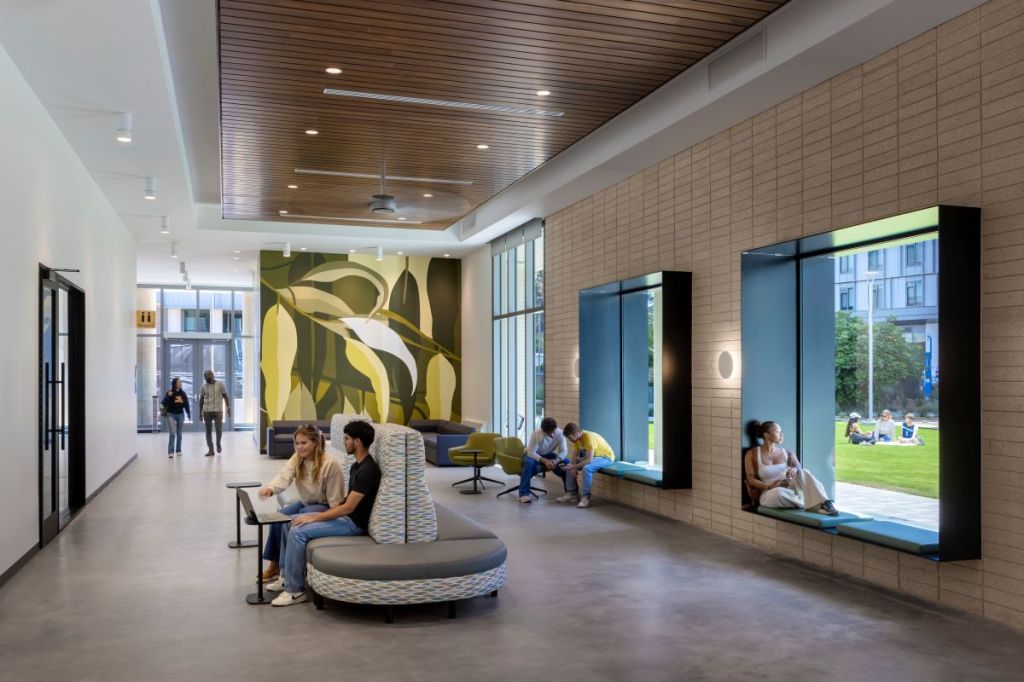
Flooded with natural light, the lounges feature flexible furniture, wall graphics and recessed window niches overlooking the central greens, providing both study and social spaces. 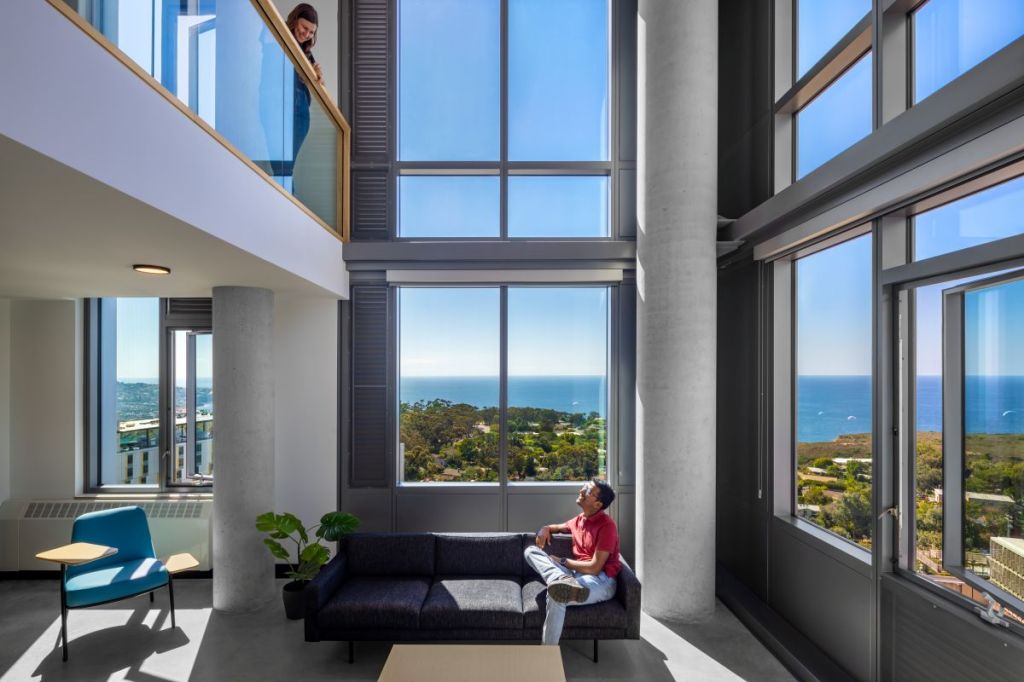
Multi-story lounges at elevator lobbies create daily opportunities for connection and collaboration, embodying the project’s philosophy of blending residential life with academic engagement. 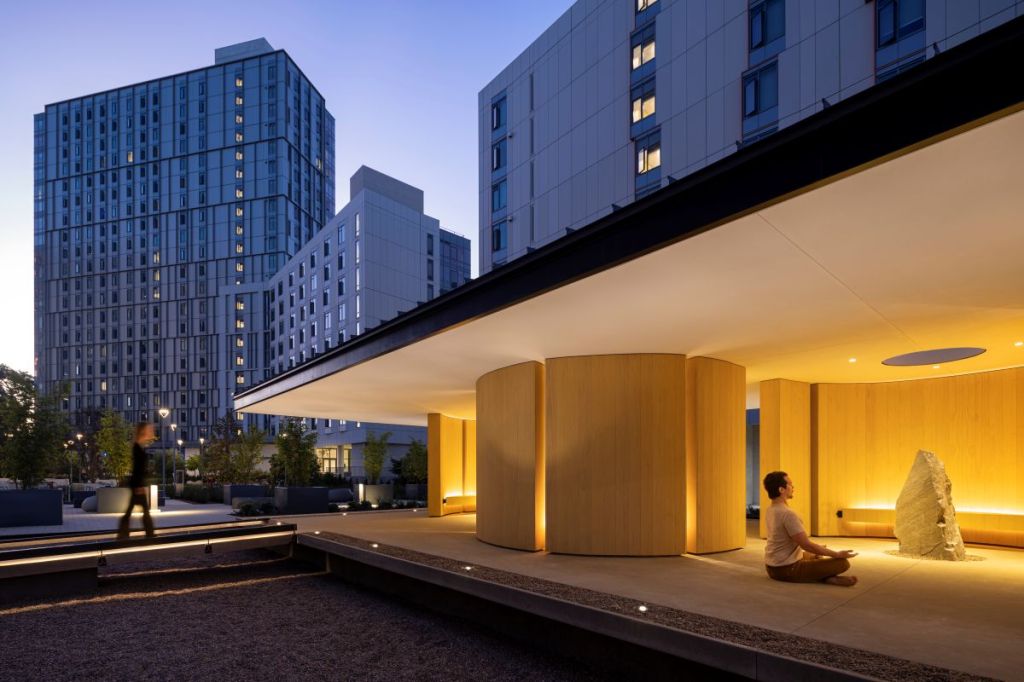
The meditation pavilion, made of warm wood and stone, is part of a wellness framework that balances physical, mental and social well-being.
How does UCSD’s Theatre District Living and Learning Neighborhood redefine student housing from a health and wellness standpoint?
Larsen: By addressing student health and wellness through the lens of sustainability, the project is designed with intentional strategies that aim to create a sense of home, safety and oneness with nature, fostering a sense of belonging so that students can feel comfortable being themselves.
Understanding that no single learning environment meets the needs of every student, research-based design strategies resulted in three distinct outdoor zones to concentrate activity choices. The Physical Wellness Zone features amenities such as a fitness center, outdoor gym, basketball courts and outdoor sports lawns.
The Mental Wellness Zone features a meditation pavilion, a sun lawn and a tea house, designed to inspire tranquil moments in nature and foster opportunities for intimate conversations. Lastly, the Social Wellness Zone houses a community kitchen, game room, barbecues, communal dining areas and the public-facing Market Hall plaza that allows students and the La Jolla community to share experiences.
The Ramble is a signature element of the project. Tell us more about its design and the key challenges in weaving it through the new neighborhood.
Larsen: Our landscape design partner, SWA Group, presented a conceptual idea to the team of re-establishing a historic drainage pattern that had long been paved over back through the center of the site. The entire design team embraced this idea and chose to make it the centerpiece of the neighborhood.
As an ecological corridor, The Ramble manages stormwater through a series of stepped basins and bioswales and serves as the neighborhood’s primary pedestrian thoroughfare, ensuring continuous interaction with nature while organizing the five residential towers. Each residence hall tower’s entrance and ‘front porch’ open onto The Ramble, fostering spontaneous engagement and shared experiences through intentional ‘see and be seen’ design.
Key design challenges included strategically placing the project’s four-level subterranean garage under building footprints to maximize area for in-grade landscape and bioswales and to seamlessly navigate landscape transitions from on-structure to on-grade with paving, large containers for trees and native grasses requiring minimal soil.
READ ALSO: Green Oasis: Multifamily Trends in Outdoor Spaces
How did you balance the property’s high density requirements with the sense of openness you wanted to obtain across the site?
Larsen: During site planning and building mass evaluation, we used computational solar shade modeling and were encouraged by our client to reduce the current six-building scheme to a five-building design so we could maintain optimal openness and enhance environmental satisfaction. To do this and maintain the density required by the program, we sensitively added floors to two of the buildings on the east edge of the site, next to adjacent open space.
To keep the added tower heights more slender and less impactful, we developed an innovative connected half-floor stacked resident community, to be managed by a single resident advisor that maintains campus requirements for resident advisor/bed ratios. These design strategies resulted in one of the highest amounts of open space—square feet/bed—of any residential community on campus.
Can you expand on how you overcame other challenges in such a complex project?

Larsen: Our existing site was a large surface parking lot that served as UCSD staff and faculty parking and shared use as evening and weekend parking for theater patrons attending the adjacent La Jolla Playhouse performing arts venues. As part of the project program scope, we were challenged with designing a new enhanced vehicular circulation and parking experience for theater patrons that engaged public space and respected the privacy of the student community.
A re-envisioned drop-off loops back into a convenient entrance to a subterranean parking garage and a terraced parking garden arrival to a new shared community plaza, surrounded by a gourmet market hall and restaurant spaces. The student realm is focused away from the Market Hall Plaza—all housing lobbies are oriented to a separate central landscaped corridor. The design enables students and theater patrons to have opportunities to come together in a new, exciting gathering space.
If you had to highlight one feature that most encapsulates the spirit of this development, which would it be and why?
Larsen: Sustainability underpins every aspect of the project and is at the forefront of our design strategies to support the students, staff, theater patrons and the greater UCSD and La Jolla communities. The principles of exponential ecology merge beauty and performance, creating unique, welcoming experiences and giving back to the environment.

It can best be exemplified in the design of our serrated building facades that take full advantage of the local microclimate to significantly reduce building energy use intensity by capturing natural ventilation to cool all student rooms.
Computational fluid dynamics modeling informed the design of student rooms, with windows rotated 6 degrees off the facades to enhance airflow and maximize comfort and ocean view potential. The facade design is both practical and artistic. It has a performance-based design evocative of the sandstone and shale forms of the nearby sea cliffs and canyons that have been carved by the wind and water over time.
Could this project serve as a model for other student housing developments at UCSD or other academic institutions on the West Coast?
Larsen: Reaching out beyond its borders, the project positions UCSD as a destination and global hub. Its rooftop meeting complex, offering breathtaking views of the La Jolla coastline, positions the project as a convening space for thought leaders drawn to one of the world’s leading research universities. Paired with the cultural complex of adjacent theatres, these destinations bring the energy of an off-campus experience onto campus.
The project also exemplifies how thoughtful design can transform campus life. By fostering connections to nature, social interaction and a profound sense of belonging, the project holistically supports student success. Its innovative integration of diverse uses, sustainable strategies and community-focused design establishes a new benchmark for campus living and learning environments, ensuring a brighter, healthier future for students and the university.