Using AI and Data to Gain a Competitive Edge
How multifamily marketers can identify trends and use them to their advantage.

If there’s one thing apartment marketers have in abundance, it’s data. The question, however, often lies in how to apply the data to improve promotional strategies and performance of a property.
“Most of our clients ask how to structure a marketing strategy that helps them outperform their competition, whether it be through SEO, Google ads or Meta campaigns,” said Mike Whaling, founder & president of marketing technology company 30Lines.
With the adoption of artificial intelligence tools quickly accelerating, thanks in large part to generative AI models like ChatGPT, marketers across industries are using the technology for greater efficiencies.
In fact, McKinsey research indicates that gen AI has been most widely adopted in marketing and sales, as well as product and/or service development (34 percent and 23 percent of respondents, respectively, according to its 2024 Global Survey).
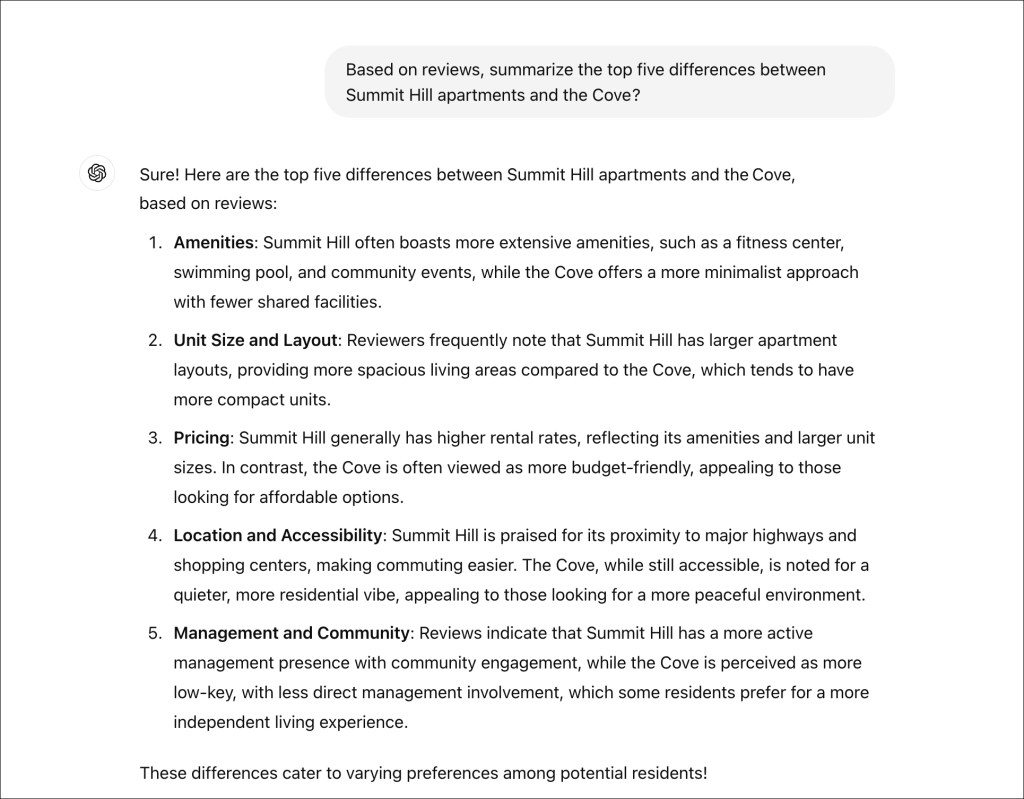
To quickly and effectively glean competitive insights–and understand where your own properties may be lacking–Whaling suggested looking at publicly available reviews and using AI to synthesize the information. This tactic, he explained, can go a long way toward understanding and measuring resident experiences.
What the data says
Widewail, a software company that manages online customer engagement, helps owners and operators define their residents’ experiences.
“You can take lots of unstructured feedback from across your portfolio and make sense of it quickly with AI,” Jake Hughes, director of marketing for Widewail, said.
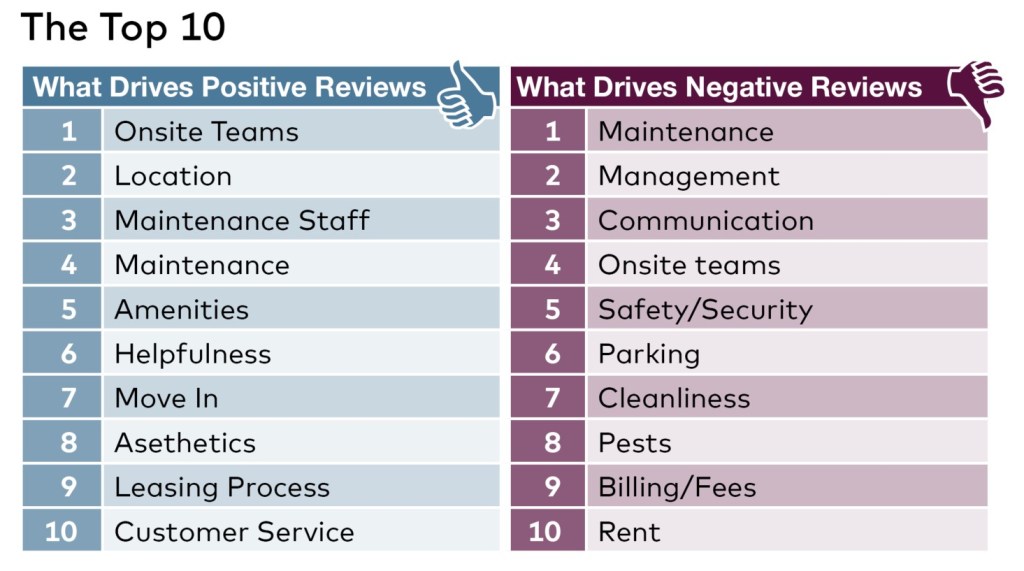
In fact, in its 2024 Multifamily Reputation Index, the company parsed resident data from more than 400,000 Google reviews into 49 unique topics. Using AI, the team was able to categorize the reviews into topics based on more than just keywords.
For instance, a review that talks about a good tour experience can be applied to customer service without an explicit mention to the latter, which could then inform an operator’s strategy moving forward.
Indeed, on-site teams are the top driver in positive reviews, having been mentioned in close to 65 percent of positive reviews analyzed in the Index. Not to mention, with AI removing some of the burden of tedious tasks from on-site teams, the technology can enable these teams to increase their focus on customer service.
Maintenance is another huge area of concern. Hughes pointed to an example of a client who has “exceptional sentiment reviews around maintenance,” which, incidentally, is the No. 1 cause of negative reviews, according to the Index.
The client is now using this feedback to “shape (its) branding.” This client, who is currently developing new properties, is workshopping brand slogans centered around maintenance.
Other owners and operators can take a page from this playbook by identifying their own respective strengths and weaknesses upfront to determine whether, and how, to lean into their assets or improve upon their challenges, pointed out Hughes.
Driving site traffic
Another way to embrace AI in this landscape is to analyze the top-performing keywords for competitors and identify gaps in your own property’s keyword strategy to work toward improving SEO and website traffic, Whaling suggested.
At WC Smith, for example, CMO Holli Beckman used AI to assist in writing “keyword-targeted alt descriptions for thousands of images across our corporate website. Every image is described for SEO and accessibility, and the descriptions include the exact keywords we’re trying to target for that particular web page.”
That work, she noted, would have “taken an impossible number of hours if we had to do that manually.”
Beckman added that you can leverage this information to identify new competitive selling advantages. “I regularly see properties with ‘hidden selling points’ that are easily surfaced with AI,” she said.
For instance, one property mentioned valet parking in multiple reviews. This feature, however, was only mentioned once on the company’s website, and it was a buried bullet point. Understanding that this was a competitive selling point, the property could highlight this amenity across its marketing platforms.
Another trend to uncover is the traffic patterns of your property, which can help inform how a property staffs itself and nurtures its leads, as well as how much to budget for monthly advertising. “Beyond just seeing when traffic is at its peak and valley, you can also dissect what pattern occurs with your conversions of those leads,” Beckman pointed out.
Building personas
Once you have identified specific topics that residents appreciate most about your property–and perhaps how you can use them as competitive selling points–it can be helpful to use AI to help build out audience segments or personas, according to Whaling.
For example, if the reviews of a particular property tend to focus on its proximity to mass transit, perhaps one segment to focus on are those who tend to live an environmentally conscious lifestyle. With this insight, you can then turn to chatGPT, for example, for some messaging assistance.
The human touch
While one of the strengths of AI is its ability to process large amounts of information, it can only take you so far. It’s meant to support humans and can help reduce the number of hours spent on tedious tasks.
Whaling emphasized the importance of quality control and editing with the use of an AI tool. “AI is far from perfect,” he admitted, pointing out the importance of setting things up correctly from the start. “If you take the time to set up your prompts well and give it clean data, you’ll end up with a much better result.”