How Diversification Future-Proofs Communities
Some development and design experts favor a mix of rental housing styles to retain residents.
As renter preferences evolve and market competition intensifies, multifamily developers are moving beyond the one-size-fits-all approach. Whether the goal is to resell or hold, integrating a mix of product types like garden-style apartments, townhomes, build to rent detached houses and apartment buildings within a single development can unlock opportunities. An architect and two developers shared insights into this product diversification strategy during “Mix It Up: The Power & Profit in Product Diversification,” at the National Association of Home Builders’ International Builders’ Show in Orlando.
Product diversity resonates with home buyers who decide to rent while sitting on the sidelines waiting out the market, as well as renters by choice including empty nesters who are downsizing. And young adults living back at home while they consider their next move might be enticed to try a build to rent property if they’re looking for more space or a yard for their pup.
Design decisions drive stickiness
“There’s still a lot of supply coming online in hot markets in the Sun Belt and Beyond,” said Kyle Whitaker, a development partner at Northwood Ravin. “There’s pent up demand as well. So there’s still a reason to build in these places. I think all product types work. It’s just a matter of what works within each market.”
According to Whitaker, product diversification has helped Northwood Ravin differentiate themselves. “This is a great way to introduce new product types into a market, whether that’s introducing BTR into a market that doesn’t have it, or multifamily into a traditionally BTR market.”
“You see that very typical four- or five-story wood building with a parking garage all over the place,” added Whitaker. “Our goal is to create something that’s unique, different and feels like a neighborhood. When we introduce a variety of housing product types at different scales and with different architectural features, they can work very well together.” Residents like having options within the community to rent a larger—or smaller—home as circumstances change.
READ ALSO: 2026 Single-Family Rental Index
Diversification also plays well with neighborhood groups and municipalities when zoning conversations come up. “If they see a variety of property types and (the design) feels cohesive and not cookie cutter, that goes a long way towards assuaging any fears about what a rental product might look like,” said Alexis Helmick, associate development manager at Landmark Properties.
When you’re allowed to create structures at different densities, you can augment that density in a way that’s impactful, according to Bobby Long, principal, director of design, KEPHART. “We can create streetscapes that are more user friendly, neighborhood friendly and create a sense of community with stoops and things of that nature. It gives us as designers a lot more opportunity to get really creative.”
Debt and equity opine
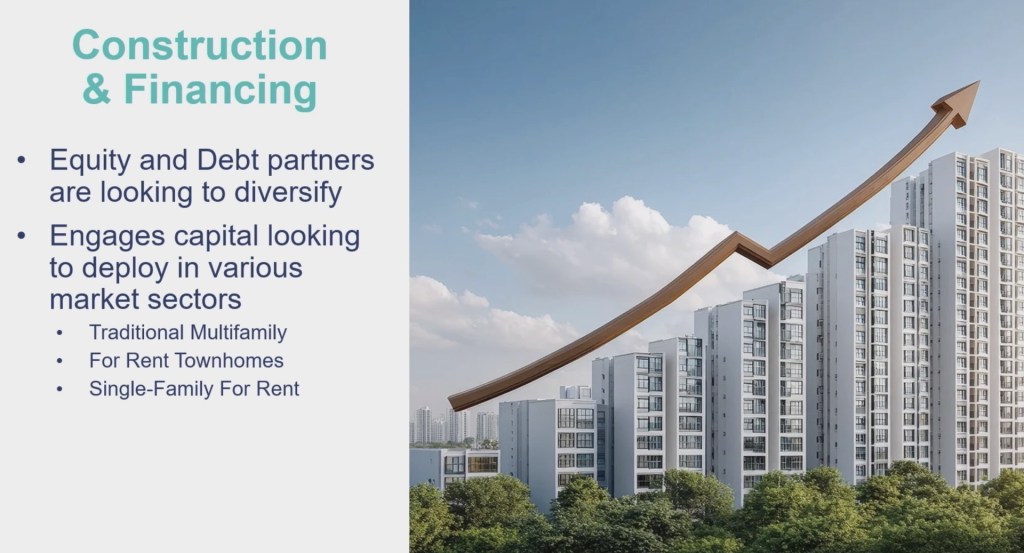
Diversification also helps ensure the financial resilience of real estate assets by softening the potential impact of market shifts in a particular subsector. “One thing we always hear when we talk to debt and equity partners is they’re looking for diversity,” said Whitaker. “That’s nothing new. But now we’re seeing groups within multifamily wanting to diversify within that sector. There’s been a lot of movement from institutional capital to get into the BTR space over the last few years in particular. We can say, ‘Hey, we don’t have a full BTR project, but we do have a project that’s 45 percent BTR… can we talk?’”
Landmark Properties finds that some equity partners are looking for smaller BTR development and sometimes in a more infill market or a higher-cost-of-living market. In order to make the deal work, they need to add density. “If it were all BTR, there are concerns about lease up of one single product type, and also just the scale of that deal for less of a proven product,” explains Helmick.
“One way that we can hedge that is by adding the multifamily component, which gets equity a lot more comfortable with the deal when they see you can offset one product type with the other.” Helmick said. “It can also be a great way to introduce a new product type to the market.”
According to Long, BTR—whether it’s a full single family standalone or town homes—pairs well with a garden product, even when they’re literally two separate projects. “From an exit strategy, you could spin off one or both, or they could work together and build efficiencies by sharing leasing and management team,” Long explained.
“You can share amenities or build separate amenities. But, make sure that the community stays unified visually, that they’re cousins with similar architecture, so you’re starting to build that feeling of neighborhood. It shouldn’t look like two totally separate projects. They should integrate together. You need to tell the right story architecturally within the product mix,” Long advised.
Looking at ProForma
The panelists agreed that diversification can also make it easier for the pro forma to pencil. Every time you take units away, it gets harder to make the numbers work. You can reduce density by adding different product types, but you’re also adding different price points. Different products have different construction costs and different rental rates. That math can get complicated—but there is power and flexibility to move things around between the product types within the pro forma to get the numbers to work to get to a product that feels good, can get entitled and be built.
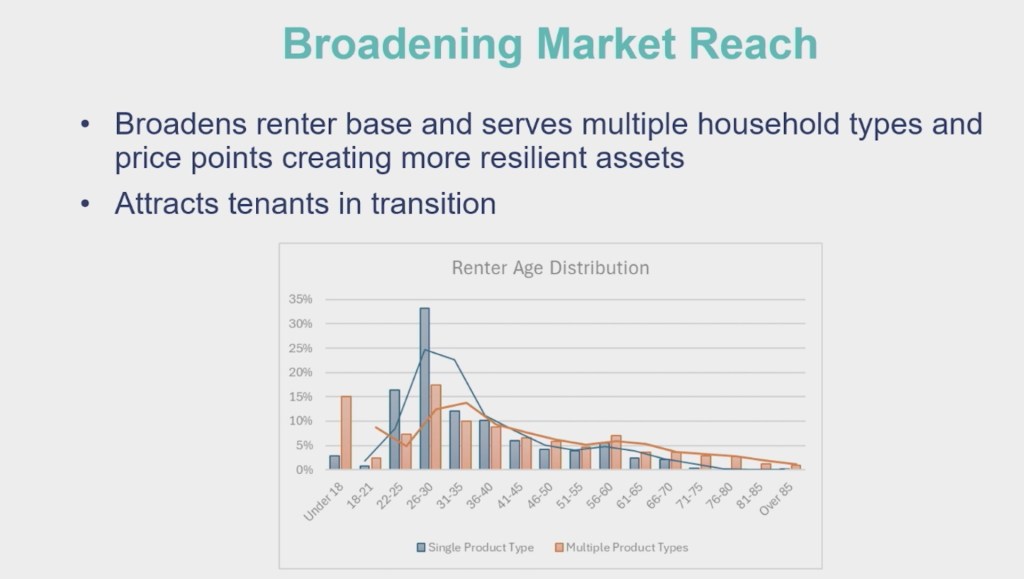
“We always find that the BTR units are cheaper to build per square foot, and you can also charge that premium rent,” said Helmick. “So that does help soothe that burn a bit of losing some density. With diversification, you’re broadening your tenant base. You’re appealing to a much wider audience.”
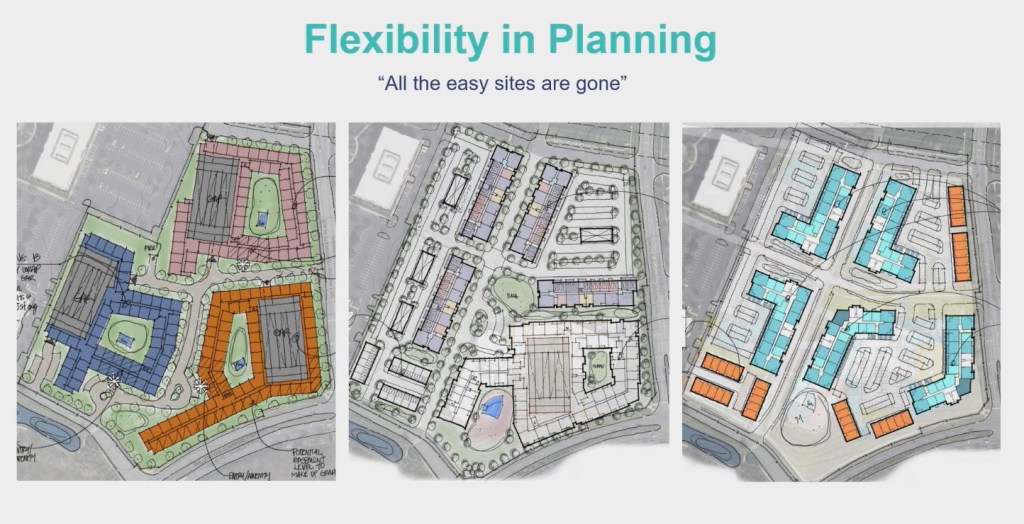
Whitaker pointed out that the key takeaway regarding diversification is that all the easy sites are gone. “Everything is harder to pencil these days. Sites are more complicated.” Diversification gives you a different way to look at development opportunities, because it opens up some of those sites that may not otherwise be feasible.