National Multifamily Report – October 2026
Advertised rents reached their highest annual growth rate in more than three years.
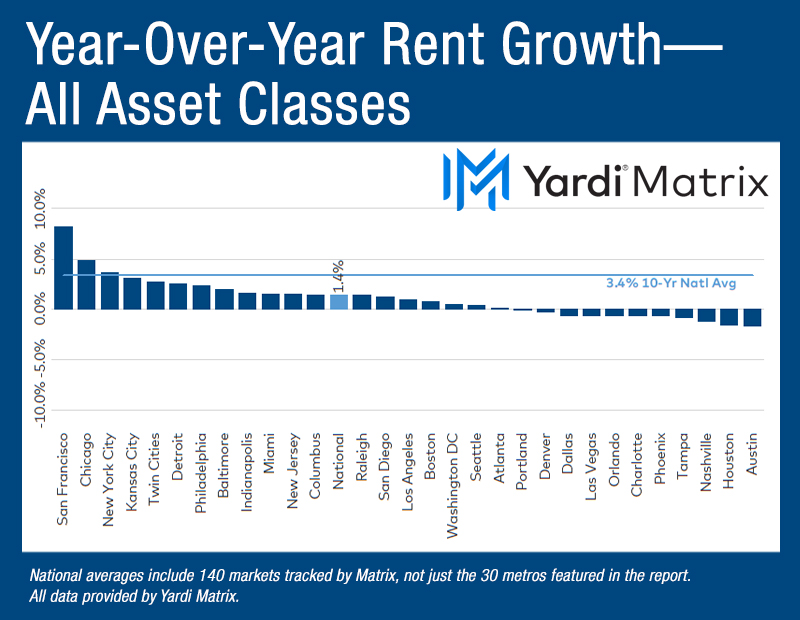
U.S. advertised asking rents edged up $1 in October to $1,777, according to Yardi Matrix’s latest survey of 140 markets. It was the first October increase since 2022, while annual growth reached 1.4 percent, the highest in more than three years. Gateway and Midwest markets outperformed, led by San Francisco. Single-family build-to-rent asking rates rose 1.1 percent year-over-year despite a monthly decline.
San Francisco led annual rent growth at 8.2 percent, followed by Chicago (4.8 percent), New York City (3.6 percent), Kansas City (3.1 percent) and the Twin Cities (2.7 percent). Sun Belt metros remained weaker: Austin rents declined 1.7 percent, Houston fell 1.5 percent, Nashville dropped 1.2 percent and Tampa slipped 0.8 percent. Still, Austin’s annual decline was its smallest in more than three years.
National stabilized occupancy held at 94.3 percent in October, down 20 basis points year-over-year. Columbus, Indianapolis and Las Vegas each recorded 60-basis-point declines, while Tampa lost 50 basis points. Six of the top 30 metros logged annual occupancy gains.
October gains defy seasonal slowdown
Rents increased 0.1 percent monthly, with 14 of the top 30 markets posting gains. San Francisco led at 0.7 percent, followed by Chicago (0.5 percent) and Philadelphia (0.3 percent). Nashville fell 0.5 percent, Las Vegas declined 0.4 percent, New York dropped 0.3 percent and Raleigh also contracted. Despite relatively modest annual growth, Boston, New Jersey, Los Angeles and Seattle registered monthly increases. New York’s third consecutive decline reflected a 1.8 percent drop in Renter-by-Necessity rents.
Elevated interest rates present another obstacle. The 10-year Treasury yield climbed from 4.38 percent in late June to 5.31 percent in early October before retreating to 4.85 percent. Higher financing costs complicate deals, with some sellers potentially facing price reductions of 3 to 6 percent. Multifamily transactions totaled $62.6 billion through the first three quarters, putting sales on pace to match or fall slightly below last year’s volume, according to Matrix.
In the BTR segment, advertised rents fell $4 to $2,247 in October, despite increasing 1.1 percent annually. Occupancy stood at 94.9 percent, up 10 basis points year-over-year. Miami led rent growth at 5.6 percent, followed by Austin at 3.9 percent and Indianapolis, while San Antonio (down 5.5 percent), Houston (down 2.4 percent), Pensacola, Phoenix and Harrisburg were among the weakest. Renter-by-Necessity occupancy reached 98.9 percent in Las Vegas, 98.6 percent in the Twin Cities and 98.5 percent in Austin, underscoring demand for more affordable rentals.