Most US Rental Markets Just Got Hotter
Renter competition was up across more than 80 percent of the U.S. this year, a new analysis shows.
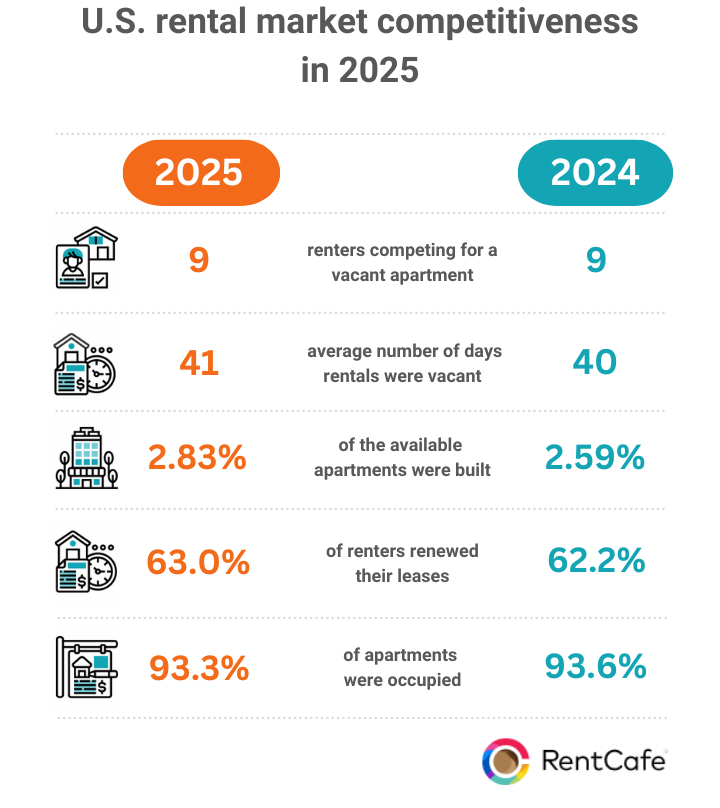
As we head into 2026, competition between renters in many U.S. rental markets heated up, according to a RentCafe analysis. Some 82 percent of markets proved to foster a tougher environment for renters, while just 18 percent showed signs of softening.
RentCafe employed Yardi Matrix data to investigate the largest 139 markets across the nation, assigning each a Rental Competitiveness Index based on five key metrics: the average number of days on market for apartments, occupancy rates, the number of renters competing for a given unit, share of renters renewing and completions as a percentage of total stock.
The average RCI at a national level clocked in at 75.2, above last year’s figure of 74.4, underlying a competitive environment for the average renter even amid rental growth slowdown and many new available apartments to choose from—multifamily deliveries in 2025 made up 2.83 percent of stock, up from 2.59 percent in 2024.
The Northeast was the most competitive region (RCI of 80.6), followed closely by the Midwest (80.3) and Florida (79.5). The South had a score of 76.4, besting the Mid-Atlantic (76.1), which rounded up the top five.
The other regions scored below the U.S. average, with California (74.0) ahead of the Southeast (72.8), Southwest (72.0), Pacific Northwest (70.6) and the West (69.3). While the supply-heavy environment of the Sun Belt most likely influenced renter competition in some areas, the lower index can also imply higher renewals despite an abundance of choices.
While the Northeast stood out as the hottest region, it provided none of the top three most competitive markets. Florida and the Midwest, meanwhile, gave the top three: Miami, Chicago proper and Suburban Chicago.
Miami units are the most sought-after; Chicago apartments spend fewest days on market
Metro Miami continued its reign as the nation’s hottest rental market, even increasing its RCI by 1.7 points year-over-year, to 92.9, more than double the average national increase of 0.6 points. As many of the largest tech and finance firms expand in the Magic City, demand is keeping up, leading to the average unit in the metro having 19 prospective renters vying for occupancy—the highest number across the country.
The market’s surging demand also translated into an occupancy rate of 96.4 percent and a lease renewal rate of 72.5 percent, even as new completions equated to 4.22 percent of total stock. All these metrics clocked in higher than their respective national averages.
While Miami apartments had the most renters competing, Chicago’s multifamily market led by a different metric. Units in the Windy City spent the least amount of time vacant when compared to all other large markets, with an average vacancy of just 32 days, down from 34 days last year. For reference, the national average came in at 41 days.
Chicago’s RCI score ticked up an impressive 5.7 points year-over-year, to 88.2. Its occupancy grew 60 basis points to 95.1 percent, all while renters chose to renew their leases at a 61.1 percent rate, up 90 basis points compared to last year. However, new supply was less abundant in 2025, with new completions making up 0.75 percent of stock, down from 1.87 percent last year.
The Windy City’s RCI score growth mirrors the increase in renter contention across other top markets, such as Manhattan, N.Y., where the index ticked up 5.6 points, or Minneapolis–St. Paul, Minn., which witnessed a growth of 5.2 points.
Renter competition gets hot across Twin Cities suburbs
Yet, it wasn’t any of these that took the crown as the market rising most in 2025. The suburbs of Minneapolis-St. Paul, including places such as Woodbury, Minn., Roseville, Minn., Bloomington, Minn., Brooklyn Park, Minn., Edina, Minn., as well as River Falls, Wis., and Hudson, Wis., witnessed the most pronounced surge among large markets: a spike of 9.2 in its RCI reading.
The market saw a significant slowdown in deliveries, with 2025 completions making up just 2.5 percent of stock, down from 5.2 percent in 2024. With fewer choices, renters stayed put—renewals increased 170 basis points year-over-year to 67.8 percent in 2025—and occupancy likewise grew 80 basis points, to 94.7 percent. Meanwhile, 11 prospective renters competed for one unit, up from nine in 2024.
Urban Twin Cities fundamentals solidified across the board as well, yet the figures were mostly tamer in comparison with the suburbs. Occupancy went up 80 basis points to 93.2 percent, renewals spiked 280 basis points to 63.0 percent, all the while 10 potential renters vied for one apartment, up from nine last year.
Somewhat surprisingly, smaller rental markets recorded even larger spikes in RCI scores.
Smaller U.S. rental markets are just as competitive
Port St. Lucie, Fla., emerged as the small rental market with the highest year-over-year rise. The area’s population grew by more than 25 percent since 2020, making it the sixth-largest city in the Sunshine State, according to the U.S. Census Bureau and Florida Demographics.
Most of the new residents are remote workers and renters priced out of South Florida, as well as retirees, all of whom drove lease renewals to 75.1 percent in 2025, up from 69.8 percent last year. Meanwhile, new construction plummeted as 2025 deliveries made up just 2.6 percent of stock, down from a whopping 12.9 percent in 2024.
As a result, Port St. Lucie’s RCI landed at 86.9, up 12.5 year-over-year. This ranking places it sixth among smaller rental markets, but also ninth across all markets, regardless of size.
Another notable up-and-coming market is Lubbock, Texas, which witnessed its RCI figure tick up 8.2 points year-over-year, to 82.4 in 2025, on the heels of a massive increase in the number of renters competing for one unit—11 on average this year, up from just five in 2024.