Austin’s Rent Realignment: From Fastest Growth to Steepest Drop
Local policies drove this shift, according to The Pew Charitable Trusts.

Against the backdrop of a population spike, rents in Austin, Texas, have seen a serious shift over the past two decades, according to a report by The Pew Charitable Trusts.
Between 2010 and 2019, Austin rents went up nearly 93 percent, a growth eclipsing all other major cities across the country,
Then, between December 2021 and January 2026, median rates fell from $1,546 to $1,296, marking a 16.2 percent drop. The figure declined from 15 percent above the U.S. average to 4 percent below that benchmark.
Zooming in on tighter timelines, Austin multifamily buildings of 50 units or more have witnessed a 7 percent drop in rents from 2023 to 2024, the steepest decline across all large metro areas around the nation. Notably, this happened even as the market’s population grew by 18,000 residents between 2022 and 2024.
Austin rents tumbled post supply expansion
One of the key drivers behind this rental adjustment was Austin’s regulatory reform, which greatly spurred multifamily development. Between 2015 and 2024, developers added 120,000 units to the city’s inventory, marking a 30 percent growth, more than three times the national average increase of 9 percent.
This led to apartments becoming the predominant housing typology in Austin proper as of 2024. However, at the time single-family homes or townhomes still made up 71 percent of U.S. housing and 80 percent of Austin’s suburbs.
Two policies had the largest impact on Austin’s construction industry, namely reducing and eliminating parking mandates, as well as rezoning commercial and underbuilt areas for multifamily, Alex Horowitz, project director of The Pew Charitable Trusts’ housing policy initiative, told Multi-Housing News.
In fact, Austin is the largest U.S. city to remove minimum parking requirements for almost every type of property. This change was enacted in 2023. Meanwhile, the rezoning initiative targeted the downtown area and certain areas near the University of Texas at Austin, increasing maximum building height. In exchange for these benefits, developers had to include income-restricted units.
Affordable production took off
And Austin went beyond loose height restrictions to bolster affordable housing production. Other initiatives included a $250 million bond measure signed in 2018, followed by similar $350 million one in 2022. A different development program, approved by the city council in 2019, offered many benefits in exchange for at least 50 percent of units being income-restricted.
“The biggest beneficiaries of Austin’s reforms were low-income renters, because with additional housing they faced less competition from higher-income renters for older, naturally affordable apartments,” Horowitz mentioned.
All these incentives led to Austin topping the national ranking for affordable housing deliveries in 2024. That year, developers brought online 4,605 such units, more than doubling the figure of 2023.
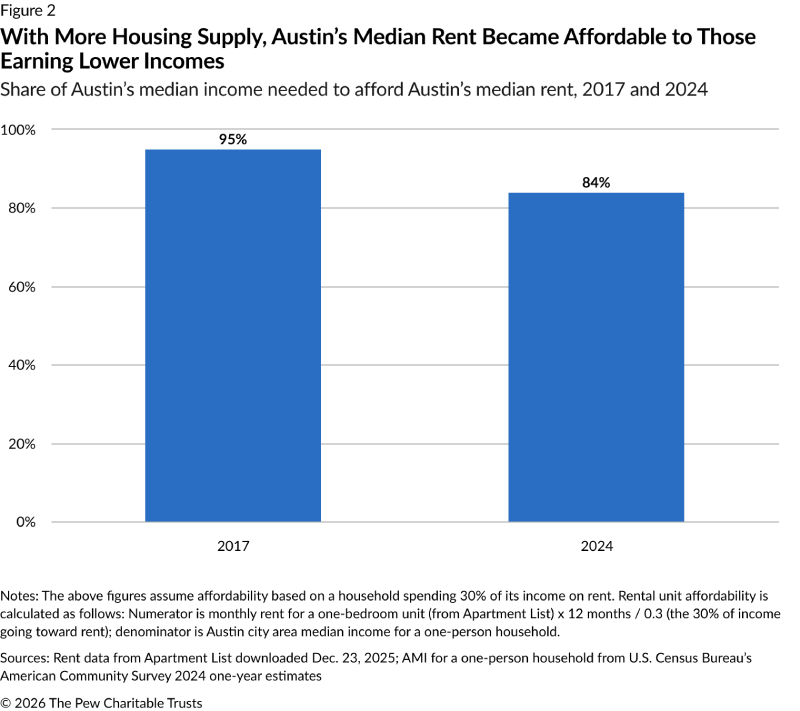
All these changes led to the city’s median rent becoming affordable to a single-person household earning up to 84 percent of the area median income in 2024, down from 95 percent of AMI in 2017.
Can inventory expansion keep up with demand?
Despite these initiatives, there was an underproduction of more than 23,000 units in Austin in 2022, according to housing equity advocacy organization Up for Growth.
Since then, several additional regulations have been passed to address mounting multifamily demand, improving duplex, triplex and accessory dwelling units construction, as well as streamlining renovations, easing lot size and width requirements, in addition to allowing taller buildings near single-family homes.
Still, with lower prospective gains, further incentives may be required for projects to pencil out across Austin. “With lower rents, for housing production to stay high, it’s necessary to continue lowering the regulatory barriers to adding housing,” Horowitz added.
READ ALSO: Megaregion in the Making? Austin-San Antonio’s I-35 Corridor
The city tackled some of those barriers through expediting the permitting process. These procedures were the bread and butter of multiple initiatives that passed between 2023 and 2025. Some of the latest procedures have even adopted AI technology.
These changes were implemented despite the fact that Austin already had the speediest permitting process across Texas. For instance, between 2021 and 2023, the city averaged 957 apartment permits for every 100,000 residents. San Antonio was second at only 346 apartments for every 100,000 residents.
Applying Austin’s housing approach across the nation
Elsewhere, other cities have pursued similar policies in recent years. Minneapolis, for instance, has eliminated minimum parking requirements for new developments, stimulated multifamily development in commercial corridors and established height minimums in high-density zones, among other measures, according to another report by The Pew Charitable Trusts.
The result was a 12 percent inventory growth between 2017 and 2022, while rents grew just 1 percent. Conversely, the rest of Minnesota witnessed its stock grow by just 4 percent during the same period, while rents spiked 14 percent.
In time, many other cities have made it easier to build and improve affordability conditions. They include Houston, Durham, N.C., Spokane, Wash., and New Rochelle, N.Y., Horowitz mentioned.
However, there are several barriers to look out for. Cities may face a potential hurdle when attempting to enact pro-housing policies in the form of vocal minorities that oppose such initiatives.
“Even though allowing more housing is popular with the general public, cities often use feedback processes that are dominated by a vocal minority of residents who are more negative than their communities about allowing enough homes for everyone,” Horowitz added.