Appealing to Prospective Renters: Cost Transparency and Speed
New surveys and federal data show renters prioritize total-cost transparency and fast, mobile-first service.

Renters in 2025 are pragmatic and time-strapped, a reflection of broader multifamily trends emphasizing cost transparency and convenience. They want to know the actual monthly cost before they book a tour. They want routine service handled the way everything else in life is handled—on a phone, quickly, with updates they don’t have to chase. They trust specifics over slogans, and they’re increasingly alert to which communities reduce friction versus add it. Underneath those preferences is a simple calculus: time and money. The faster you make costs clear and the easier you make day-to-day living, the more likely you are to win the lease, and the renewal.
Affordability is the backdrop to all of this. The latest national report from Harvard’s Joint Center for Housing Studies confirms that renter cost burdens are at a record high, with 22.6 million households—half of all U.S. renters—cost-burdened in 2023. That environment is exactly why renters evaluate communities through a total-cost lens first and reward properties that make trust visible in the details.
Transparency ranks highest
What renters most want to see online isn’t a flashy perk but a breakdown of costs. The 2025 SatisFacts Biennial Online Renter Study shows “mandatory fees beyond the advertised rent” ranks at the top of content prospects expect on community sites and listings, alongside rents and specials, availability, floor plans and photos. Close behind are how rent is determined and utility billing practices.
For policy context, the National Consumer Law Center’s latest brief documents how “junk fees” in rental housing inflate total costs and highlights state efforts to curb them—momentum that argues for clean, public fee schedules and elimination of redundant line items. Transparency isn’t just good marketing, it’s aligning with the policy climate.
Federal read: late fees down, balances up
A recent analysis by the Consumer Financial Protection Bureau (CFPB) quantified renter strain and underscored why fee clarity resonates. Using new rental-payment data, the Bureau reported that the share of renters incurring a late fee climbed from 15.4 percent in 2021 to 23 percent in 2023, then eased to just under 14 percent by November 2024. Over the same period, the median outstanding rent balance rose roughly 60 percent, and among those who pay late fees, the average fee is about $85.
These are the kinds of costs residents want to see up front. Pairing transparent fee schedules with proactive budgeting tools (e.g., reminders, grace-period messaging) could reduce distress and delinquency risk.
Digital-first service—and fast, human replies
The leasing and living journeys are phone-first, reflecting the evolution of multifamily leasing toward digital convenience and responsiveness. SatisFacts shows text and email as the top resident communication channels, and a strong interest in submitting maintenance requests via text. Public responsiveness matters, too. A majority of renters read company responses to reviews and consider a one to two business days reply window acceptable. Templated or robotic language undermines credibility, while concise, property-specific replies that acknowledge the issue and name the next step build trust and reduce churn.
Amenities that actually move the needle
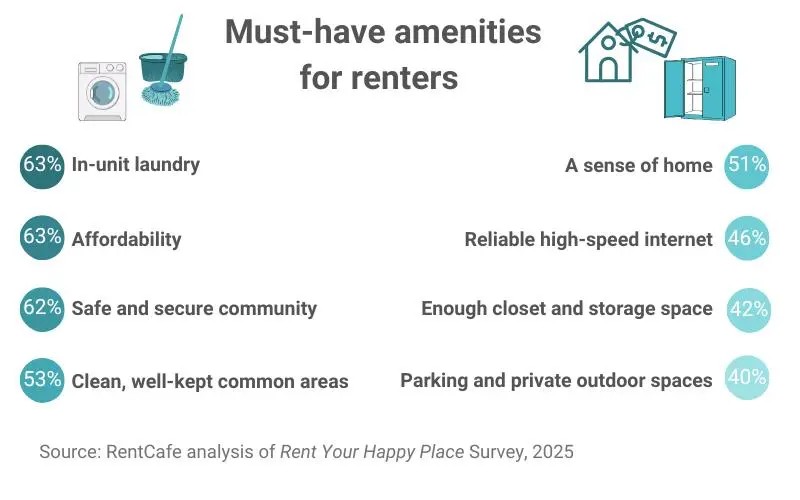
Renters’ “must-have” bundle is practical. RentCafe’s 2025 survey of more than 5,000 renters puts in-unit laundry, safety/security measures, clean common areas, reliable high-speed internet and better storage at the top. Parking and private outdoor space are also widely valued. If capital spending is limited, these daily-utility features punch above their weight in leasing and retention.
Neighborhood priorities mirror that pragmatism: safety first, then walkability and access to transit and daily-needs retail. Cross-checks from the National Multifamily Housing Council (NMHC) and Grace Hill’s national renter preferences survey, with input from more than 172,000 residents across 4,220 communities, reinforce the same through-line: connectivity, in-home conveniences and friction-removing technology across the journey.
Reputation is the new curb appeal
Before touring, renters are pressure-testing online. In SatisFacts, prospects rate detailed review content—specifics on unit conditions, service quality and follow-through—as the most helpful element, with visuals and “verified resident” signals also influential.
Review management became a core leasing function and a key driver of resident satisfaction. Hence, property managers and operators should encourage residents to share details after a maintenance job is completed, respond to low-star reviews with concrete fixes (and a timestamp) and keep tone tight, human and actionable.
Credit building can differentiate, if you tell the story
Rent reporting sits at the intersection of financial wellness and loyalty. Credit reporting would benefit renters, but awareness is low—many residents don’t know whether their community reports on-time rent at all. According to the CFPB, rental payment history remains largely absent from consumer credit files, so opt-in rent-reporting programs can provide real value, not just marketing copy.
Touring behavior: digital tools matter, but most still want to “see”
High-quality unit photos, 3D floor plans and video walkthroughs are now baseline expectations and materially help prospects make decisions. SatisFacts’s survey found media scoring well above automated chat, emphasizing utility over novelty. Sight-unseen leasing remains a minority behavior (roughly one in six renters), but most who leased without visiting said they were happy when visuals were accurate and follow-through was strong.
Practical moves for operators
Here are some actionable steps for marketers:
- Publish the full cost picture. Itemize every recurring and one-time charge (application, admin, pets, parking, utilities, convenience fees) and explain how rent is determined. Mirror this on listings so there are no late-stage surprises.
- Stand up a review-response service level agreement. Route reviews into your CRM, assign owners and require a tailored reply within one–two business days.
- Meet residents in their preferred channels. Enable text for maintenance and announcements and ensure mobile payment and request flows take minimal clicks.
- Lead with must-haves. Put laundry, safety and connectivity at the top of copy and tours. Back them with proof (washer and dryer photos, internet provider speeds, access control and lighting).
- Clarify screening and fees. Publish criteria, timelines and all application-related costs. Add a short “what we check/how to dispute errors” FAQ aligned to consumer-protection guidance.
- Make rent reporting visible. If you report, label it clearly and explain enrollment. Otherwise, evaluate adding it—awareness is low, but perceived benefit is high.
Renter behavior is practical: people want the true total cost up front, everyday conveniences that respect their time, and a community that communicates clearly and acts quickly. Put transparency and response at the center, emphasize must-have features (laundry, safety, reliable internet) and use credit building, value-forward incentives and mobile-first service. In a market where many households are stretched, that combination earns trust—and leases.