
The Perfect Storm for Apartment REITs
Improving fundamentals and share price markdowns are getting investor attention.

The multifamily sector’s challenges have been well-documented over the past few years: Extraordinary rent growth during the pandemic triggered a development boom that outpaced absorption, leading to stagnant or declining occupancies and rents. The weakness has affected apartment landlords broadly, but the capital markets have taken a decidedly bearish view of publicly traded REITs—despite their strong balance sheets.
At the end of September, apartment REIT share prices reflected a roughly 20 percent discount to portfolio net asset value after the U.S. 10-year and five-year Treasury yields both rose above 5 percent for the first time since 2007, according to analysts. That topped the 15 percent of three months ago by about 5 percentage points.
“The public markets reward growth,” said Jeff Yurk, co-head & portfolio manager of the global real estate securities group at Heitman. “And ever since we saw the pandemic pop in rents, multifamily rent growth has been pretty anemic and slowing down.”
Behind the public-private gap
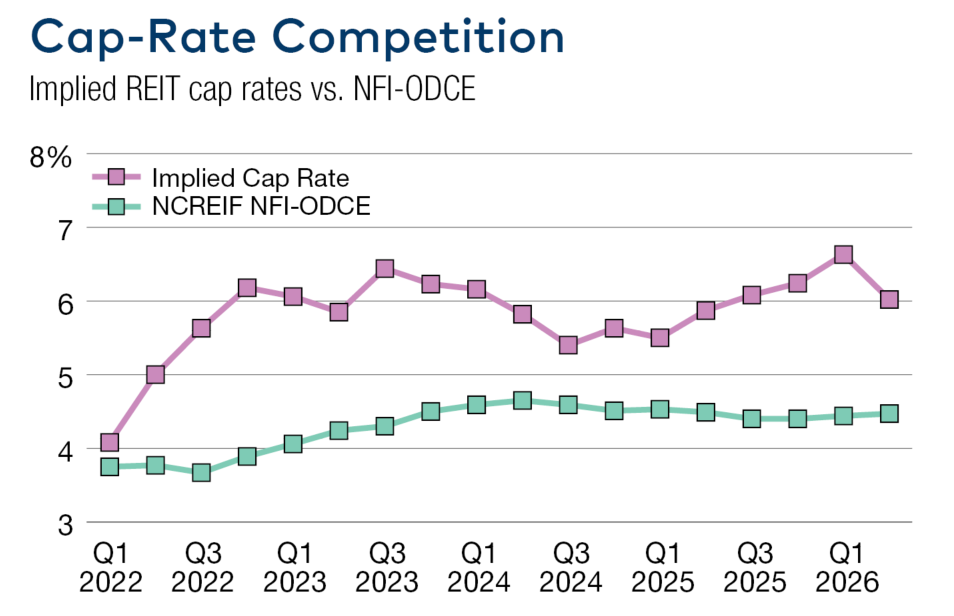
Private apartment values haven’t reflected the same degree of weakness. Despite facing the same fundamental headwinds, private apartment owners have seen the cap rates largely bounce between 4 and 4.6 percent since late 2022, according to data from NCREIF’s Open-End Diversified Core Equity Index. By comparison, the implied cap rate of multifamily REITs has hovered around 6 percent over the same period, according to Nareit, representing a spread of roughly 150 to 200 basis points above the private market.
The public markets reward growth. And ever since we saw the pandemic pop in rents, multifamily rent growth has been pretty anemic and slowing down.
—Jeff Yurk, Co-Head & Portfolio Manager, Global Real Estate Securities Group, Heitman
For perspective, at the beginning of 2022, multifamily REIT implied cap rates exceeded the appraisal cap rates of private portfolios by only about 30 basis points. Historically, the type of value gap that emerged four years ago would have corrected within four to six quarters, said Edward Pierzak, senior vice president of research at Nareit. But this cycle’s stubborn imbalance in apartment supply and demand, and the resulting sluggish rent and net operating income growth has prolonged the wide differential.
The current dynamic could be changing. The spike in interest rates late in the third quarter will put additional upward pressure on private cap rates, Pierzak said. What’s more, multifamily supply and demand are balancing out, and some dedicated REIT investors have taken slightly overweighted apartment positions in anticipation of improved financial performance in the quarters ahead, he added.
“We think there will be a convergence of cap rates, and once they come back into sync, we’ve found that REITs tend to outperform private markets,” Pierzak said. “The third part of that is timing, and unfortunately, that remains a bit uncertain. But the current environment appears to be an impetus to begin to push toward closure.”
Multifamily REIT Cheat Sheet
As apartment fundamentals improve and multifamily REITs eventually return to favor, they will be in a better position consolidate a fragmented market. While some public REITs will be bought by private companies, as in the case of Veris Residential, which was acquired by a consortium led by Affinius Capital earlier this year, others will acquire assets held by private funds or nontraded REITs. Public multifamily REITs will also continue to combine with each other, as in the case of the recent $69 billion merger between Avalon Bay and Equity Residential.
Upon the merger’s completion in August, the two REITs rebranded as Vivmark Residential as the companies moved to the integration phase of the combination. Trading under the ticker VMRK, Vivmark has a market capitalization of some $46.6 billion and owns more than 184,000 apartment homes along the coasts and in Texas and Colorado.
Here are the other major pure-play apartment REITs on investors’ radars. Market capitalizations are based on recent pricing. Portfolio information was captured from regulatory filings and investor presentations.
Essex Property Trust (ESS)
Market cap: $18.5 billion
More than 62,000 units of Essex’ properties are on the West Coast, predominantly in Northern and Southern California. The majority of its acquisition activity over the last two years has been in Northern California submarkets, and the company continues to target the region for investment.
Mid-America Apartment Communities (MAA)
Market cap: $13.8 billion
Roughly 105,000 of Mid-America’s units focus on high-growth markets in the Southeast, Texas, Midwest and Southwest. Mid-America has a roughly $800 million development pipeline in markets such as Denver, Phoenix, Kansas City, Mo., Richmond, Va., and Charleston, S.C.
UDR (UDR)
Market cap: $12.4 billion
UDR owns about 60,000 units in the Northeast, Mid-Atlantic and West Coast regions as well as in Texas, Colorado, Florida and Tennessee. UDR expects to dispose of up to $750 million in assets this year to fund growth—including potentially $300 million in acquisitions in 2026—and share repurchases.
Camden Property Trust (CPT)
Market cap: $11.2 billion
Camden owns more than 56,000 units in the Southwest, Mountain, Texas, Southeast and Mid-Atlantic regions. The company exited California when it sold an 11-property portfolio for more than
$1.6 billion to a BlackRock vehicle in August. The REIT has also purchased assets valued at $755 million this year and expects to spend up to $300 million more.
Independence Realty Trust (IRT)
Market cap: $3.5 billion
IRT owns nearly 37,000 units primarily in the Midwest, Southeast and in Texas. In September, IRT and multifamily REIT Centerspace announced plans to merge in a $1.8 billion transaction. The merger, which is being challenged by an IRT shareholder, would create a company with roughly 44,000 units and expand IRTs presence in the Mountain West region.
Centerspace (CSR)
Market cap: $920.5 million
Centerspace owns and operates 47 apartment communities with more than 10,000 market-rate and townhome units in Colorado, Minnesota, Montana, Nebraska, North Dakota and Utah.
NexPoint Residential (NXRT)
Market cap: $973 million
NexPoint’s portfolio comprises 13,000 units in the Southeast and Southwest regions and in Texas. NXRT focuses on acquisitions that provide opportunities to add value in growing employment centers, while avoiding more competitive gateway markets.
BRT Apartments Corp. (BRT)
Market cap: $250 million
The company owns nearly 9,000 units in the Southeast and in Texas and Ohio. BRT owns and operates Class B or better communities and, since 2022, it has focused on buying out joint venture partner interests as well as direct acquisitions with the opportunity to create value.
Equity competition
Markets such as San Francisco, New York, Kansas City, Mo., and Chicago are exhibiting signs of a firming recovery. All experienced strong year-over-year rent growth that either approached or exceeded 5 percent in August, according to Yardi Matrix. In particular, San Francisco’s 6.1 percent rent growth, driven by artificial intelligence hiring, has cast West Coast apartment REIT Essex Property Trust, which derives 43 percent of its NOI from the San Francisco Bay Area, in a favorable light. Its share price reflects a discount of only about 9 percent to NAV—some 11 percentage points below the apartment REIT sector discount, Yurk noted.
More broadly, Heitman is weighting multifamily REITs neutral instead of underweight given signs of recovery in San Francisco and beyond, he observed. “We see a stabilization that’s about to occur and potentially an uptick in the rate of growth,” Yurk explained. “But we’d like to see a few more signs before we get bullish, and one thing I’m watching closely is jobs for new graduates. They just haven’t been at the levels to support the industry.”
The thing about the multifamily REIT space is that the companies have good operating platforms with meaningful scale, and they have very low leverage compared to private markets.
—Anthony Paolone, Co-Head of U.S. Real Estate Stock Research, J.P. Morgan
Making the case that fundamentals are improving is only one front on which multifamily REITs are battling for investor attention. They also are going up against alternatives in the broader equity market, said Anthony Paolone, co-head of U.S. real estate stock research at J.P. Morgan. Multifamily REITs are projected to have relatively flat earnings per share this year, for example, compared with 7 percent growth for the entire REIT universe and 35 percent for the S&P 500 index. While multifamily REIT earnings are expected to improve in 2027, they will still lag the growth other equity sectors are generating, he added.
Still, the current share-price discount, along with multifamily REITs’ the solid and transparent operating track records, can be attractive to some investors, Paolone noted. “The thing about the multifamily REIT space is that the companies have good operating platforms with meaningful scale, and they have very low leverage compared to private markets,” Paolone pointed out. “So if you’re a long-term investor, you can feel pretty good about buying quality real estate at a compelling discount in a liquid way.”
Public benefits
Indeed, residential REITs, which include smaller single-family rental and manufactured home companies, had a debt-to-market-assets ratio of 28.5 percent in September, Pierzak said. Additionally, the interest rate on the lion’s share of that debt is fixed and below 4 percent, according to Nareit. When stacked against private multifamily owners, REITs, in many cases, enjoy broader capital-raising options, including the traditional mortgage markets and equity issuances, Pierzak and others assert.
One of the more appealing alternatives is in the unsecured debt market, where the companies can access capital at a more attractive interest rate than in the mortgage market, shared Todd Kellenberger, director and client portfolio manager of real estate securities at Principal Asset Management. That type of financing gives multifamily REITs more flexibility to acquire assets or to make changes at their own properties that are unencumbered by mortgages, he added.
The size of multifamily REITs also allows them to create economies of scale and provide significant amounts of data that can be harnessed and crunched by AI to improve operational efficiencies, investment and disposition decisions, and asset management, Kellenberger and others said. Even in times when share prices are struggling, the REITs have an opportunity to create shareholder value through stock buybacks and asset dispositions, Kellenberger noted.
Meanwhile, compared to other REIT sectors, multifamily REITs can more quickly capture sizable rent increases in a recovering market given the typical one-year lease durations, he reported. For those and other reasons, Kellenberger is keeping a close eye on apartment demand.
“At the end of the day, an apartment is someone’s home, so there is a bit of stability and defensiveness compared to retail, hotel and maybe even office real estate that’s going to be more sensitive to economic changes,” Kellenberger says. “We’re still cautious about when the demand inflection point is going to come. But from a valuation standpoint, if you’re looking for an attractive entry point to buy institutional-quality apartments, it’s a pretty interesting moment.”