National Student Housing Report – September 2026
Preleasing reached 93 percent in August, while rent growth continued to lose momentum, Yardi Matrix data shows.

Preleasing across the Yardi 200 reached 93 percent in August, 80 basis points above Yardi Matrix’s final August 2025 estimate and 120 basis points above August 2024, according to the latest national student housing report. The preliminary figure remains subject to revision as final occupancy data is collected, but Yardi Matrix expects the season to finish at roughly 94 to 94.5 percent.
Performance varied sharply by property quality and location. Class A communities were 93.8 percent preleased, compared with 92.1 percent for Class B and 91.7 percent for Class C assets. Properties within a quarter-mile of campus reached 93.4 percent, while those between a quarter-mile and a half-mile stood at 93.2 percent. Communities more than 2 miles from campus were only 88.7 percent preleased and trailed last year by 110 basis points.
READ ALSO: Inside the Student Housing Amenities Evolution
At a market level, 28 Yardi 200 schools reported full preleasing and another 11 were above 99 percent. University of Maryland and Auburn University were both fully preleased, while University of Missouri reached 99.9 percent and Virginia Tech reached 99.8 percent. Nearly 320 individual properties were reported as 100 percent preleased, slightly more than at the same point last year. Strong results in several large markets have also attracted new development.
Momentum was far from universal. Fifty-two schools remained below 90 percent preleased, including 21 below 80 percent, and 23 markets trailed August 2025 by at least 10 percentage points. Utah Valley stood at 71.1 percent, Syracuse at 77.9 percent and North Carolina State at 78.8 percent. NC State’s shortfall followed the August delivery of 2,195 beds, with another 970 beds under construction for 2027.
Rent growth slows as enrollment moderates
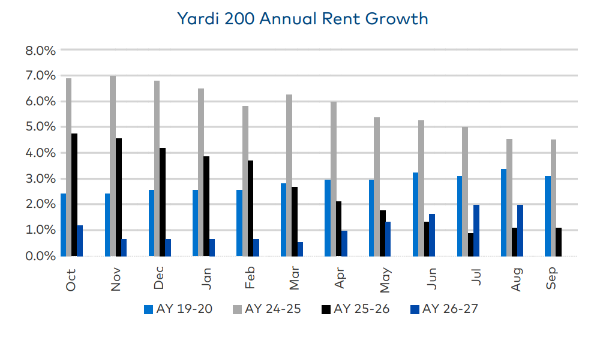
Average advertised asking rent fell to $927 per bed in August, down from $929 in July and $930 in June, marking the lowest level since January. Annual rent growth nevertheless held at 2 percent because rents had declined for five consecutive months during the prior year. Across the 2026-2027 leasing season, growth averaged 1.1 percent, down from 2.8 percent a year earlier and 5.9 percent two leasing seasons ago. Same-store growth averaged only 0.4 percent.
Location also shaped pricing power. Properties within a quarter-mile of campus averaged 1.6 percent rent growth during the leasing season, compared with a 1.2 percent decline for communities more than 2 miles away. Among major markets, annual rent growth reached 7.7 percent at both Auburn and Oklahoma year-over-year, while Arizona and Purdue recorded declines of 7.2 percent and 11.4 percent, respectively. The spread reflects the effects of recent supply as well as uneven demand.
Preliminary enrollment results added another note of caution. Among 38 Yardi 200 schools that had released fall 2026 figures, total enrollment increased by 6,840 students, or 0.6 percent, to 1.1 million, compared with 1.8 percent growth in fall 2025. Arizona State University’s Tempe campus and the University of North Texas reported declines of 7.4 percent and 3.6 percent, respectively. Texas Tech and Georgia Southern posted gains of 9.2 percent and 7.6 percent for the second consecutive year.