C-PACE Expands 1 State, 1 Upgrade at a Time
Key changes are making the program more user-friendly.

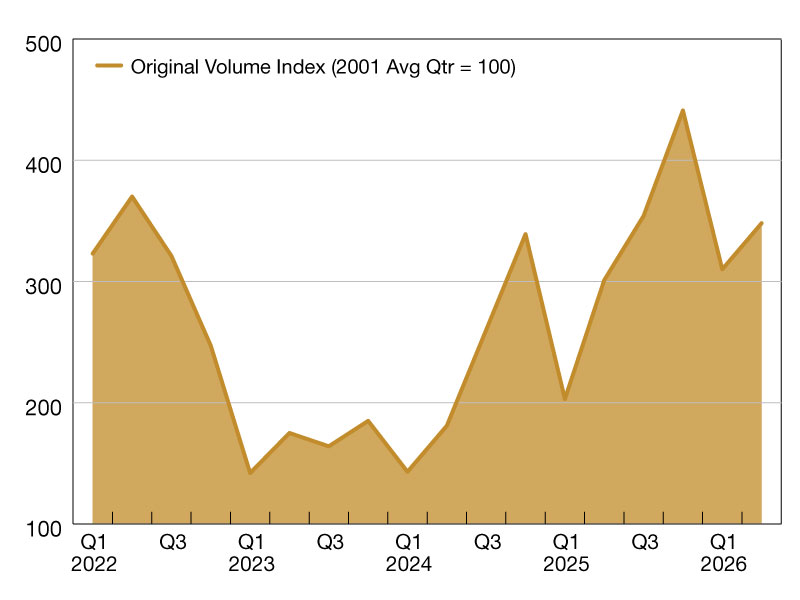
Adoption of C-PACE financing continues accelerating, and one driver is the evolution and growth of state-by-state programs. Overall, Commercial Property Assessed Clean Energy is maintaining a dramatic uptick in adoption. For the first six months of 2026, total market originations have reached approximately $1.56 billion, a doubling over the same period last year when originations were approximately $754 million. Since inception, cumulative C-PACE financings have now surpassed $13 billion.
Observers tend to focus on the number of states that have adopted C-PACE but an equally important view is the advancements made among those states’ programs, making them more flexible, more lender-friendly, and better aligned with the financing needs of today’s commercial real estate market.
LIKE THIS CONTENT? Subscribe to MHN’s Finance & Investment Newsletter
What are some key state-level changes?
State-level program enhancements and momentum have been significant, creating new opportunities for commercial real estate owners, developers and lenders through expanded project eligibility, increased financing capacity and updated regulations making C-PACE more flexible for both new construction and redevelopment.
Vermont recently became the 41st state to authorize C-PACE. Vermont’s newly enacted legislation represents another important milestone, establishing the framework for municipalities to offer C-PACE financing for energy efficiency, renewable energy, resiliency and water conservation improvements. As the program is implemented, it will provide developers and building owners throughout the state with access to long-term capital for modernization projects while supporting broader economic development and energy savings initiatives.
New York recently approved one of the most significant updates to its C-PACE statute since the program’s inception. The legislation broadens eligible improvements to include water efficiency and resiliency measures while removing traditional payback requirements for projects that advance the state’s Climate Leadership and Community Protection Act goals. The changes also establish clearer underwriting standards, eliminate outdated cost-effectiveness requirements, codify mortgage lender consent procedures and create a non-accelerating assessment structure consistent with many of the country’s most mature C-PACE programs.
New York City also expanded C-PACE eligibility for use in financing the acquisition of a property undergoing adaptive reuse as well as financing low-embodied carbon materials in all properties. Aimed to help accelerate office conversions, the inclusion of embodied-carbon reduction as a C-PACE eligible measure means that foundations, footings and building enclosure elements may now be financed in addition to the mechanical, electrical, and plumbing systems.
Collectively, these changes are expected to increase financing flexibility and potentially allow larger C-PACE proceeds on qualifying projects.
The U.S. Virgin Islands also moved forward this year with legislation authorizing a Commercial PACE program. In addition to allowing financing for energy, water conservation and resiliency improvements, the legislation includes provisions enabling the territory’s Energy Office to delegate billing and collection responsibilities to private capital providers, an approach designed to streamline program administration and encourage private investment.
Several existing state programs have also substantially expanded their offerings.
Colorado has updated its program guidelines to permit significantly higher Total Assessment-to-Value thresholds for projects meeting enhanced energy performance standards, including compliance with the 2024 International Energy Conservation Code and certain Colorado energy and carbon requirements. The program now also explicitly includes resiliency and embodied carbon improvements among eligible measures.
New Jersey has likewise broadened its program by making ground-up new construction eligible in addition to traditional retrofit projects. Eligible improvements now include energy, water and resiliency measures, while financing may account for up to 35 percent of a project’s stabilized value.
The momentum extends beyond the U.S. as well. Ontario recently published draft regulations for its Commercial PACE program, marking an important step toward launching Canada’s largest provincial market. As implementation moves forward, stakeholders will be evaluating proposed project eligibility requirements and financing provisions that will shape the program’s long-term development.
Expansion of resiliency, seismic, flooding measures
Among these state-level program expansions, there are two larger shifts at play which are driving broader adoption and also increasing the loan-sizes for C-PACE, now often in the hundreds of millions of dollars.
First, C-PACE programs that include resiliency measures now go beyond the early focus on energy, HVAC, water/wastewater systems and building envelope. Today, many programs include resiliency aspects such as storm-related hardening and protection, flood mitigation, seismic-related infrastructure, and other measures.
States expanding resiliency measures include California, Colorado, New Jersey, New York, Oregon, Pennsylvania, Utah and Virginia.
States specifically authorizing seismic retrofit provisions include California, Oregon, Pennsylvania, Utah and Nevada.
States expressly recognizing flood mitigation and related protective improvements are Alabama, Florida, Georgia, North Carolina and Virginia.
The improvements are particularly useful in rehab and repositioning of older properties, including the recent wave of office conversions for residential use. In many cases, we’ve seen the need for extensive upgrades to older systems expand C-PACE eligibility to 40-50 percent of construction costs. Broader applications such as resiliency allow C-PACE to finance more construction components and achieve higher loan-to-cost and loan-to-value benefits than previously possible.
Combo financing with traditional loans
Another trend driving C-PACE growth is combination financing, where C-PACE is structured alongside traditional construction loans. In a number of recent combo-financings, we’ve worked closely with bank and debt fund partners to structure C-PACE alongside existing debt strategies, and also funded some of them with an in-house turnkey solution.
Through collaborating among lenders, mortgage brokers, sponsors, and advisors, C-PACE capital stack solutions can support the needs of all parties involved. In many cases, C-PACE can provide long-term, fixed-rate capital for eligible improvements while helping preserve liquidity, reduce balance sheet pressure, and support overall project execution.
We’ve been seeing this momentum firsthand at Bayview PACE. C-PACE is increasingly being used to support new construction, recapitalizations, renovations, and energy-efficient improvements across a broad range of asset classes. As traditional senior lenders and alternative capital providers become more familiar with the structure, C-PACE is no longer an afterthought. It is being evaluated earlier in the financing process and integrated alongside senior debt, preferred equity, mezzanine capital, and other sources of project funding.
Anne Hill is senior vice president of Bayview PACE.
Please note: To become a Viewpoint writer, reach out to Therese Fitzgerald at therese.fitzgerald@cpe-mhn.com. All Viewpoints are copyright of Multihousing News 2026. We do not accept AI-written content.