Why Reservations About Hotel Conversions Are Subsiding
These transformations offer distinct advantages over other sources of new units.
Converting hotels to housing is an idea that gets mixed reviews from housing advocates and communities. But it’s hard to deny the cost and efficiency advantages versus other types of housing production
These conversions can bring affordable and supportive housing online quickly and at about half the cost of ground-up development. In California, for example, the cost is about half—$300-to $400 per unit compared to $600 to $700 for new construction, according to Michael Massie, executive vice president & chief real estate development officer at Jamboree Housing, an affordable housing developer.
Hotel-to-apartment conversions in 2024 represented more than 37 percent of all adaptive reuse projects nationwide, delivering over 9,100 new apartments—a 46 percent increase over the previous year, according to a report from RentCafe.
LIKE THIS CONTENT? Subscribe to MHN’s Finance & Investment Newsletter
These projects offer a compelling value proposition. Construction costs were roughly half and the projects were completed in six to 18 months vs. several years for new construction, and these projects can generate returns of 18 to 25 percent IRR, reported Sage Investment Group, a housing developer specializing in hotel-to-housing conversions.
Massie said that Jamboree’s first hotel-to-housing project converted a 50-year-old Econo Lodge motel in Anaheim, Calif., into a revitalized Permanent Supportive Housing community for individuals at-risk of homelessness, homeless, chronically homeless with a mental health diagnosis and veterans.
Completed in 2021, Buena Esperanza is a Spanish-style project designed by architect Manuel Salazar, managing director & senior associate at Los Angeles–based Y&M Architects converted the 1970s-era motel to 69 studio apartments designed to GreenPoint-Rated standards. The project houses also provides a full-range of community support services, as well as resident activities and amenities.
The total project cost was $25.4, or $363 per unit, and was financed primarily with city bonds and LIHTCs, but the high cost left a funding gap of more than $2 million that was filled with help from the Orange County Housing Trust, a low-interest loan from the Disneyland Resort, and a gift from the Home Depot Foundation. It received $5.8 million in permanent financing from the California Community Reinvestment Corporation.
Incentives for hotel/motel conversions
Since then, the state of California and local governments have implemented legislative changes and funding programs to incentivize the conversion of vacant commercial and industrial buildings to housing, which Jamboree is leveraging to finance and speed projects to market. Key incentives revolve around streamlined approvals (ministerial review), density bonuses, impact fee exemptions, and tax increment financing.
Additionally, the state’s Homekey program, a $12-billion initiative to produce up to 16,000 homes to help eliminate homelessness, provides capital grants to buy assets for conversions. Given Jamboree’s unique experience in this space, the organization managed to secure more than $120 million in State Homekey funds to develop seven projects with more than 475 supportive homes across three counties between 2021-2024.
Jamboree is now underway on its 13th hotel-to-housing project and others are planned.
“The most straightforward and cost-effective conversions tend to be hotels that already include small kitchens,” said Sydne Garchik, founder & president of MRK Partners, an affordable-housing development and planning firm, noting that avoiding the need to add full kitchens and associated infrastructure can significantly reduce costs. She also pointed out that many hotels have generous common areas that can be repurposed for resident amenities or social service programming.
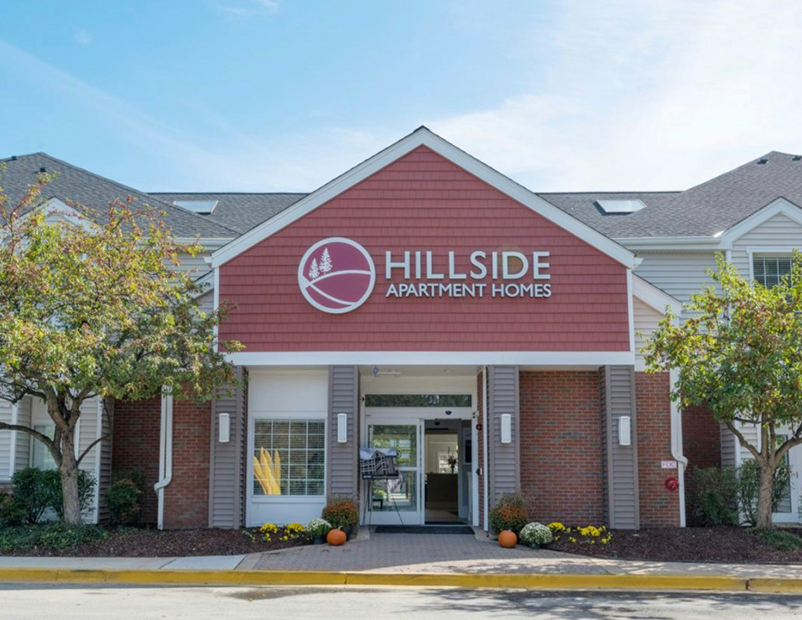
MRK converted a Hyatt House extended-stay hotel in Gaithersburg, Md., to Hillside Senior Apartments, a 140 one-and two-bedroom unit residence. The project, which was funded with a combination of low-interest, tax-exempt bonds, and LIHTC equity, incorporates many sustainable improvements, including switching all electric appliances, solar panels and LED lighting as well as plumbing fixtures with low-flow alternatives.
Other states are following California’s example. For instance, Oregon’s Project Turnkey provided $71.7 million in grants for the acquisition of motels and hotels in Oregon for use as transitional housing during the COVID pandemic. The units are now being converted to permanent, supportive or affordable housing.
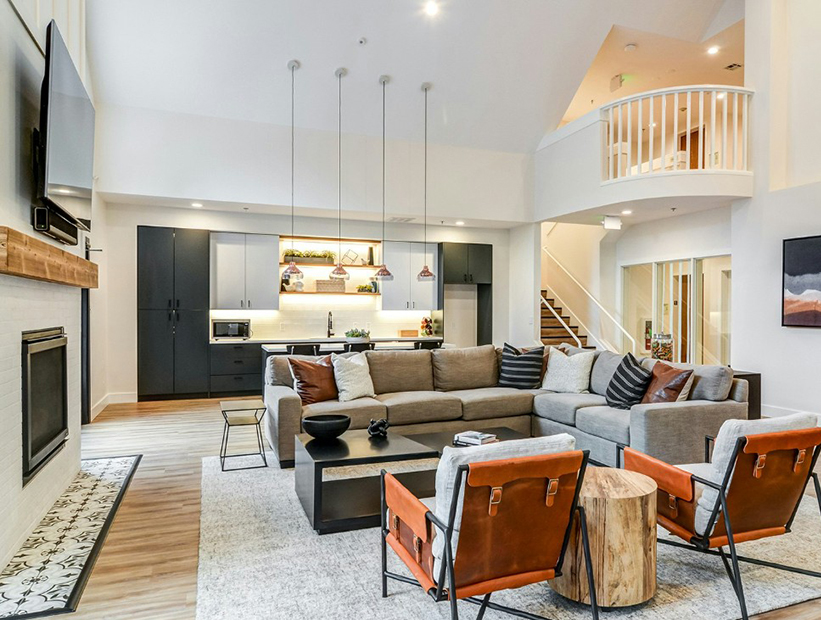
Leeb Architects adapted a 30-year Marriott Residence Inn in Portland’s Lloyd District to Sullivan’s Ridge, 168-unit apartment community for Grand Peaks Development. “This type of building use conversion is in part a result of hospitality industry volatility and the unavoidable aging of extended stay hotel structures,” noted Charles Kidwell, an associate at Leeb and lead architect for this project.
Sullivan’s Ridge is an example of how hotel conversions can provide beautiful apartments in pedestrian-oriented, amenity-dense, transit-oriented location, Kidwell said, stressing that projects like this have strengths beyond curb appeal:
“They save time and money in getting units to market. New housing programs, like Oregon’s Project Turnkey and California’s Homekey recognize that hotel conversions are a way to quickly provide affordable and emergency supportive housing. The same factors apply to providing market-rate apartments as well”
Residential makeovers for traditional hotels
As bargain-priced extended-stay hotels become scarce, developers are beginning to consider other options for creating affordable and workforce housing. Older, traditional hotel properties also are good candidates for conversion because they generally have larger floorplates than newer hotels and the resort-style amenities usually only found in luxury projects.
In Boston, a historic 13-story former hotel in the city’s Back Bay district that later served as a YMCA was converted to 118-affordable apartments for low-income and formerly homeless individuals. The project, 140 Clarendon, which was developed by Beacon Communities LLC, in partnership with Mount Vernon Co. and nonprofit service provider Pine Street Inn, is located in the city’s most expensive rental neighborhood.
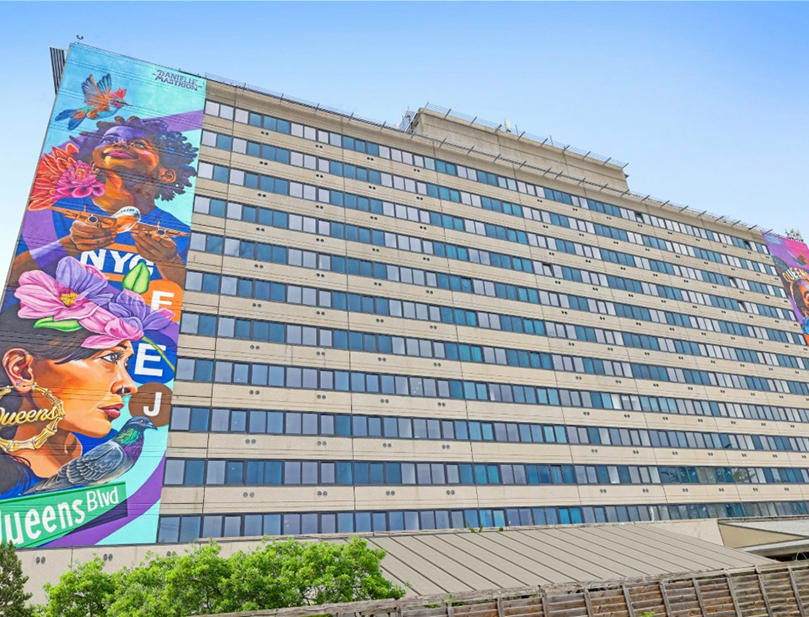
In New York City, the former 350-key airport JFK Hilton Hotel in Queens, N.Y., was redeveloped as 318 affordable apartments for low-income and formerly homeless individuals by a partnership of Slate Property Group and RiseBoro Community Partnership, which will retain nonprofit ownership and management of the asset.
“Baisley Pond Park Residences is one of the clearest examples we have of what’s possible when policy, capital, and mission align around a shared goal,” said Riseboro CEO Kieran Harrington. He noted that $167-million project, which includes 192 homes for New Yorkers transitioning out of the shelter system, was delivered in about half the timeline of conventional ground-up construction.
“That speed is the central case for hotel-to-housing conversions,” Harrington added. “At a moment when New York cannot build affordable housing fast enough to meet demand, and when construction costs and approval timelines continue to rise, conversions take advantage of existing structures and infrastructure to deliver units significantly faster and at lower cost than new construction.”
Baisley Pond Park was the first project to benefit from the the state’s Housing Our Neighbors with Dignity Act legislation, which provides funding for adaptive reuse of commercial buildings for affordable and supportive housing, and New York City’s Department of Social Services’ Affordable Housing Services program. The project is supported with $47.7 million from HCR’s Hotel and Commercial Conversion Program, which provides low-cost second mortgage financing for the acquisition and creation of permanent affordable and supportive housing; $34 million from the New York City Department of Housing Preservation & Development; and $70 million from the New York City Housing Development Corp. Notably, it was completed without drawing on the LIHTCs, preserving that resource for additional housing in the pipeline.
“The project is also a model for what permanent supportive housing can look like when it’s integrated into a real community,” Harrington said, noting that Riseboro operates a 5,000-square-foot onsite social services center to provide case management, care planning and employment assistance for residents coming from shelters. Additionally, the hotel’s kitchen is being converted to a new base for Riseboro’s Home Delivered Meals program, which serves thousands of seniors throughout the city.
Affordability for the missing middle
Blaze Capital Partners, an attainable housing developer based in Charleston, S.C., has made hotel-to-housing conversions a long-term business strategy for providing attainable or workforce housing, according to Blaze Cofounder & Managing Partner Eddy O’Brien. He said that this strategy allows his company, which is focused on providing affordable housing for young adults, to price rents $200 to $300 below market rates.
Blaze, for example, partnered with Argosy Real Estate Partners to acquire and convert an extended-stay hotel in Charlotte to 124 studio and one- and two-bedroom floor plans. Built in the 1990s, the hotel was converted into a transit-oriented project and renamed The Spoke at McCullough Station, since it is located next to the Lynx Blue Line station that provides direct service to the central business district and University of North Carolina campus in Charlotte.
The company has since done three other hotel conversion projects, in Savannah, Atlanta and Charleston
Turning a ‘Sow’s Ear’ into a ‘Silk Purse’
Housing demand and government incentives certainty are fueling growth in the hotel-to-housing movement. But high operational costs and the financial inability to make needed upgrades and repairs makes selling poor-performing hotel and motel properties to housing developers an appealing option. Budget motels in good locations often generate values above market.
These projects, however, are no “cake walk” for housing developers, often requiring more rehab than they originally bargained for. “What I found after dealing with 13 of these is that hotel owners’ main job is hiding stuff,” Massie joked. “They mostly concentrate their efforts on hiding the asset’s capital needs, and renting rooms is just a side business.”
His organization has converted both 1950s and 60s side-of-the road motels and executive, extended-stay lodging and the problems were remarkably similar.
Buena Esperanza was a hard learning experience for Jamboree. Rehabbing this 50-year-old hospitality asset to housing, not only required code upgrades, it had structural issues like dry rot and water damage that pushed the cost well above what was originally projected. Massie noted that water damage went beyond mold to actual structural degradation.
The biggest design challenges for architects tackling projects such as this, Salazar said, is developing a vision and then translating it into a design that transforms an unattractive old asset with an institutional feel into a modern, welcoming, and comfortable home. He stressed that a peaceful, home-like atmosphere aids in rehabilitating residents with mental health diagnoses, since studies show that the environment affects human emotions.
The design retained the existing footprint to avoid moving walls, but rooms ranging from 150 to 325 square feet were completely gutted and reconstructed with high-quality, environmentally friendly materials and products. “We had to replace all the drywall, took it down to the wood studs,” Massie said, noting that the project was rebuilt with sustainable features. The roof was replaced using energy-efficient, “cool” roofing material; electrical and plumbing were brought up to code; Americans with Disabilities Act upgrades were installed; and the entire structure was insulated.
Other sustainable features included energy-efficient appliances in the kitchenettes; new energy-efficient heating, ventilation, and air conditioning systems; low-E windows, bathrooms with low-flow plumbing fixtures, ceiling fans, light-emitting diode lighting and vinyl flooring made from recycled materials. And the stormwater solution retains and percolates water runoff into the soil to lessen the burden on storm drains.
Additionally, new 1,800-square-foot community center was also added to provide supportive services and a gathering place for residents.
Experiences, such as this, have caused Jamboree to implement a more rigorous due diligence process. Prior to closing on deals, Jamboree does as much destructive testing as is allowed to determine the true condition of the property.
Handling community opposition
Other challenges encountered when converting hotels to housing include the need for entitlement and zoning changes. Most California cities are very cooperative in approving these changes, especially for affordable and supportive housing projects.
Some small, rural cities in the Northeast, however, can be more resistant to multifamily development. And citizen groups that oppose locating apartment projects in their neighborhoods can delay projects or cause developers to downsize or abandon them altogether.
That could result in the loss of thousands of units over time, said Jesse Kanson-Benanav, executive director at Abundant Housing Massachusetts, a nonprofit, statewide network of pro-housing organizers dedicated to affecting policy changes to provide housing for all income levels. He noted that these groups commonly cite the impact on schools and traffic as their biggest concerns, but they really don’t want multifamily housing of any type—affordable or luxury.
Jamboree rarely encounters community opposition to projects because of the organization’s proactive and thorough community engagement strategy. The firm approaches community treats community concerns as an educational process, according to Massie, who noted that without this housing resource the community will have homeless and mentally ill people living in their streets.
Massie emphasized that the quality of supportive services is key to gaining community support for these projects. In fact, Buena Esperanza initially had pushback from the neighborhood, but the project’s “Wow” factor was so transformative that local residents embraced the project, noted