NIC Special Report: Why Senior Housing Is a Beacon of Hope Amid Economic Uncertainty
While investors face large-scale headwinds, senior housing is gaining momentum as capital returns.
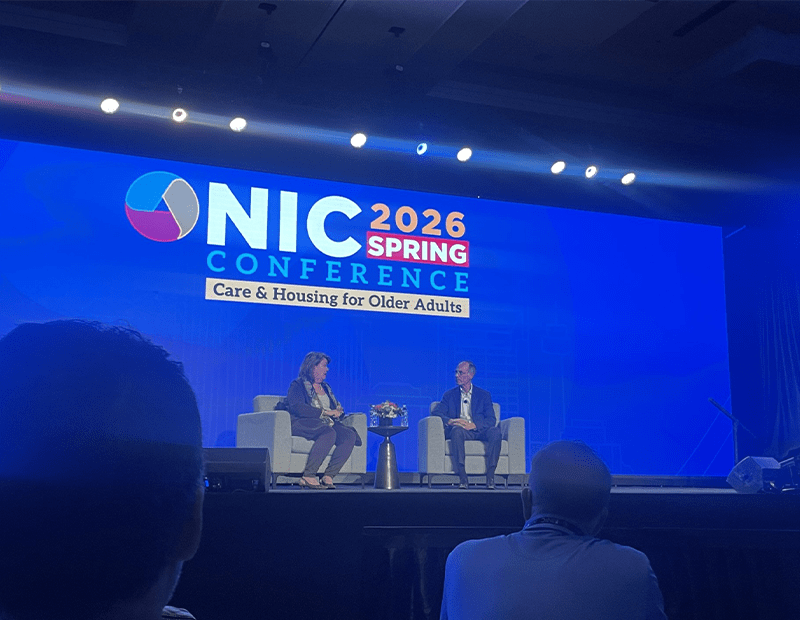
The state of the U.S. economy continues to be a question mark as the Iran conflict persists, policy concerns increase and the cost of construction and labor muddies the waters of commercial real estate investment and development. That was the outlook that Mark Zandi, chief economist at Moody’s Analytics, gave at the opening session of the National Investment Center’s Spring Conference in Nashville.
“There are only a handful of times in my 35-year career where I have been unsure about the economic outlook,” Zandi said during the session with moderator Beth Mace, former chief economist & director of research at NIC. He pointed to the Global Financial Crisis, 9/11 and the pandemic as the few examples that have given him the same feeling.
Throughout the discussion, Zandi used the rise in oil prices as a benchmark for the overall economy, noting that the cost of a barrel of oil has risen from $60 to $100. For every $10 increase, a gallon of gas rises about 25 cents, which helps explain why gas prices have increased by approximately $1—posing a challenge for many working-class Americans.
Despite these uncertainties Zandi believes that senior housing remains a compelling investment prospect, one that’s well-positioned to weather the current storm. “It’s very hard to get a fix on this. But I view (senior housing) as an industry with tremendous profits. I think there is a lot of opportunity here,” he said.
Could we see a recession?
While the outlook remains cloudy, Zandi said if things don’t improve over the next month, the U.S. could be facing a recession.
“It would take an extraordinary step by the administration,” he said. “It’s going to be very uncomfortable for many years. If, at the end of April or early May, oil is still over $100, I think that’s right on the cusp of going into a recession.”
Even if a recession is avoided, the economy will still take time to stabilize and work through the inflation pressures and uncertainty currently present, Mace and Zandi discussed. They also addressed how the Fed could position itself in this economic and political climate.
READ ALSO: Are There Any Untapped Senior Housing Opportunities?
Zandi expects that, moving through 2026 and into 2027, interest rates will rise, especially as inflation continues to increase. Looking ahead, this could signal a Fed rate hike but for now, Zandi says everyone is “sitting on their hands.”
This is because policymakers are facing rising inflation while economic growth is slowing, making immediate decisions difficult. With uncertainty around rates and economic growth, capital markets and financing across the real estate sector become more challenging, as many are waiting to see what the next policy move will be.
What’s keeping senior housing going?
At the macro level, Zandi said the outlook remains difficult to gauge, but he views the senior housing sector as having strong growth potential. David Young, managing director at Greystone, told Multi-Housing News that this asset class has already experienced its own form of a recession during the pandemic, when occupancy fell and lenders started pulling back from the market.
The demographics of the sector are what is driving growth at this point, as the older cohort of baby boomers is turning 80. Due to the aging population and the size of this generation, there is a significant supply and demand gap. New construction is difficult to pencil right now, and overall occupancy is reaching 90 percent, according to NIC MAP data.
While the sector was in a downturn following the pandemic, Young said there is increased appetite for the asset class as more capital is being introduced. He specifically pointed out that investors from the multifamily market are starting to look toward senior housing to deploy capital.
Mark Mesnier, executive vice president at Central Bank, said banks also pulled back from the sector in 2020 and became more active again around 12 to 15 months ago. As construction has slowed, banks have shifted to deals in refinancing or acquisition financing, though they are still selective about these transactions.
“This is an operationally intensive business,” Mesnier said. “We are dependent on good operators for the success of our financing and their project.”