Words Are Losing Impact in AI-Generated Marketing Language
Language is one of the most powerful tools in multifamily marketing—but only when it means something.
There was a time when a property description could do more than inform; it could create a sense of place, shaping how a prospect imagined their future home before ever scheduling a tour.
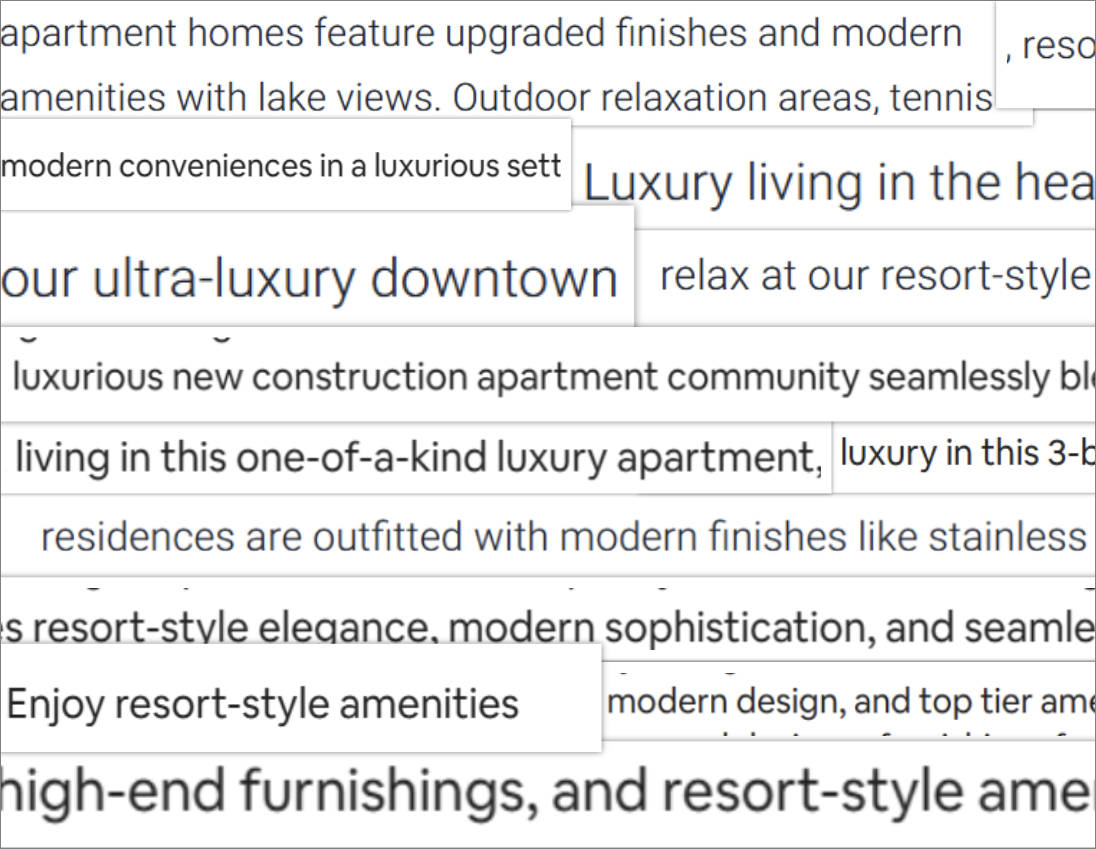
Today, that same description is increasingly likely to feel interchangeable, not because the properties themselves lack identity, but because the language used to describe them is starting to sound the same.
AI hasn’t just changed how content is produced—it’s reshaped the vocabulary of multifamily marketing through AI-generated marketing language. As teams lean more heavily on generative tools to scale output across listings, websites and chat interfaces, certain words are being used so frequently that they begin to lose meaning.
In practice, this shows up everywhere: in AI-generated property descriptions that follow the same polished rhythm, in chatbot responses that default to overly neutral phrasing, or in marketing copy that leans on familiar buzzwords to signal quality without fully substantiating it. Over time, repetition turns once-effective language into filler.
And renters are noticing.
READ ALSO: Using AI to Enhance the Renter Journey
As AI-generated marketing language becomes more prevalent, prospective renters make initial judgments about listings within minutes, often scanning multiple options in quick succession. What’s more, readers gravitate toward specific, concrete information when skimming digital content. When descriptions rely on vague or overused words, they are more likely to be skipped altogether.
Against that backdrop, it becomes easier to see how AI-generated marketing language is accelerating the overuse of certain terms—once useful, even persuasive—and how these are losing their impact. So, which are the words we’ve overused to the point of losing meaning?
“Luxury”

Few words have been stretched as far as luxury. It once functioned as a clear signal, pointing to high-end finishes, premium services and a certain level of exclusivity. Now, it appears across a wide range of properties, from top-tier developments to more modestly upgraded communities.
The issue is not just overuse—it’s inconsistency. When luxury can mean almost anything, it ultimately communicates very little. Instead of building confidence, it often prompts skepticism, pushing renters to look for visual or experiential proof elsewhere in the listing.
What works better is precision: naming materials, technologies or services that substantiate the claim, rather than relying on the label itself.
“Elevated”
Elevated has become a go-to substitute for sounding refined without committing to specifics. Whether attached to living, design or amenities, it suggests improvement but rarely explains what has actually been improved.
Its appeal to AI-generated content is obvious: it sounds polished, adaptable and broadly positive. But from a renter’s perspective, it introduces ambiguity. Without context, elevated becomes a placeholder rather than a descriptor.
Clarity comes from replacing it with detail: what exactly is better, and how does that difference show up in everyday living?
“Vibrant”
Vibrant is often used to describe community life, particularly in urban or mixed-use environments. It points toward energy, activity and social connection, but stops short of defining any of them.
That lack of specificity weakens its impact. A vibrant community could mean frequent resident events, proximity to nightlife, diverse retail options or simply well-designed shared spaces. Without clarification, the word becomes interchangeable.
Stronger messaging grounds the idea in observable reality: what residents actually experience on a daily or weekly basis.
“Modern”
At one point, modern distinguished newer or recently updated properties from older stock. Today, it has become a baseline descriptor, applied so broadly that it no longer differentiates.
In many markets, a significant share of available inventory meets the basic criteria for being modern, whether in terms of construction, finishes or layout. As a result, the word adds little informational value.
More effective alternatives focus on design language or specific elements—materials, color palettes, architectural influences—that help the reader visualize the space.
“Resort-Style”
Few phrases promise more than resort-style and few are applied as loosely. While it aims to evoke relaxation and escape, it is often used to describe amenity packages that only partially deliver on that experience.
This gap between expectation and reality is where the phrase loses credibility. Renters have learned to question what resort-style actually entails, especially when it is not supported by detailed descriptions or imagery.
Describing the environment more concretely, such as adding information on the layout, features, intended use, restores a sense of trust.
“Prime Location”
Prime location attempts to compress a wide range of location-based advantages into a single phrase, but in doing so, it oversimplifies what is inherently subjective.
Location value depends heavily on individual priorities: commute times, walkability, access to services or proximity to specific employers. By generalizing these factors, the phrase risks sounding generic rather than informative.
Specificity, which includes naming distances, connections or neighborhood features, creates a clearer and more credible picture.
“Seamless”
In operational messaging, seamless has become shorthand for convenience, often used to describe leasing processes or resident services. While it conveys ease, it rarely explains how that ease is achieved.
As with other overused terms, the issue lies in abstraction. Without detail, seamless becomes an assumption rather than a demonstrated benefit.
Explaining the mechanics—digital tools, response times, service models—gives renters something tangible to evaluate.
“Curated”
Originally associated with careful selection and intentional design, curated has gradually shifted into a stylistic buzzword. It suggests thoughtfulness but does not always show it.
When applied broadly to either spaces, amenities or experiences, it can feel decorative rather than descriptive, especially if the underlying intent is not.
Reintroducing that intent—who the space is designed for, how elements were chosen—helps the word regain its original meaning.
Reclaiming meaning through specificity
A 2023 study by Apartments.com found that most renters validate property claims through photos, reviews and third-party sources before taking the next step. In other words, language alone is no longer enough—it has to align with evidence.
When commonly used words no longer carry distinct meaning, they stop guiding decisions. The solution is not to eliminate descriptive language, but to anchor it more firmly in reality. That means shifting away from words that generalize and toward details that differentiate.
In a content landscape increasingly shaped by AI-generated marketing language, this kind of specificity becomes a competitive advantage. While automated tools tend to reproduce patterns, human insight can interrupt them, introducing nuance, context and precision where it matters most.
Ultimately, the effectiveness of multifamily marketing still depends on a simple principle: if the words don’t mean anything, they won’t move anyone.