NMHC Special Report: The Student Housing View From Ground Level
Investors, developers and architects speaking at the second day of the conference all had their unique strategies for combating challenges.
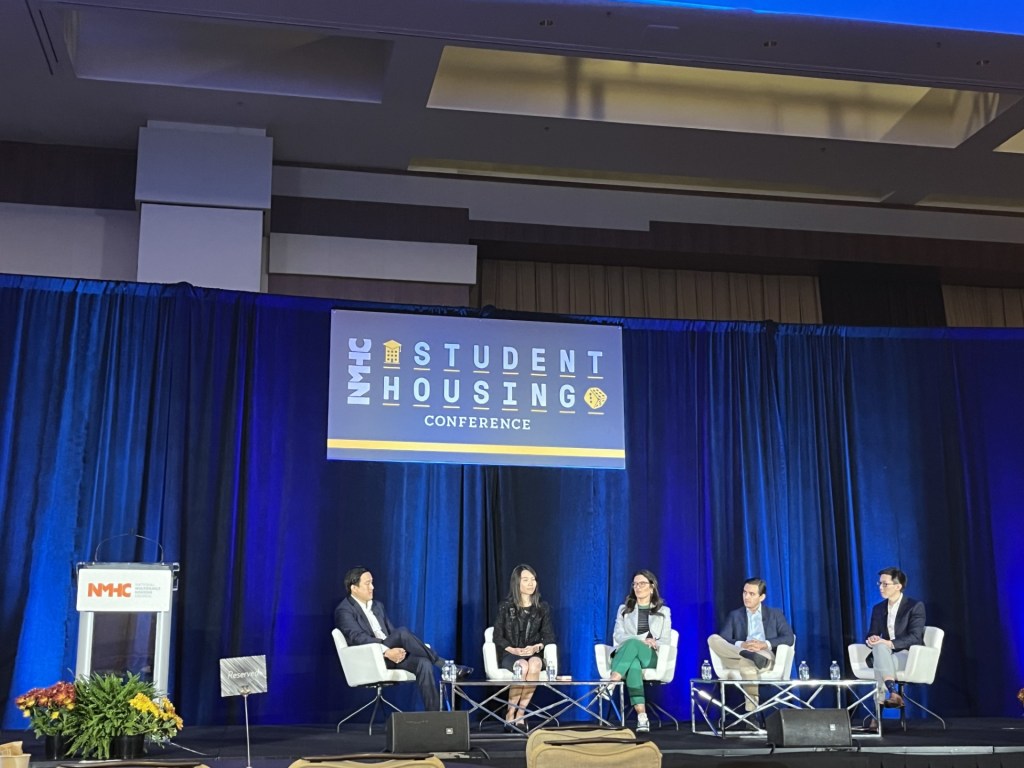
Stakeholders speaking on the second day of the National Multifamily Housing Council’s 2024 Student Housing Conference in Las Vegas discussed their specific approaches to investment and development, with challenges discussed on the previous day all lurking in the background.
Investors are opportunistic, yet sober
By and large, interest rates have been priced into investors’ strategies for a while. In turn, their effects on capital costs has caused student housing investors to refine their financing models and lending pools. For QuadReal Property Group, the biggest contributors have been pension fund systems, as they have “the best risk-adjusted returns, and are active given how high interest rates have been,” according to Darren Chan, the firm’s vice president of international real estate.
Chan’s firm also likes to work with debt funds, which have largely filled the shoes of long-absent regional banks. “They’ve gotten a lot more competitive on rate terms, and as you see pullback from regional banks, they have stepped in and have become competitive with certain deals.”
For its part, University Partners has found success with life companies offering up CMBS and single-asset single-borrower financing structures. This is due in part to agency lending having a traditionally limited exposure to student housing, as well as ample liquidity that has been on the sidelines, according to Bryan Kam, the firm’s president.
READ ALSO: Top Universities for Student Housing Transactions
As for how the funds are managed, core plus models are a reliable method, with both QuadReal and other firms focusing on adding value to existing assets as opposed to buying the shiniest Class A product all the time. “We probably set it up where we want to focus more on investments (as opposed to) getting money out the door,” Chan said.
At the same time, with many traditional investors remaining on the sidelines, buying student housing properties that are above one’s means may make a bit more sense than the past. “It’s a good time to be buying assets of quality that you might not otherwise have access to,” Kam advised.
But some firms taking Kam’s advice see it as easier said than done, even with capital costs being as prohibitively high as they are. Estella Jin, portfolio manager at APG, has observed a “more competitive” acquisition process, particularly for properties affiliated with tier 1 and Power 4 student housing markets. “Eventually, you see the big names in the buying process, and there are more entrants in there.” Still, Jin thinks that it’s a “perfect time” to be a long-term investor. “We have closed deals in the past 12 to 18 months with no debt.”
The trick to getting ahead here, according to Chan, is focusing on markets with more pronounced supply-demand imbalances, as well as more dramatically increasing rent growth. “We shied more away from markets that had a clear visible pipeline.”
In practice, this means the large flagship state universities, in addition to secondary and tertiary schools that struggle to build housing fast enough, according to Evan Baum, principal at Ares Management Corp.
What’s it like to build today?
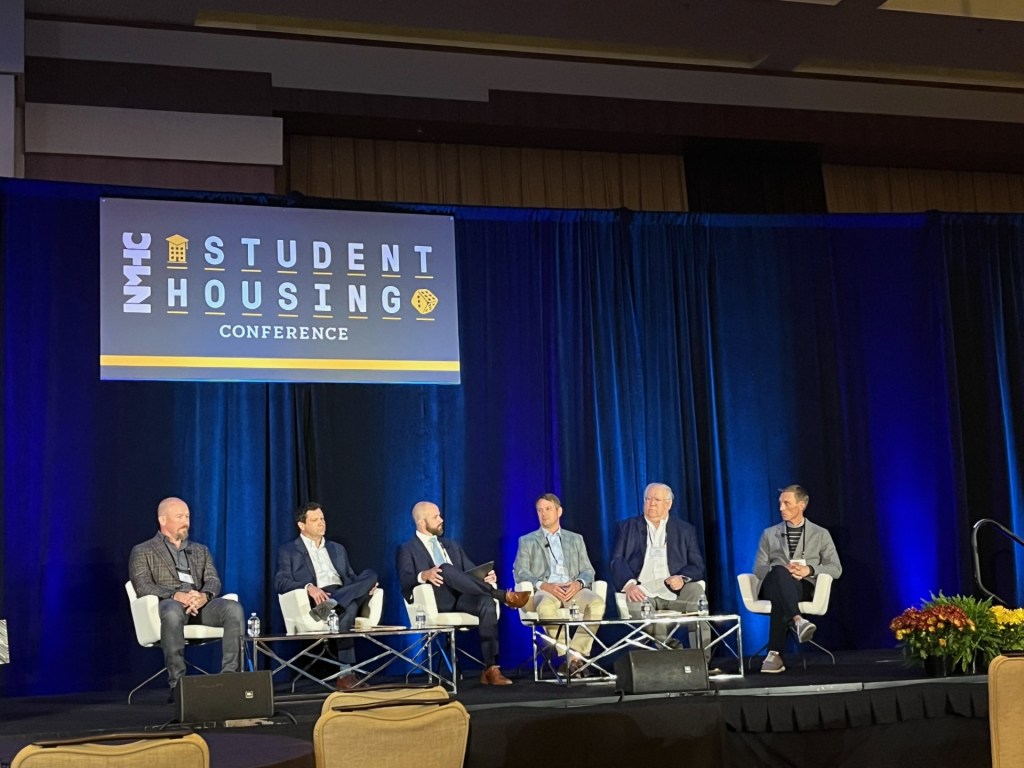
In contrast to their investor counterparts, student housing developers have fewer means to adapting to existing challenges, especially for new construction. There is no silver bullet that will alleviate high construction costs and labor costs, shorten entitlement processes or reliably build affordable units. Expansions of the money supply could clamp down on cost inflation, but this still may not be enough to make ground-up development make more sense.
“If you are considering new construction, you need to be very careful as there are a ton of forces that could slow it,” cautioned Loren King, CEO & co-founder of Trinitas Ventures. Ultimately, strong rent growth has been the one of the sector’s few insulators for new development. “The relief right now is temporary; we have been blessed and able to overcome the cost inflation because of revenue growth.”
Even getting a project approved by city planners and council members can be a headache, due to their increased acclimation with the asset class, as well as an aptitude for choosing what gets built alongside the student housing. “I feel that a lot of council members and planning staff become savvier because they have seen more student housing and know what to look for,” opined Jonathan Kubow, managing director of development at Core Spaces.
This, while not game changing on its own, is pared by a recent slew of forced retirements from the pandemic era. Now, some delays can be as long as six to nine months. “If you were to ask me what keeps me up at night, it’s elution of title, as well as the permitting process,” Kubow said.
For the projects that do get built, however, developers such as Landmark Properties are seeking to field as much efficiency as possible, be it in the locations, unit sizes or parking space allocations. Often, building a community as close to campus as possible can compensate for a lack of resort-style amenities or even bed-bath parity, and can save both developers and future renters money. “Location beats parity, and trumps a lot of the bells and whistles,” said Brian Dinerstein, CEO of The Dinerstein Cos.
One area where developers need to lock in early, however, is parking, especially given the surging popularity of southern schools, often located in or near cities where driving may be the only way to get around.
The architects’ angle

A panel of architects shared many of the same sentiments and also stressed the need to keep projects affordable while also adapting to the wants and needs of today’s undergraduates and postgraduates.
From a strict design standpoint, the most important quality is being future-proof, something that Josh Kassing, senior vice president at Mary Cook Associates sees more as a story to tell prospective students than an adherence to a strict design principle. “Are we the coolest, hip, most affordable, most social, most wellness focused? When you start there, the subsequent decisions are all rooted in that story.”
Still, it does help to follow some guidelines. “Basic principles that are just good for humans,” detailed Jessica Musick, principal at KTGY. These include access to daylight, private and communal open spaces.
Where amenities are concerned, Mohamed Mohsen, a principal at Niles Bolton Associates sees “doing more with less,” as the most practical approach for developers, particularly on the technology front. “The conversation is there, but at the end of the day it’s student housing and we can’t have everything related to smart buildings,” he concluded.