Twin Cities Multifamily Report – September 2023
While growth is sluggish, Minneapolis-St. Paul displays steady fundamentals.
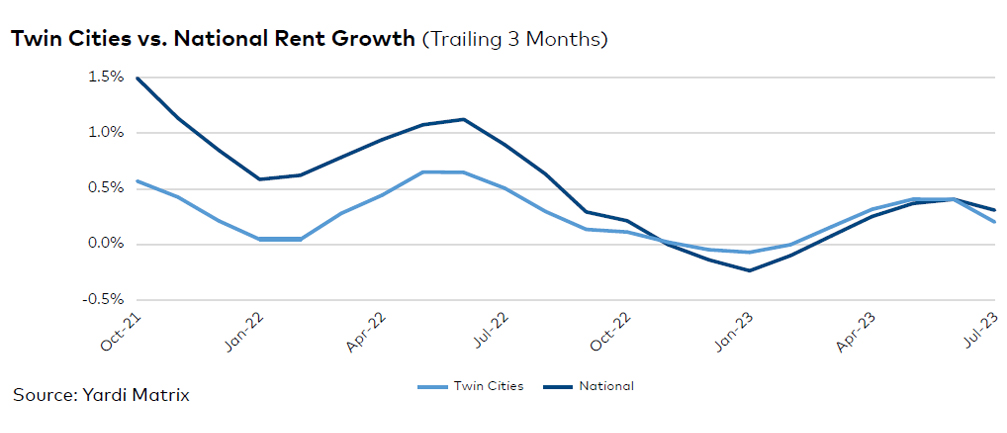
Twin Cities rent evolution, click to enlarge
Market fundamentals were modest in the Minneapolis-St. Paul market, with rents up 0.2 percent on a trailing three-month basis through July, to $1,483. The figure remained below the national average of $1,729, which advanced 0.3 percent. Year-over-year, rent growth in Twin Cities hit 1.7 percent, just above the U.S. figure, which clocked in at 1.6 percent.
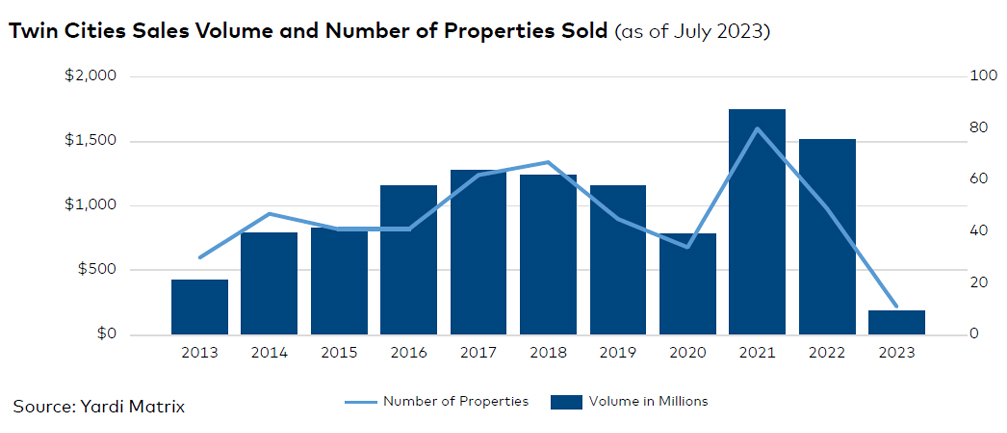
Twin Cities sales volume and number of properties sold, click to enlarge
Twin Cities employment growth (1.8 percent) trailed the national average (2.8 percent) as of May. Despite only two sectors recording losses, the rate was 100 basis points below the U.S. figure. Sectors recording significant gains included leisure and hospitality (17,700 jobs, up 9.6 percent), education and health services (12.900 jobs, up 3.5 percent) and government (7,200 jobs, up 2.8 percent). Meanwhile, the metro’s 3.3 percent unemployment rate as of June was below the already low national figure, which sat at 3.6 percent.

Twin Cities. Photo by Aerial_Views/iStockphoto.com
Transactions slumped after two years of record volumes. In the first seven months of 2023, investors mainly targeted Renter-by-Necessity properties, with the total year-to-date through July at just $186.9 million. Developers brought 1,494 units online, with an additional 16,679 units underway as of July. Yardi Matrix expects 6,841 units to come online during 2023, marking a clear change of pace from the previous two years, when nearly 23,000 units came online in 24 months.