Navigating the Costs of Office-to-Multifamily Conversions
Panelists at Apartmentalize shed light on the debate around these projects and the challenges of repurposing older properties.
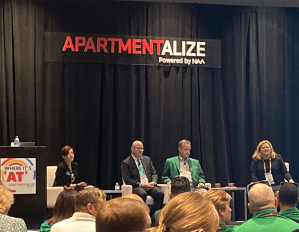
From left: Munger, Lybik, McManus and Pollard discuss office-to-residential conversion. Photo by Fotios Tsarouhis for MHN
As office-to-residential conversions become increasingly common, there are unique challenges to consider, tax codes that impact construction and an emerging policy discussion around the trend. Panelists speaking on the final day of the National Apartment Association’s Apartmentalize conference in Atlanta on Friday addressed how they are traversing this new terrain.
Surprising and unexpected costs can throw a wrench in conversion plans, David McManus, vice president at Westover Management Company, reminded conference-goers, citing a project his firm was involved with.
Problems were identified early, which was helpful as the property had myriad defects that were critical to address. “Because of the age of the building, there were environmental issues, a tremendous amount of asbestos, electric transformers that were leaking, water lines that were rusted out,” McManus said.
Knowing the potential pitfalls associated with a project is critical, as is assembling the right group of companies and individuals that will be responsible for seeing the conversion through, said McManus. “You really want to look at your building and know what you’re getting into, have an end game in mind, know what the hurdles are going to be, and—I can’t emphasize enough—the team that’s involved.”
Experience is key when assembling that team, agreed Jay Lybik, national director of Multifamily Analytics at CoStar Group. “One developer I had an extensive conversation with brought up making sure you’re working with engineers and architects who have done previous conversions,” he noted.
Tax credits and public policy

Apartmentalize 2023 is being held in Atlanta. Image by Fotios Tsarouhis
Several tax credits that bolster conversions are available, but there are changes to those rules, among other steps, that policymakers can take to facilitate refurbishments and conversions, according to the panelists.
Concerning the tax incentives, Lybik suggested a new class of tax credit for conversions. Many builders attempt to take advantage of existing incentives for historic properties, but those credits necessitate that the building layout does not change. Working with municipalities to secure a streamlined process for a particular project is also an option, said Paula Munger, vice president for research at the National Apartment Association.
In addition to a patchwork of state and local tax credits, some federal tax credits can be utilized, said Munger. As is often the case with federal tax incentives, these big-ticket tax equity financings “are usually coming from banks or other tax credit institutions,” she noted.
The Revitalizing Downtowns Act, which is pending in Congress, is aimed at incentivizing the conversion of office buildings to multifamily housing in “core downtown markets that are suffering,” said Munger. The legislation was introduced in the House during the current Congress by Rep. Jimmy Gomez (D-Calif.) and in the Senate during the last Congress by Sen. Debbie Stabenow (D-Mich.).
Designing layout is a team project
The layout of a property is an important consideration in office-to-residential conversions, as dealing with an existing structure means there will be restraints on any potential design. “You’re handcuffed, to a large degree, by the structure,” said McManus.
Nevertheless, it is important for developers to work with architects, designers and others to ensure a property is designed practically and functionally, said Bobbie Pollard, vice president at Bell Partners. Leasing offices should offer enough workspace and functionality to enable employees to work there for full eight-hour days, Pollard added.
Soliciting input from maintenance managers early in conversion planning is also important and is often overlooked. “They are critical,” Pollard said. “They need to understand the plumbing and the electric and having them in the building as it’s being constructed, they can see things behind the wall they can never see again.”