National Multifamily Report – March 2026
March thawed the multifamily markets short-term, yet yearly growth remained modest, according to Yardi Matrix.

Spring fuels growth across multifamily, though the pace is still modest. U.S. average advertised asking rents increased $5 to $1,750 in March, marking a 0.3 percent month-over-month rise and a 0.1 percent year-over-year improvement, according to Yardi Matrix’s latest survey of 140 markets. For reference, the annual March expansion averaged 3.6 percent between 2012 and 2019. Single-family build-to-rent advertised rates also grew by $5, ticking up to $2,202 in March, yet the figure was 0.5 percent below its reading last year.
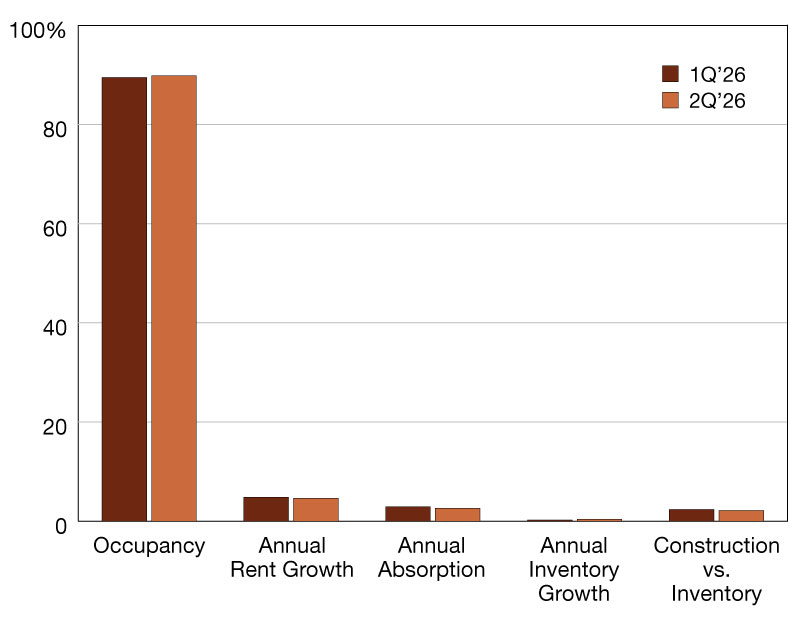
On an annual basis, gateway and Midwest markets posted the largest advertised rent gains, with New York City leading the way (4.5 percent growth year-over-year), trailed by San Francisco (3.9 percent), Chicago (3.4 percent), the Twin Cities (2.5 percent) and Kansas City, Mo. (2.3 percent). Supply-burdened metros exhibited decreases, including Austin, Texas (-4.1 percent), Denver (-3.5 percent) and Tampa, Fla. (-3.4 percent). Occupancy-wise, the chasm between the best and worst performing markets was wide, at 5-6 percent in February. Some of the metros with low rates consisted of Houston (91.8 percent) and Austin (92 percent), while the tightest ones included New York (98.2 percent) and New Jersey (96.7 percent). Nationally, the rate clocked in at 94.3 in February, down 40 basis points year-over-year.
Amid mounting macroeconomic uncertainties, Sun Belt markets post gains
March turned the short-term tides, with nearly all Matrix top 30 markets posting advertised rent increases. Just three metros recorded declines, including Seattle (-0.2 percent), Raleigh, N.C., and New Jersey (-0.1 percent each). Notably, the Sun Belt witnessed gains across several markets, despite ongoing supply encumbrances. For instance, Austin’s rents ticked up 0.9 percent month-over-month, while Charlotte saw its rates go up 0.7 percent in March. Other solid performances were recorded in New York (1.0 percent), Indianapolis, San Francisco and Philadelphia (0.8 percent each).
Meanwhile, geopolitics and technological advancements may impact demand for commercial real estate. Near-term challenges include the blockage of the Strait of Hormuz, which will affect energy, fertilizer and petrochemical prices, potentially leading to higher inflation. Long-term issues may stem from AI investments displacing consumer spending as a driver of the U.S. economy, which already exhibits k-shaped features with the aforementioned spending tilted toward the upper-income echelon.
At a national level, the advertised rates for single-family build-to-rent units increased $5 to $2,202 in March, but still represented a 0.5 percent yearly decline. While the current housing bill that makes its way through Congress aims to increase affordable housing financing, the consequences of its SFR-BTR limitations might prove counterproductive. Requiring developers to sell BTR homes after seven years may prevent new projects from entering the market, which could lead to a reduction in the housing supply of approximately 72,000 units per year, studies suggest.
Read the full Yardi Matrix multifamily real estate report.