
Multifamily Investors Lean Into Conversions
Ample distress in the office market and government incentives are helping drive the trend.
Despite the naysayers, the number of investors pursuing office-to-residential conversions is only increasing.
The struggling office market has opened the door to repurposing a significant number of office properties to multifamily, which enjoys strong demand and steady rent growth, especially in markets with housing shortages. Many of these investors are increasingly recognizing conversion as a way to “do well by doing good.”
The expanding crop of distressed office assets is a “generational opportunity to access high-quality, urban multifamily assets at an attractive basis,” said Dune Real Estate Partners CEO Daniel Neidich.
Last month, a joint venture of Dune and New York City-based commercial developer TF Cornerstone Realty formed Alta Residential, a $1 billion venture-capital fund, to undertake office-to-residential conversions nationwide.
READ ALSO: 3 Hot Buttons for Owners
“Dune believes that returns will be competitive to other residential investment alternatives over the coming years,” Neidich said, noting that Alta will convert projects, stabilize their occupancy and exit the investments over three to five years.
“Alta Residential is responding to both the U.S. housing shortage, which is particularly acute in city centers, and the significant value decline and distress in office properties in major U.S. cities,” Neidich continued.
Alta projects are currently underway in Los Angeles and New York City as it targets locations with high barriers to entry in desirable, transit-oriented residential neighborhoods.
Why some investors prefer conversions
Besides creating much needed housing stock, conversion projects help to revitalize city centers and provide a smaller carbon footprint than new construction, shorter delivery timelines and quicker lease-up than new developments.
“Shorter development timelines, coupled with a greater risk premium and well-executed conversion, often provide investors an investment-grade asset with a favorable delta to replacement cost,” said Scott Lamontagne, national director of National Development Services at Northmarq, who noted that expected returns for these types of projects are typically slightly higher than comparable new construction. “We are often seeing a 1.8 minimum equity multiple, IRRs in the mid-20s, and yield on costs at least 150 basis points higher than current in-place cap rates.”
Housing conversion projects activate apartment density in the heart of downtown markets that otherwise could not be built due to zoning or land availability, said Joe Slezak, CEO at 3L Real Estate, a value-add investor/developer located in the Chicago metro.
“Over time, that kind of real estate has proven to outperform other types of real estate assets,” Slezak said, “since you are starting at a lower basis with a strong supply/demand equation and ultimately are transforming an asset to a more financeable property with multifamily options like Fannie and Freddie.”
Jeremy Shell, principal at TF Cornerstone, a New York City-based commercial developer, noted that the conversion pipeline has quadrupled in size since 2021.
A total of 55,339 multifamily units are in the conversion pipeline nationally, RentCafe reported. Washington, D.C., and New York City lead with 5,820 and 5215 units underway, respectively, followed by Dallas (3,162), Chicago (2,822) and Los Angeles (2,442).
READ ALSO: Office to Residential Conversions—Making the Choice
With an estimated 15 percent of CBD office buildings in 105 U.S. cities suitable for residential conversion, Shell suggested that this translates to potentially 170,000 new units. “In Manhattan alone, it is estimated that between 25 to 40 million square feet of office space will be converted under New York State’s new ‘467m’ housing program,” he said.
The 467m program provides housing conversion projects a 10 to 40 percent property tax abatement for 25 to 35 years.
In Washington, D.C., there are currently about 30 commodity A, B and C buildings in the downtown area with vacancy below 50 percent and a desirable footprint for conversion, noted Randolph C. Harrell, CBRE vice chairman in the Washington, D.C., office.
However, the city’s height restrictions complicate conversion. “The lack of vertical scale is a hindrance to spreading development costs over a larger building, impacting the financial viability of conversions,” Harrell added, noting that some building cores and public spaces will need adjustments to be structurally suitable.
Meanwhile, Alexandria, Va., is a hotbed of housing conversion activity, especially the Old Town district, which features small, older office buildings that are ideal candidates for conversion.
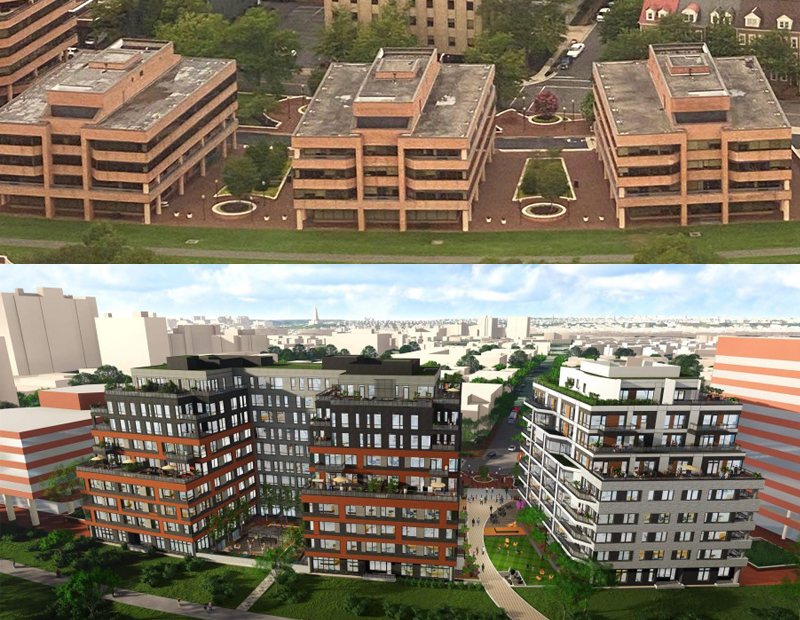
Three projects were recently completed there, and more are underway, including Tidelock in Old Town North, which is converting three four-story, 40-year-old office buildings to residential mixed-use. A joint venture of local developer Community Three Real Estate Development and national real estate investment firm Whitaker Investment Corp., the project will provide 169 apartments and 65 condominiums, 15 of which are affordable; 7,000 square feet of space for retail and arts; and a 217-space subterranean parking garage.
Tidelock’s architect Jeremy Sharp, associate principal at Torti Gallas + Partners, said that the LEED Silver project benefited immensely from city height and density bonuses for including affordable units and an arts space. The increased height and density allowed the developer to add five stories to each building, expanding the total square footage from 120,000 to 270,000.
Governments get in the game
Recognizing that conversions keep central business districts vibrant and active and supplement the housing stock, a growing number of local and regional governments are offering generous incentives for housing conversion projects. These programs can be a strong attraction for some investors/developers, especially when coupled with current deep office discounts, often making projects viable that otherwise wouldn’t pencil.
“Government incentives are now pervasive for conversions, as these programs enhance returns,” said Neidich.
Congress has introduced the Revitalizing Downtowns and Main Streets legislation, which if passed, would offer tax credits for conversions and expand existing Housing & Urban Development federal lending programs to include commercial conversions.
Additionally, New York and California are at the forefront of conversion incentives. Last year, New York passed a new law (467m), which provides real estate property tax abatement for office-to-housing conversions. New York City also launched the City of Yes for Housing Opportunity program, which includes an Office Conversion Accelerator to provide flexible zoning regulations and expedite project approvals.
But these lucrative incentives come with strings attached. To qualify for a property tax exemption, the conversion must reserve 25 percent of units as affordable, and construction work must pay a minimum of $40 per hour.
The State of California approved $400 million in grants for commercial-to-residential conversions, including $105 million for affordable housing, as well as a state tax credit for up to 30 percent of the cost of a housing conversion.
Separately, Los Angeles has rolled back certain building and application requirements to fast-track more housing development, reported the Los Angeles Times, to speed permits for 9,000 affordable units underway.
To boost conversion of suitable office buildings in San Francisco, the city is waiving the transfer tax on properties converted to residential use and has proposed eliminating affordable housing requirements and impact fees, which would save developers $70,000 to $80,000 per unit, reported the SFist.
Potential conversion candidates
Research by Yardi Matrix, a global source of commercial real estate intelligence, indicated that about 1.3 billion square feet of office space is suitable for conversion to housing out of an 8 billion-square-foot inventory of office assets nationally.
Doug Ressler, manager of Business Intelligence at Yardi Matrix, said that this estimate is based on a conversion feasibility index created by Yardi around the continued destruction of office values and an increase in office-to-residential government incentives.
“Our point was to show that there are more buildings that can be converted than originally thought (15 percent vs. 10 percent), and obviously, there’s a financial component that’s the driving factor on this and a vacancy component,” said Peter Kolaczynski, associate director for CommercialEdge.
Conversions pose many challenges
While there is significant enthusiasm—and capital—for conversions, physical and financial barriers remain.
The biggest challenges to designing housing conversion projects involve fitting a residential building into an office building footprint, Sharp said, since buildings must be no more than 80 to 100 feet at their narrowest depth to avoid unit depths of more than 35 to 40 feet from the exterior wall.
Viable candidates should also have a structural system that is easy to modify for the many new openings required for a conversion (ducts, pipes and other infrastructure). And for high-quality apartments, the building should provide the ability to get to 9-foot ceilings, he added.
One of the biggest financial decisions is whether to reuse the facade, he said, noting that outdated office buildings are likely to have unappealing facades that are not energy efficient, may leak, and do not have quality air and water barriers. And, in nearly all cases, the windows need replacing. At Tidelock, for example, destructive testing and review of the facade’s structure, revealed that the facade walls did not meet code and had to be replaced.
Another barrier to conversions is many suitable office buildings are partially occupied by tenants on long-term leases that need to be bought out before converting the building.
Sharp noted that in Washington D.C., office owners are considering partial conversions, where 50 percent is converted to housing and the other half remains office to accommodate long-term tenants. “I think we will have to find many creative, flexible solutions to make use of outdated office space,” he added.
What’s next for conversions?
With the first wave of distressed office assets only recently having hit the market, sources said there is deep potential in conversions. As office loans mature and large tenant leases expire, more owners are likely to sell at steep discounts or default on loans, increasing the number of bank-owned assets available for sale at distressed pricing,
“Our expectation is that this sector will continue to accelerate for the next few years as more large block leases come to term and are expected to either have smaller footprint requirements or eliminate space altogether,” Lamontagne said. He also noted that refinancing presents challenges for owners given today’s higher interest rates, lower occupancies and greater scrutiny from lenders on leases and tenant creditworthiness.