How Rent Regs Drag on NYC’s Investment Market
One segment's struggles overshadowed strong results, noted Ariel Property Advisors' Shimon Shkury.
With big office sales and recapitalizations, New York City has become the exemplar for post-COVID investment recovery. But it’s a layered market. Not all layers are enjoying the same momentum, and one is in “deep distress” in terms of values and capital markets access, according to Ariel Properties President & Founder Shimon Shkury.
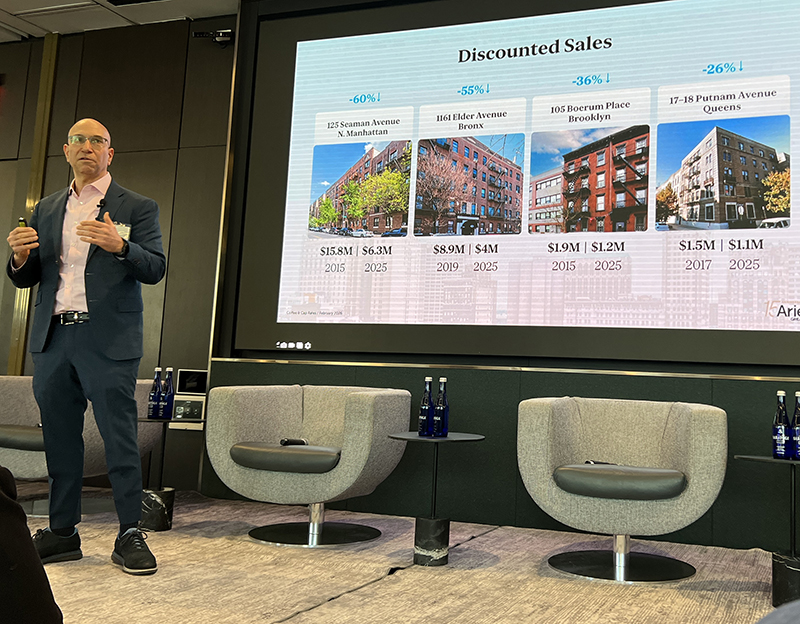
During Ariel Properties’ semi-annual “Coffee & Cap Rates,” Shkury drilled down into last year’s sales activity to reveal both successes and pain points for investors. And the segment feeling the most pain right now is the rent-stabilized segment.
The rules of the rent-regulated market changed in 2019, Shkury noted, with the passage of the Housing Stability and Tenant Protection Act of 2019, which severely limited landlords’ ability to raise rents or recoup renovation costs, even upon vacancy. Then came Covid, spiking interest rates and soaring operating costs. According to the NYU Furman Center, about 40 percent of the city’s housing stock is categorized rent-stabilized.
LIKE THIS CONTENT? Subscribe to MHN’s Finance & Investment Newsletter
“It’s about tenants left living in the best conditions, but it’s also about valuations that dropped drastically last year and over the past few years, and the amount of transactions which is less than half than what it was prior to 2019,” Shkury said.
The dollar value of multifamily transactions in the city dropped 2 percent to $8.91 billion last year, while transaction volume was up by 6 percent. Smaller assets sales (of less than 10 units), which offer tax advantages, and free-market units—in Manhattan, rents are as high as $95 per square foot and the vacancy is 2.5 percent—made up 66 percent of total dollar volume and 48 percent of total multifamily transactions.
Meanwhile, the dollar value of transactions in the rent-stabilized market was down 27 percent, with pricing for these assets falling 61 percent in Manhattan. Despite the regulatory constraints, investors in this segment were attracted by the low basis and the hope that the policy misalignment would shift some day, Shkury said.
Some larger rent-stabilized owners found solutions to the rent-stabilized dilemma last year. In April, LeFrak sold 755 rent-stabilized for $109.5 million to Iris Holdings, which will convert them to affordable housing. In December, Blackstone secured a $3.15 billion refinancing from Wells Fargo and Blackstone for its Stuyvesant Town-Peter Cooper Village, an 11,200 unit rent-stabilized complex.
And HSPTA is not the only policy impacting multifamily investment in the city. The 485-x tax incentive program, which replaced the 421-a program, puts high wage requirements on construction projects of 100 units or more. As a result, developers are focused on smaller projects rather than the larger projects that would help the city meet its housing supply goals.
“The fact that you have big, capable developers looking around for 99-unit buildings is absurd,” Sam Alison-Mayne, co-founder & partner at Brooklyn development firm Tankhouse, said later during the panel discussion. “You’re not going to get to 500,000 units building 99 at a time.”
Strong numbers overall

In total, New York City investment activity was up 24 percent last year at $35.3 billion, though $3.8 billion of that was the entity sale of Paramount to Rithm Capital, Shkury noted.
In the office sector, the dollar value of New York City office sales rose 118 percent over 2024 to reach $11.6 billion while the number of transactions stayed roughly the same. Eight-five percent of the value of office transactions was in Class A trades and 15 percent was in Class B/C assets. But 75 percent of the volume of transactions was in B/C properties, with some properties have sold for 60 percent of what they previously sold for.
The remainder of the $35.29 billion in sales was made up of $7.1 billion of development transactions (up 25 percent)—the highest since 2018, $1.65 billion of hotel trades (down 14 percent) and $1.35 billion of industrial sales (down 33 percent). Conversions sales were down 50 percent, but there was a 60 percent increase in permits filed. In that segment of the market, city and state policy are helping boost transaction-related and owner-led conversion, Shkury said.