National Student Housing Report – October 2026
Student housing occupancy is expected to finish the year below 2025 levels, as new supply and slower enrollment growth put pressure on several major university markets.

Student housing occupancy across Yardi 200 universities reached a preliminary 94.5 percent in September for the 2026-2027 academic year, matching both September 2025 and the historical average since 2019, according to the latest Yardi Matrix national report. However, the initial estimate is expected to decline as additional data becomes available. An alternative methodology currently under development projects occupancy at 92.1 percent, 240 basis points below September 2025.
The projected decline reflects a challenging leasing season marked by increased supply and signs of slowing enrollment growth. More than 31,000 dedicated off-campus bedrooms were delivered in 2026, a 20 percent increase from 2025. Although half of the newly completed projects reached full occupancy, properties delivered this year averaged just 84.1 percent occupancy in September, compared with 95.3 percent for 2025 deliveries at the same point last year.
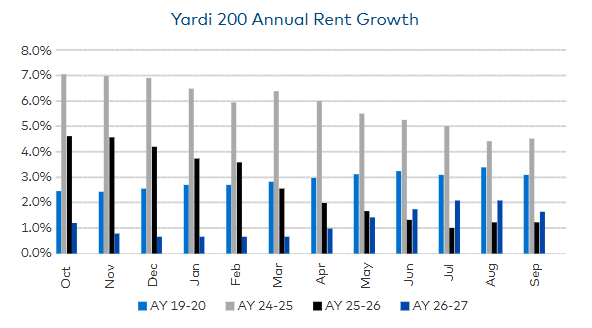
Average advertised rents across the Yardi 200 slipped to $928 per bedroom in September, down from $931 in July. Despite remaining largely flat over the past eight months, rents increased 1.6 percent year-over-year, benefiting from declines recorded during summer 2025. Leasing-season rent growth averaged 1.2 percent across all properties, including new deliveries, while same-store growth reached only 0.5 percent.
Occupancy results varied significantly across university markets. Thirty-six Yardi 200 markets were estimated to be fully occupied in September, including larger markets such as Oklahoma, Washington, Virginia Commonwealth and Virginia Tech. Conversely, 38 markets recorded estimated occupancy below 90 percent, with weaker performance concentrated among schools experiencing enrollment declines or substantial new deliveries.
New supply weighs on major university markets
Some universities nevertheless posted substantial recoveries from previous years. UNC Charlotte reached 98.3 percent occupancy, compared with 91.8 percent in 2025 and 85.3 percent in 2024. Boise State improved to 98.2 percent from 92.6 percent and 86.8 percent, respectively. East Carolina also continued its recovery, reaching 93 percent after recording 87.9 percent last year and 82.3 percent in 2024.
Among the weakest markets, North Carolina State recorded 81.3 percent occupancy following the delivery of 2,195 bedrooms in 2026. UC Berkeley reached 89.7 percent after adding 1,430 beds. Purdue, which has added 1,588 beds since 2024, saw occupancy decline to 88.2 percent from 94 percent last year. Another 3,673 beds are under construction in that market, potentially extending leasing pressure.
Rent performance showed a similar divide. Oklahoma State recorded leasing-season rent growth of 11.4 percent, with average rents reaching $671 per bedroom. Louisville posted a 9 percent growth to $756, while Mississippi State registered a 6.3 percent increase to $720. Meanwhile, Purdue recorded an 8.2 percent leasing-season rent decline, while Arizona State and North Carolina State posted decreases of 6 percent and 3.3 percent, respectively.
Supply-heavy markets face additional challenges heading into 2027. The 10 university markets with the most 2026 deliveries added more than 17,000 bedrooms combined, while weighted-average occupancy declined 300 basis points year-over-year to 92.8 percent. Among eight of these universities reporting fall enrollment, student counts declined an average of 0.5 percent, compared with 1.8 percent growth in 2025. With another 18,500 bedrooms under construction across these markets, occupancy and pricing pressures could persist next year.