Managing Insurance Costs as Climate Risk Rises
Despite lower base prices, owners feel the weight of catastrophic occurrences and more granular underwriting.
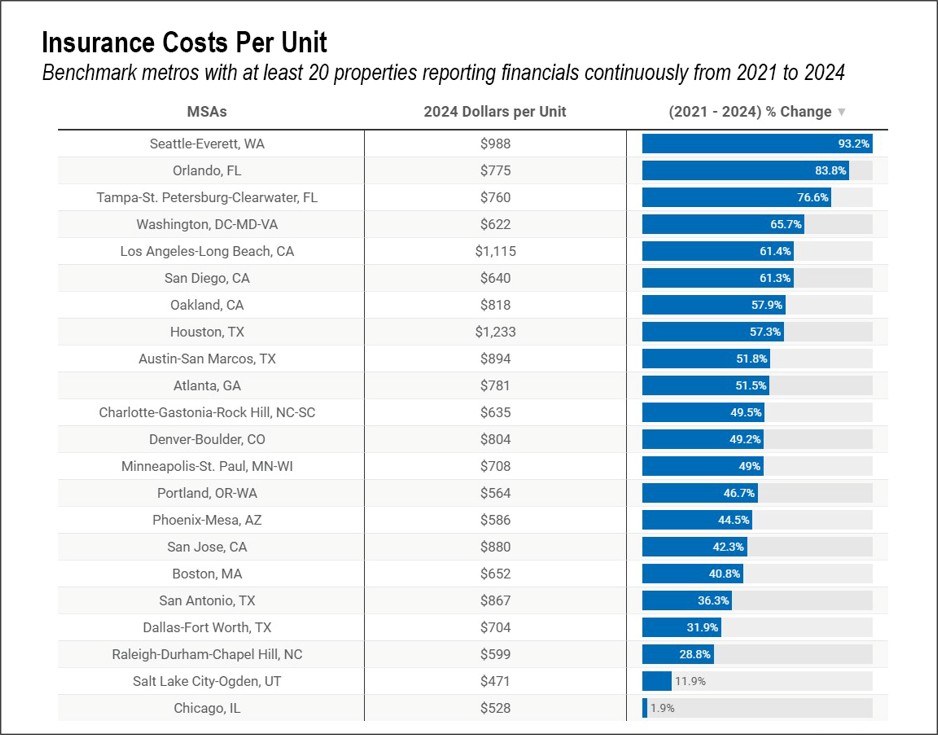
The cost of multifamily property insurance has morphed from a minor operating expense to a major financial pressure on profitability, with premiums soaring 75 percent since 2019.
A 2025 study by the Federal Reserve reported that the cost of insurance increased on average from $39 per unit in 2019 to $68 per unit in 2024. It also found that property owners bear the brunt of the higher cost, with each dollar of insurance increase reducing their net income by $0.72.
Over the last year, however, insurance premiums decreased overall due to increased capacity, profitability and competition in the marketplace as well as a decline in natural catastrophes. But insurers are imposing stricter underwriting standards, increasing deductibles, lowering coverage limits and imposing higher retentions—forcing owners to shoulder more of the risk.
In fact, wind and hail deductibles now average 2 to 5 percent of a building’s value, compared to a flat $10,000 to $25,000 previously, according to Barrett Lowell, head of asset management at Bonaventure, a Virginia-based multifamily developer/operator.
Sublimits on water damage, business interruption and exclusions for older roofing or electrical systems work against rate reductions. As a result, he said, “premiums may not come down as much as the broader ‘softening market’ headlines imply.“
LIKE THIS CONTENT? Subscribe to MHN Finance & Investment
Stricter underwriting makes documentation essential

The return of capacity has improved owner’s negotiating leverage and provided more flexibility in structuring insurance programs, said Alexander Reath, U.S. Real Estate and Hospitality practice leader at Marsh Risk, a global leader in reinsurance and risk advisory services. He noted, however, that owners should carefully evaluate deductibles, limits and replacement-cost values to ensure cost reductions are not at the expense of adequate protection for assets and tenants.
Compared with five or 10 years ago, underwriting is far more granular, noted Tiana Heath, senior manager of Industry Relations at the National Apartment Association. Carriers now evaluate each building’s age, maintenance history, roof condition, life-safety systems, loss history, replacement cost, surrounding exposures and documented mitigation.
In addition to lower sublimits and added exclusions, she sees a greater reliance on layered programs or surplus-lines (non-admitted) markets, she added.
In addition, the market is more selective, so well-maintained, loss-free properties in lower-risk locations may see more competition and pricing relief, while properties with catastrophe exposure, older systems, prior losses or incomplete documentation face closer scrutiny, Heath said. As a result, she stressed that documenting preventative maintenance and keeping clear repair and incident records are essential in today’s environment.
“Coverage remains available but often comes with more conditions,” Health continued. Insurers may require detailed property-condition data, frequent inspections, higher deductibles, updated replacement-cost valuations, stronger loss controls and tighter terms for wind, hail, flood, wildfire, water damage or aging infrastructure.
A strong submission includes accurate property-level data, current replacement-cost values consistent with the policy requirements, roof and system ages, protection information, occupancy details, loss history and a clear explanation of improvements made after prior losses, explained William Heil, area manager at FM Affiliated, a commercial property insurance brokerage.
Owners also should communicate improvements implemented at each site, including staffing, inspection programs, preventive maintenance, plumbing, roof work, emergency planning, water-detection technology and completed capital improvements, he added, advising owners to engage insurance partners early on.
“Early information sharing gives the broker and underwriting team time to resolve valuation questions, identify missing data, evaluate alternative and communicate the strengths of the risk before the renewal deadline.”

Reath said incomplete underwriting data “will often cause an underwriter to make more conservative judgements of the risk—resulting in more coverage restrictions and a higher cost. Therefore, property owners need to make sure their data is 100 percent complete from a construction, occupancy and protection perspective.
The largest insurance reductions generally involve large shared and layered placements, including some catastrophe-exposed programs where additional market capacity increased competition, Heil said. He pointed out that owners should evaluate the total cost of risk—not premium alone—as a lower premium that comes with materially higher deductibles or reduced coverage also may transfer more risk back to the owner’s balance sheet.
Intensifying climatic risks drive up insurance costs
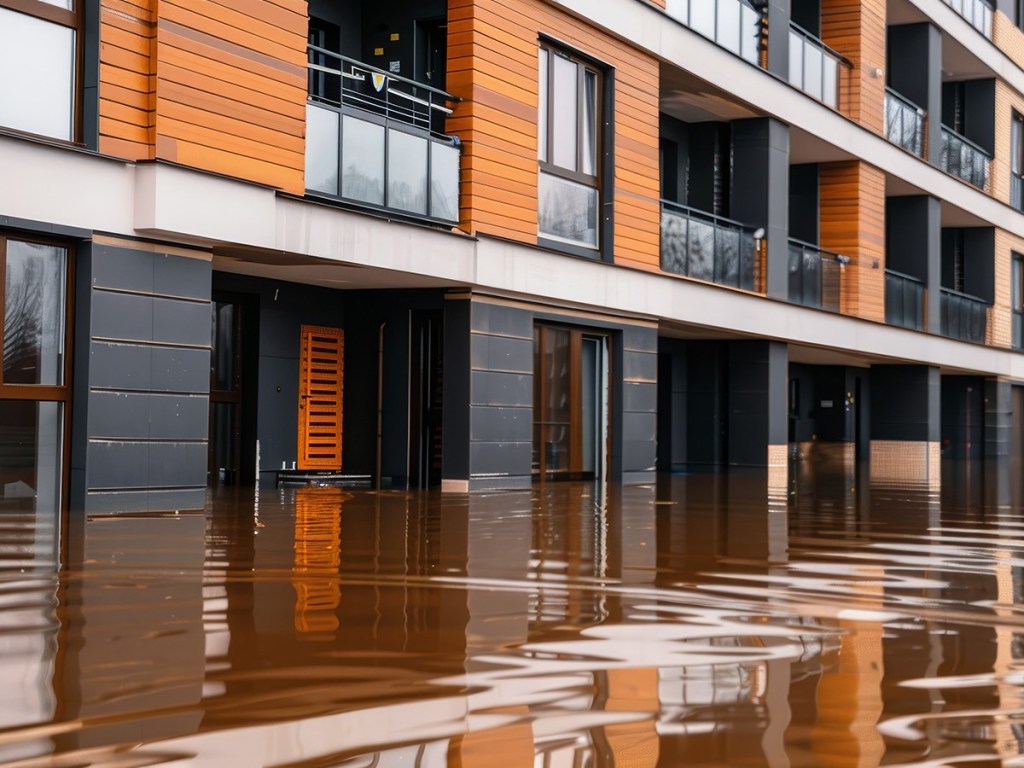
The greatest differentiation in cost is in regions with significant catastrophe or localized weather exposure. That includes hurricane, storm surge and flood-exposed areas along the Gulf and Atlantic coasts, wildfire and earthquake-exposed areas in the West and locations exposed to severe convective storms, including hail, tornado and straight-line wind across portions of Texas, the Great Plains and the Midwest.
“Over the past five to 10 years, we have seen more stringent underwriting scrutiny for convective-storm exposure, along with a noticeable increase in deductibles for hail and tornado losses,” Reath said, noting that as population growth expands into regions vulnerable to hail and tornadoes, insurers have experienced an increase in related claims.
The perimeter of catastrophe-exposed areas has expanded, with wildfire risk now extending across Colorado, the Sierra Nevada foothills and parts of the Pacific Northwest, Lowell said. Moreover, hail and tornado risk maps have been redrawn to capture more of the Midwest and the Southern Plains corridors, such as Oklahoma City, Kansas City and Dallas-Fort Worth.

Hurricane (tropical cyclone) risks also remain a challenge for insurers due to exposure aggregations, Reath continued. While insurance carriers have a long history of claims experience in Tier 1 Windstorm risk, it represents some of the more volatile pockets of the property insurance market and capacity, and pricing can be very reactive following an active hurricane year.
Florida and the Gulf Coast area, for instance, now typically see only one to two Excess and Surplus, non-admitted carriers quote coverage versus four to six admitted carriers previously active in these regions, Lowell said. “Climate trend data has now priced more risk across the country, and insurers are using increasingly sophisticated catastrophe and climate-risk modeling to evaluate exposures that have not received the same level of scrutiny in the past,” he added.
Affordable housing in NAT-CAT zones hit hardest
For affordable housing developers/operators based in catastrophe-prone areas, insurance costs can affect whether a new affordable housing development is financially feasible at all, said Michael Massie, chief development officer & executive vice president at Jamboree Housing, an affordable housing developer/operator in Southern California.
“This isn’t just an operating expense,” he remarked. “It can affect the ability to build more housing, and it’s a growing challenge for existing properties.”
Massie said that the biggest change in his organization’s insurance was the amount of risk his organization is expected to carry. Jamboree’s deductible has increased from $25,000 to $100,000. This means “we have to plan for that and make sure the property has the reserves to cover it,” Massie added. “Anytime there’s a crisis, you have to get back to the fundamentals of ownership. For us, that means prevention and risk mitigation become even more important.”
Massie noted that Jamboree has the financial strength and experience to manage these challenges, but rising costs and risks are threatening the financial stability of peers’ individual properties and, in some cases, the organizations themselves.
“Affordable housing owners face headwinds from two directions,” suggested Lowell, noting that properties developed in the 1990s are now 30 to 35 years old, for example, and have aging roofs, plumbing and electrical, while revenues remain capped via fixed rent and AMI requirements.
“This makes it much more difficult to absorb insurance cost increases, unlike market rate operators that can recover some increases through renewals and rent growth,” he pointed out.
Critical role of preventive property management
New exposures and insurance capacity always moves with market cycles, Heil said. Over the past five to 10 years, the level of property-specific information and analysis available to underwriters has changed, allowing the market to differentiate more precisely based on an asset’s condition, quality, location, prior losses and protection measures, he added.
As a result, Heil noted, two properties in the same general region may receive materially different outcomes. A well-protected and well-maintained property may have strong insurance options even in a challenging geography, while a property with deferred maintenance, repeated losses or limited exposure information may face higher deductibles, restricted capacity or more limited terms.
He contended that this boils down to good property management that prevents small problems from becoming large ones and capital improvements that harden properties against natural catastrophes.
Heil said that underwriters are placing greater emphasis on roof age, roof condition and prior roof replacement. And multifamily property owners with exposures in Convective and Named-Windstorm areas tend to see more restrictions in coverage in the form of increased retentions and less available limit in the hard market cycle. “Increased retentions for multifamily owners are especially impactful because deductible costs cannot be passed on to tenants and directly impact profitability,” he noted.
Hardening apartment assets
Hardened assets tend to model better, and many lenders require Natural Catastrophe limits to match a specific modeled return period, Reath said, pointing out that hardening assets can also reduce insurance costs 30 percent to 50 percent.
Hardening a multifamily property, however, is more complex than other property types due to the density of systems and occupants, Lowell contended, noting that a 300-unit apartment complex has 300 plumbing penetrations and HVAC connections.
In addition, Massie pointed out, “You have hundreds of residents living at a property while you’re trying to make improvements, so you have to coordinate all of that while keeping the property operating and minimizing the impact on residents. That adds complexity.”
Improvements that typically provide the greatest return include impact-resistant glazing on windows, roofing improvements and enhanced roof anchoring, siding and cladding improvement, and flood-protection measures in storm-surge zones.
Reath said that the majority of his clients make these improvements at the time of construction or acquisition, when the cost can be incorporated into the overall construction or acquisition budget. He noted that when integrated during the property’s design phase, many of the improvements can be implemented relatively inexpensively.
When the cost of improvements is justified or not
However, Lowell said, that the payback in reduced insurance costs does not always justify the cost of improvements. “The economics depend heavily on the asset, the market and the specific risk being addressed,” he explained. For example, a $1 million roof replacement would need to generate $150,000 to $200,000 of insurance premium reduction to justify the investment. And in higher catastrophic markets, owners may see limited premium relief even after making significant improvements, particularly where E&S carriers do not provide discounts.
Lowell noted that insurers may offer discounts or more favorable terms for certain risk-mitigation measures, like plumbing re-lining or replacement of polybutylene or galvanized piping, installation of leak detection systems and smart sensors to help monitor water heaters, supply lines, unit penetrations and other points of failure or identify leaks before they result in large claims.