How Municipalities Can Speed Up Housing Development
Form-based zoning offers developers a more streamlined and predictable approval process.

As municipalities across the country grapple with the widespread housing shortage and affordability issues, form-based zoning is being rediscovered as a way to loosen restrictions on apartment development. Unlike traditional Euclidean zoning, which divides land into distinct zones with specific uses—such as residential, commercial and industrial—form-based zoning regulates what can be built based on shape and form.
“I like to describe form-based design colloquially as: You blow up the balloon of floor-area ratio on the site and then you decide what you’ll put in it,” said Daniel Gehman, director of multifamily with Ware Malcomb. “So it gives developers a kind of certainty that, as long as they stay within the parameters of form-based design, they can basically put whatever they want in the building. That’s the most liberal interpretation.”
According to Nicholas Julian, director of land use for the National Association of Home Builders, form-based zoning sets parameters for building placement, massing and design features to shape how streets and public spaces function.
“The goal is to create predictable, high-quality urban form and walkable, mixed-use neighborhoods,” he explained. “For developers, the benefits can include more predictable outcomes, faster approvals when designs meet the code and greater flexibility in mixing uses.”
NAHB has seen huge momentum recently behind localities studying their zoning codes and their impact on housing. “Because form-based codes can allow higher density and a broader mix of uses by right when standards are met, I would say multifamily developers are paying more attention.”
Form-based zoning can work well when paired with clear, objective standards and truly by-right approvals for compliant projects, experts say. But it can become a barrier if the code is overly prescriptive or if form requirements are layered on top of existing use-based restrictions without streamlining the process.
Not in New York
While New York City has been focusing on zoning changes to spur housing development, it’s not likely to adopt form-based zoning—despite the enormity of the existing code and the fact that it dates back to 1961, according to Eldad Gothelf, senior vice president at Kasirer, a government relations and strategy firm in New York.
“The zoning code that we have today in New York City is (because) we really don’t take code away,” he observed. “We just add layers upon layers in an attempt to address housing concerns.”
Outside New York City, however, municipalities across the country are increasingly adopting this approach. And developers everywhere welcome the simplification of processes so they can get to the business of building housing.
Ideally, the adoption of form-based zoning will come with robust community engagement. “When it’s time to advance projects, there won’t be public outcry because the public would have already been bought in on the details and the benefits of updating the code,” said Gothelf.

Miami, the early adopter
Miami has been a hotbed of form-based activity since 2008, when it rolled out the Miami 21 zoning code. This citywide standard follows New Urbanist principles and has resulted in several walkable, mixed-use urban environments. Street frontages are built for people, and parking garages are hidden.
Miami’s Brickell City Centre, a mixed-use property developed by Swire Properties Inc. and Related Group and designed by Arquitectonica, demonstrates form-based zoning with its open-air retail component, street-level engagement and connection to public transit.
Instead of spending months navigating subjective interpretations or negotiating variances, we can design according to clear rules for height, massing and use.
—Matthew Moinian, Principal, Moinian Group
Another example is Moinian Group’s Bezel at Miami Worldcenter, a 43-story, 434-unit luxury high-rise in the new mixed-use development in the city center, which features more than 400,000 square feet of retail, dining and entertainment venues. Bezel at Miami Worldcenter was developed in collaboration with ZOM Living and designed by Stantec.
In Miami, form-based zoning has made the multifamily and mixed-use development process faster and more streamlined, according to Moinian Group Principal Matthew Moinian. “Form-based zoning has brought much-needed predictability to the entitlement and approval process,” he said. “Instead of spending months navigating subjective interpretations or negotiating variances, we can design according to clear rules for height, massing and use.”
The easy-to-navigate framework benefits lenders, municipalities and residents as well, Moinian noted. “Reducing red tape and lowering carrying costs makes it easier to deliver housing and mixed-use projects that align with long-term urban planning goals.”
South Bend shows how it’s done
Form-based zoning has also proven its effectiveness in the Midwest. In 2021, South Bend, Ind., won the Form-Based Codes Institute’s Richard H. Driehaus Form-Based Code Award for its citywide zoning ordinance that adopted a new form-based code in January 2020. The award recognized the code’s success in promoting walkable neighborhoods, encouraging mixed-use development and infill projects, and using a clear format with graphics.

“From those awards, you can see exemplary form-based codes,” noted Katharine Burgess, vice president of programs and operations at Smart Growth America. “South Bend has great examples of small-case, adaptive-reuse and midrise apartment buildings.”
Additionally, the city eliminated the off-street parking requirement.
Smart Growth America is also now home to the Center for Zoning Solutions. “We see form-based codes as one of the many zoning solutions that can help unlock more abundant housing in great locations,” Burgess added. “We hope to address the housing-access crisis and the cost-of-living crisis.”
Burgess and her colleagues are seeing a lot of momentum nationally around form-based codes, with the recognition that it’s a holistic solution that can support the development of a wider range of housing types, including all varieties of multifamily.
Form-Based Zoning In Action
The National Association of Home Builders supports policies that remove barriers to housing construction, whether for single-family or multifamily. Form-based zoning results in greater predictability and efficiency in the approval process—both are critical to apartment development. Here are some case studies that NAHB recommends:
– Arlington, Va.’s Neighborhoods Form-Based Code, adopted in 2013, enables multifamily development that balances increased density with pedestrian-friendly design.
– Miami 21 has one of the most ambitious, citywide form-based codes in the U.S. In 2008, it replaced traditional zoning with a transect-based framework, a planning tool that creates more complete, sustainable and walkable communities by integrating different densities and uses.
– Cincinnati adopted its form-based code in 2013. The city’s first comprehensive plan in over 30 years introduced transect zones, walkable neighborhood standards and building frontage types.
LA codifies best practices
For nearly a decade, Los Angeles has been involved in the re:code LA project, a comprehensive, multiyear effort to modernize the city’s zoning code, which was originally adopted in the 1940s.
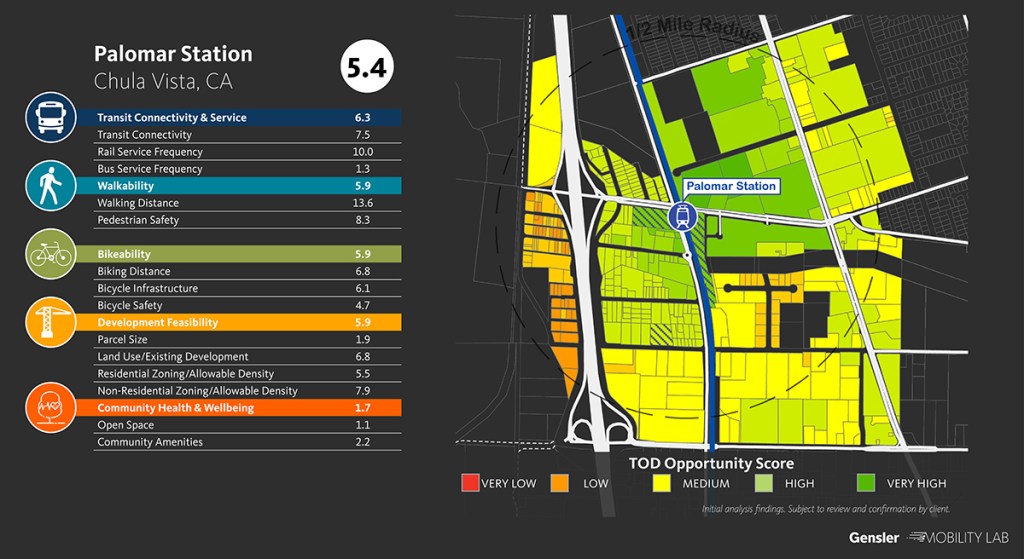
“Piecemeal changes made to that zoning code over the years as the city has grown have created a cumbersome and convoluted process that doesn’t offer a lot of clarity for our developer clients or for community members in terms of what could be built in their neighborhoods,” said Jaymes Dunsmore, mobility and transportation leader & senior associate with Gensler.
For developers, the benefits of form-based zoning include more predictable outcomes, faster approvals when designs meet the code and greater flexibility in mixing uses.
—Nicholas Julian, Director of Land Use, NAHB
As part of re:code LA, the city is rolling out a form-based code starting with the downtown area. “One of the biggest things that we’re seeing is a focus on transit-oriented development and transit-oriented communities,” noted Dunsmore.
Gensler has been working with transit agencies throughout Southern California looking to better utilize excess land. In addition, the state of California recently adopted changes to the environmental law that will exempt infill housing projects in urban areas. “That’s going to help out a lot,” stressed Dunsmore.
The removal of parking requirements within the downtown district is one of the biggest changes under L.A.’s new form-based zoning. “It’s a huge burden lifted off of what developers need to provide,” said Dunsmore. Parking is still allowed, but developers who have an odd-size parcel—and maybe couldn’t previously figure out any way to develop it—now have more flexibility.
L.A. is on a trial basis because people are just starting to get into the new zoning and understand it, Ware Malcomb’s director of multifamily, California, Daniel Gehman noted. At the same time, he expects municipalities to try to mimic L.A.
“A phenomenon that happens, just generally, is that smaller municipalities will try to follow the trend of the big municipalities and sometimes that works out OK, but in other cases you get a smaller municipality that’s trying to swing a punch above its weight,” he said.
Clearly, one size does not fit all when it comes to form-based zoning—that’s the idea. But as more towns and cities shed their old ways, there will be a greater variety of case studies to explore.