2025 Rent Growth
Yardi Matrix’s latest report on this key market indicator.
The U.S. multifamily market wrapped up 2025 on a somber note as sluggish late-year performance wiped away all gains from earlier in the year, according to Yardi Matrix’s latest survey of 140 markets. Average national advertised asking rents declined $5 month-over-month and $16 quarter-over-quarter to $1,735 in December, reducing annual growth to 0 percent, down 20 basis points year-over-year. This fourth-quarter showing marked the weakest rendition since the global financial crisis. Rates across the build-to-rent market registered the steepest drop in more than a decade, falling $4 to $2,180 in December, down 1 percent year-over-year.
—Posted on Jan. 30, 2026
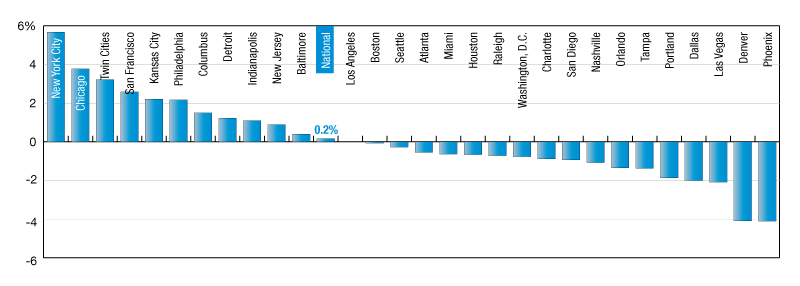
The U.S. multifamily market has witnessed its advertised rents dropping for the fourth consecutive month, according to Yardi Matrix’s latest survey of 140 markets. Rates dropped $8 in November to $1,740, continuing a slowing pattern. However, the yearly rental change was still positive at 0.2 percent, which admittedly marked the lowest level since 2021’s first quarter. The build-to-rent segment struggled both in the short and long term, with rates down $10 to $2,185 in November, marking a 0.5 percent downturn year-over-year.
—Posted on December 30, 2025
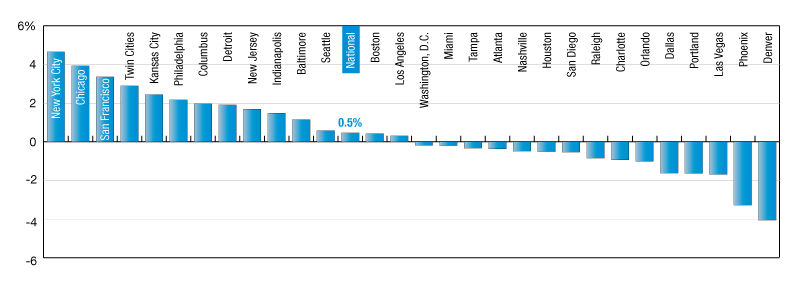
The U.S. multifamily market’s cooling continued, according to Yardi Matrix’s latest survey of 140 markets. The average advertised asking rents contracted, falling $4 to $1,743 in October, marking the third consecutive monthly decrease, although year-over-year growth remained flat at 0.5 percent. This also represented the third straight October bearing a similar rental moderation. The build-to-rent sector mirrored multifamily trends as advertised rates declined $6 to $2,195.
—Posted on November 26, 2025
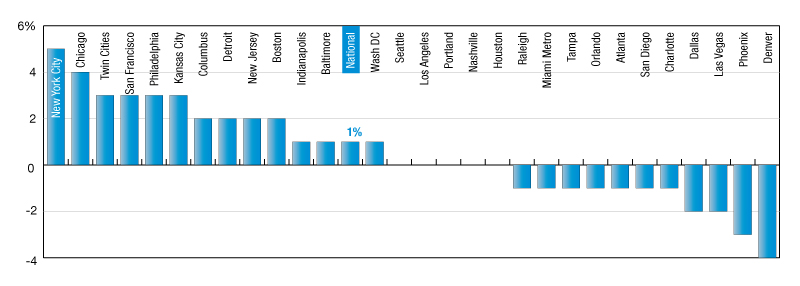
The U.S. multifamily market downshifted in September, according to Yardi Matrix’s latest survey of 140 markets. The average advertised asking rent slid $6 to $1,750 in September, while annual growth stood at 0.6 percent, down 30 basis points. That was the worst monthly showing since 2022 and the weakest September since 2009. Tides turned in the build-to-rent sector as well, as the advertised rates dropped $15 to $2,194, unchanged year-over-year.
—Posted on October 29, 2025
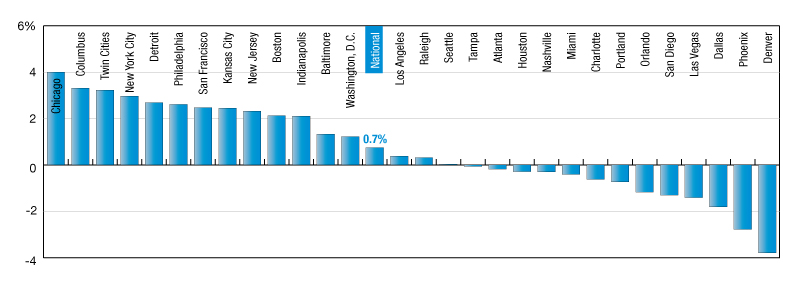
The summer season has cooled the U.S. multifamily market, according to Yardi Matrix’s latest survey of 140 markets. The average advertised asking rent fell $1 to $1,755 in August, slowing its year-over-year growth rate by 10 basis points to 0.7 percent. Occupancy rates stood their ground at 94.7 percent in July, unmoved year-over-year. The advertised rates for single-family build-to-rent units reached a new record in August, climbing 0.6 percent year-over-year to $2,208.
—Posted on September 22, 2025
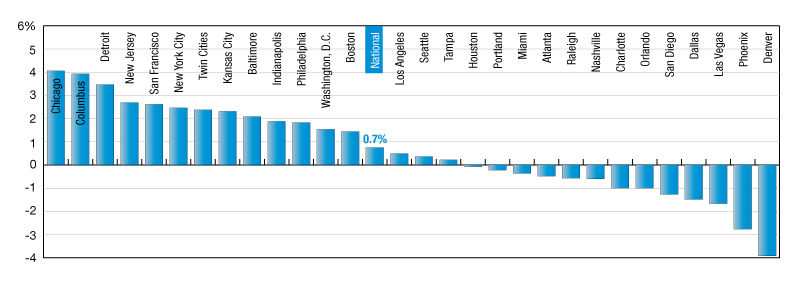
As we settle into the third quarter, the U.S. multifamily market is posting consistent results, according to Yardi Matrix’s latest survey of 140 markets. The average advertised asking rent grew $2 to $1,754 in July, marking a 0.7 percent improvement year-over-year. Occupancy held steady at the same level for four months, at 94.7 percent as of June, and down 0.1 percent year-over-year. The average advertised asking rates in the build-to-rent sector delivered stable results, going up $3 in July to $2,205, representing a 0.4 percent growth year-over-year.
—Posted on August 22, 2025
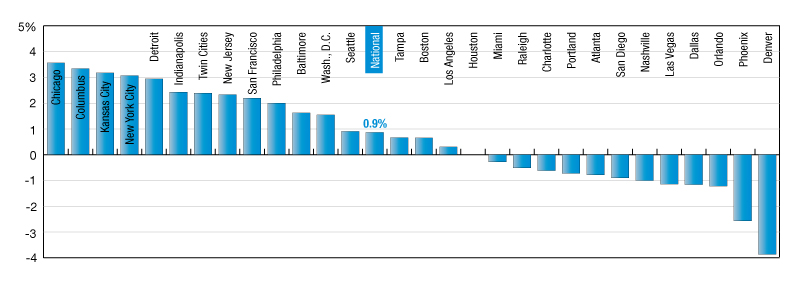
The U.S. multifamily market maintained steady performance during the first half of 2025, according to Yardi Matrix’s latest survey of 140 markets. Against the backdrop of mounting economic uncertainty and record-high deliveries, the national average advertised asking rent rose 1.2 percent over the first two quarters. The figure increased by $3 to $1,749 in June, up 0.9 percent year-over-year. Occupancy stood at 94.6god percent in May, unchanged over the past seven months, but down 20 basis points year-over-year. Over in the build-to-rent sector, the average advertised asking rents rose by $4 to $2,201 in June, up 0.7 percent growth year-over-year.
—Posted on July 22, 2025

The U.S. multifamily market maintained a steady performance in May, according to Yardi Matrix’s latest survey of 140 markets. The average advertised asking rent gained $6 to $1,761, maintaining growth at 1 percent year-over-year. Varying degrees of positive movement sprang from weak-performing markets, including Denver, San Francisco, Dallas and Austin.
The national occupancy rate fell by 30 basis points year-over-year to 94.4 percent in April, the lowest level since 2013. Meanwhile, the average advertised asking rent in the single-family build-to-rent sector rose by $3 to $2,183 in May, down by 0.1 percent year-over-year.
—Posted on June 18, 2025

The U.S. multifamily market continued to exhibit moderate growth at the start of the second quarter of 2025, according to Yardi Matrix’s latest survey of 140 markets, sustained by a combination of a robust labor market and a weak home sales market. The average advertised asking rent increased by $5 to $1,736 in April, for a 0.9 percent year-over-year growth. The national occupancy rate in stabilized properties slid to 94.4 percent in March, the lowest level in more than a decade. Meanwhile, the single-family build-to-rent advertised asking rates rose $5 to $2,178 in April, and the occupancy rate fell 0.6 percent year-over-year to 94.8 percent in March.
—Posted on May 29, 2025

The U.S. multifamily market ended the first quarter of 2025 on a steady trend, according to Yardi Matrix’s latest survey of 140 markets. The average advertised asking rent gained $5 in March to $1,755, up 1.0 percent year-over-year and 0.4 percent over the first quarter. The national occupancy rate remained at 94.5 percent for the third straight month. Single-family build-to-rent rates also rose by $5 to $2,169, and occupancy remained unchanged year-over-year, at 94.7 percent in February.
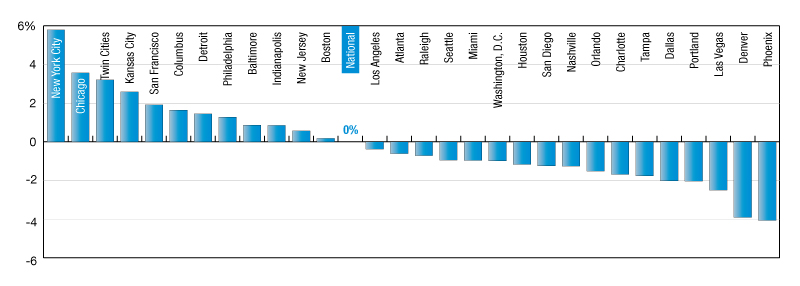
Rent growth was strongest in New York City (5.5 percent), Chicago and Kansas City (both 3.7 percent), Columbus (3.5 percent) and Philadelphia (3.2 percent). The weakest rent performance was posted by Austin (-5.4 percent), Denver (-3.6 percent) and Phoenix (-3.0 percent), each with supply growth higher than 5.0 percent of existing stock over the past year. Occupancy increased in eight of Yardi Matrix’s top 30 metros, led by San Francisco and Las Vegas (both 0.3 percent) and Los Angeles (0.2 percent).
—Posted on April 28, 2025

At the tail end of the winter season, and with economic uncertainty on the rise, the U.S. multifamily market maintained a steady performance, according to Yardi Matrix’s latest survey of 140 markets. The average U.S. advertised asking rent gained $1 in February, to reach $1,751, marking a 1.2 percent year-over-year increase.
The average U.S. occupancy rate remained consistent at 94.5 percent in February, with records of negative performance in many high-supply markets. Single-family build-to-rent advertised asking rents stayed unchanged at $2,165, up 0.2 percent year-over-year. SFR occupancy held at 94.7 percent in February.
—Posted on March 25, 2025

The U.S. multifamily market showed good stamina at the start of 2025, breaking a six-month negative streak for rents, according to Yardi Matrix’s latest survey of 140 markets. The average U.S. advertised asking rent increased $3 to $1,746 in January, up 20 basis points to 0.8 percent year-over-year. Yet, supply growth led to a 0.1 percent decline in the national occupancy rate to 94.5 percent in January, the lowest level recorded since 2014.
Prospects are positive but not without volatility from the economy and policy uncertainty. Meanwhile, the single-family build-to-rent rental market also reported gains in the average rental rate after several months of declines and rose $5 to $2,157 in January.
—Posted on February 26, 2025